
GST Audit vs GST Compliance in India: Which Service Does Your Pune Business Actually Need?
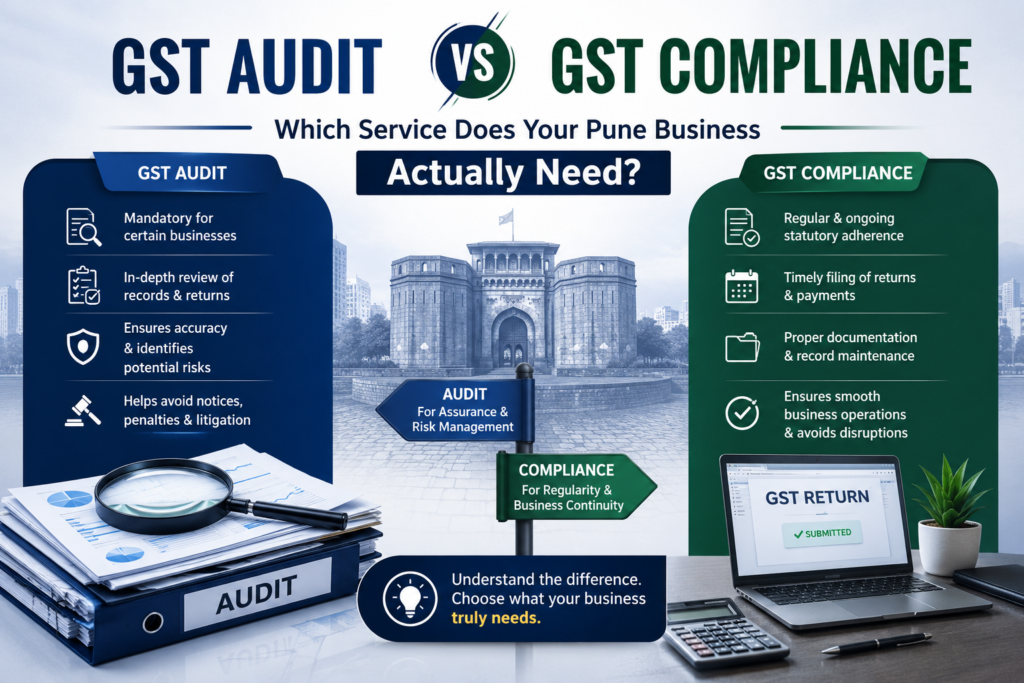
Many businesses confuse GST audit with GST compliance, even though both services solve very different problems. In simple terms: GST compliance focuses on ongoing filing, reconciliation, reporting, and adherence to GST regulations. GST audit focuses on reviewing GST records, identifying discrepancies, assessing risks, and ensuring reporting accuracy. Most SMEs and startups in Pune primarily need structured GST compliance support. Businesses with higher transaction complexity, reconciliation issues, notices, or internal control gaps often require deeper GST audit assistance. This guide explains: The difference between GST audit and GST compliance Which service your business actually needs Common GST risks businesses face How professional GST consultants improve compliance accuracy Why GST Management Has Become More Complex in 2026 GST compliance in India has evolved significantly over the last few years. Businesses now deal with: E-invoicing requirements Real-time invoice matching Input tax credit reconciliation Vendor compliance tracking Automated GST scrutiny systems Departmental data analytics As GST systems become more technology-driven, even small reporting inconsistencies can trigger: GST notices ITC reversals Penalties Delayed refunds Compliance scrutiny For businesses in Pune’s growing startup and SME ecosystem, maintaining accurate GST records has become operationally critical. Understanding GST Compliance GST compliance refers to the ongoing process of ensuring that a business follows GST regulations correctly and consistently. This is a recurring operational function. GST Compliance Typically Includes GST registration support Monthly and quarterly return filing GSTR-1 preparation GSTR-3B filing Input tax credit reconciliation Vendor reconciliation E-invoice compliance GST payment calculations Record maintenance Notice response support Why GST Compliance Matters Strong compliance systems help businesses: Avoid penalties Reduce reconciliation mismatches Maintain clean tax records Improve vendor relationships Ensure uninterrupted ITC claims Businesses with weak compliance structures often face repeated operational disruptions. Understanding GST Audit GST audit is a detailed review and verification process that evaluates whether GST records and filings are accurate, complete, and compliant with GST law. Unlike routine compliance, GST audit focuses on: Risk identification Error detection Transaction verification Process review Compliance gap analysis GST Audit Typically Covers Invoice verification GST reconciliation analysis ITC validation Tax liability review Classification checks Reverse charge mechanism review Documentation verification Internal process assessment Purpose of GST Audit GST audits help businesses: Detect reporting inconsistencies Identify compliance risks Prepare for scrutiny Improve internal controls Reduce future disputes For growing businesses, audits act as preventive risk management tools rather than just corrective exercises. GST Audit vs GST Compliance: Key Differences Criteria GST Compliance GST Audit Objective Ongoing compliance management Detailed compliance review Frequency Monthly/Quarterly Periodic or need-based Focus Filing & reporting Risk assessment & verification Nature Operational Analytical Outcome Timely compliance Compliance validation Complexity Moderate High Best For Most businesses Businesses with risk exposure Which Businesses Need GST Compliance Services? Almost every GST-registered business requires compliance support. This includes: Startups SMEs E-commerce businesses Service companies Manufacturers Professional firms Businesses That Particularly Need Structured Compliance Startups Startups often lack dedicated internal tax teams. Outsourced GST compliance improves: Filing accuracy Operational focus Compliance consistency SMEs SMEs handling multiple vendors and invoices require structured reconciliation systems to avoid mismatches. Multi-State Businesses Businesses operating across states face: Place-of-supply complexity Multi-registration management Interstate reconciliation challenges Which Businesses Require GST Audit Support? While not every business needs continuous GST audit support, several business categories benefit significantly from periodic reviews. Businesses Facing GST Notices If your business has: ITC mismatches Return discrepancies Vendor inconsistencies a GST audit can help identify root causes quickly. High-Transaction Businesses Businesses with large invoice volumes often require deeper reconciliation reviews and transaction validation. Rapidly Growing Companies As operations scale, GST complexity increases. Audits help strengthen internal compliance systems. Businesses Preparing for Funding or Due Diligence Investors increasingly review: Tax compliance history GST accuracy Regulatory exposure Poor GST controls can negatively impact credibility. Common GST Mistakes Businesses Make Delayed Reconciliation Businesses frequently postpone reconciliation activities, leading to: ITC mismatches Vendor conflicts Incorrect filings Depending Entirely on Internal Staff Single-person dependency creates operational risks and increases the chance of unnoticed errors. Ignoring Vendor Compliance Vendor filing inconsistencies directly affect input tax credit eligibility. Treating GST as a Filing-Only Activity GST management involves: Process discipline Documentation Continuous monitoring Internal controls Not just return submission. How Professional GST Consultants Help Businesses Professional GST consultants improve: Compliance consistency Reporting accuracy Documentation quality Risk management Reconciliation efficiency They also help businesses respond proactively to regulatory changes. Why Pune SMEs & Startups Outsource GST Management Pune has a rapidly expanding ecosystem of: Startups IT companies Manufacturers Service businesses Many growing businesses prefer outsourcing GST functions because it: Reduces operational burden Improves compliance quality Provides expert guidance Ensures process continuity How to Choose the Right GST Service Partner Businesses should evaluate GST consultants based on: Evaluation Area Importance GST expertise High Reconciliation capability High Industry experience High Technology adoption High Responsiveness High Audit support Medium Advisory capability High Mittal & Co. GST Support Services Mittal & Co. provides GST-related services including: GST registration GST return filing GST reconciliation Audit support Tax advisory Compliance management Accounting and bookkeeping support (camittal.com) The firm’s service structure aligns with startups, SMEs, and businesses seeking centralized compliance and advisory support. Final Thoughts GST compliance and GST audit are not interchangeable services. GST compliance helps businesses maintain ongoing regulatory discipline. GST audit helps businesses identify risks, validate reporting accuracy, and strengthen internal controls. Most businesses require structured GST compliance support as a foundation. As transaction complexity grows, periodic GST audits become increasingly important. For Pune businesses seeking organized GST management, compliance consistency, and advisory-focused support, firms like Mittal & Co. position themselves as integrated compliance and financial advisory partners. (camittal.com) Internal Linking Suggestions “GST filing services in Pune” “accounting and bookkeeping services” “tax audit services” “virtual CFO services” “business compliance consultants” 6. FAQ SECTION What is the difference between GST audit and GST compliance? GST compliance involves routine filing and reconciliation activities, while GST audit focuses on reviewing GST records, identifying discrepancies, and assessing compliance risks. Is GST audit mandatory for all businesses? Not all businesses require formal GST audits regularly, but many businesses benefit from periodic GST