
Annual Information Statement (AIS): A Complete Guide for Taxpayers
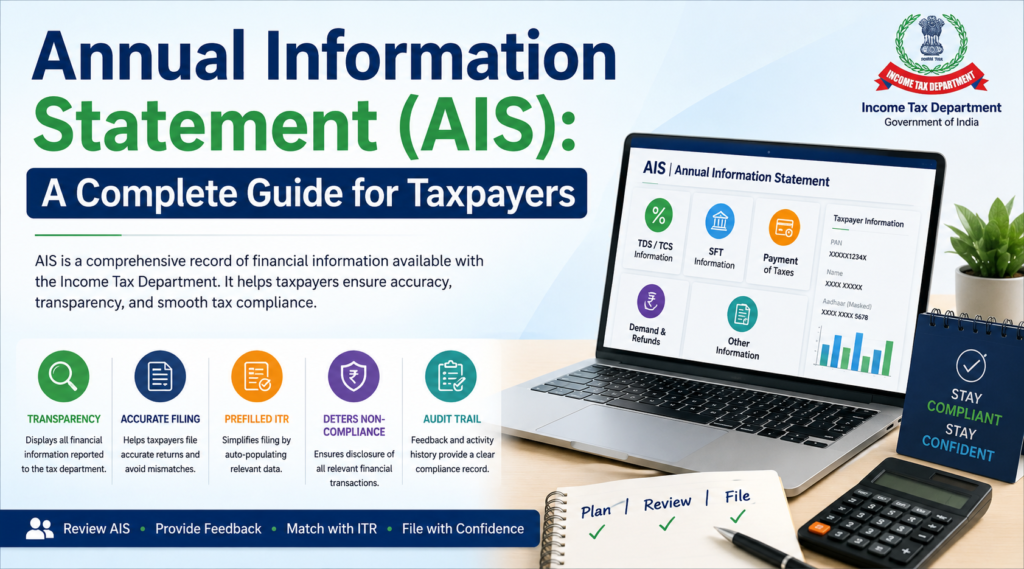
Introduction The Annual Information Statement (AIS) is a comprehensive record of financial information available with the Income Tax Department. It provides taxpayers with a consolidated view of their income, taxes paid, and other financial transactions. By offering transparency and enabling prefilled returns, AIS has become a cornerstone of India’s compliance ecosystem. Importance of AIS ✅ Transparency: Displays all financial information reported to the tax department. ✅ Voluntary Compliance: Helps taxpayers file accurate returns and avoid mismatches. ✅ Prefilled Returns: Simplifies filing by auto-populating data. ✅ Deters Non-Compliance: Ensures taxpayers disclose all relevant transactions. ✅ Audit Trail: Feedback and activity history provide a clear compliance record. Contents of AIS AIS is divided into two main parts: Part A – General Information PAN, masked Aadhaar, name, date of birth/incorporation, contact details, and address. Part B – Financial Information TDS/TCS Information: Tax deducted/collected at source. SFT Information: High-value transactions reported by banks, mutual funds, etc. Payment of Taxes: Advance tax and self-assessment tax. Demand & Refunds: Refunds issued and demands raised. Other Information: Salary details, foreign remittances, GST turnover, interest on refunds, etc. Additionally, AIS allows taxpayers to provide feedback on reported transactions, showing both reported and modified values. Matching AIS with ITR To ensure smooth filing: Download AIS in PDF/CSV/JSON formats. Compare AIS data with your own records (salary slips, bank statements, Form 16, etc.). Check for mismatches in TDS, SFT, or other reported transactions. Submit feedback if any entry is incorrect or requires modification. Use Taxpayer Information Summary (TIS) – the deduplicated and confirmed values here are used for prefilled ITRs. This process ensures your Income Tax Return (ITR) matches the department’s records, reducing the chances of notices or scrutiny. FAQs on AIS Q1: Is AIS the same as Form 26AS? No. Form 26AS only shows TDS/TCS data, while AIS covers a wider range of financial information. Q2: Can I modify feedback multiple times? Yes, there is currently no limit on modifying feedback. Q3: Does AIS show GST turnover? Yes, under the code EXC-GSTR3B, visible in the “Other Information” tab. Q4: How can I access AIS? Login to Income Tax Portal, navigate to e-File → AIS, and view/download your statement. Q5: Can I track my activity history? Yes, AIS provides an Activity History tab with system-generated IDs for each action. Conclusion The Annual Information Statement (AIS) is more than just a compliance tool; it’s a taxpayer’s mirror into their financial footprint. By reviewing AIS carefully, submitting feedback, and matching it with your ITR, you ensure accuracy, avoid disputes, and make tax filing seamless. As India moves toward greater transparency, AIS empowers taxpayers to stay compliant with confidence. BLOG BY: CA MITTAL & Co.
How AI & Automation Are Transforming Accounting in India: What Businesses Must Do to Stay Ahead
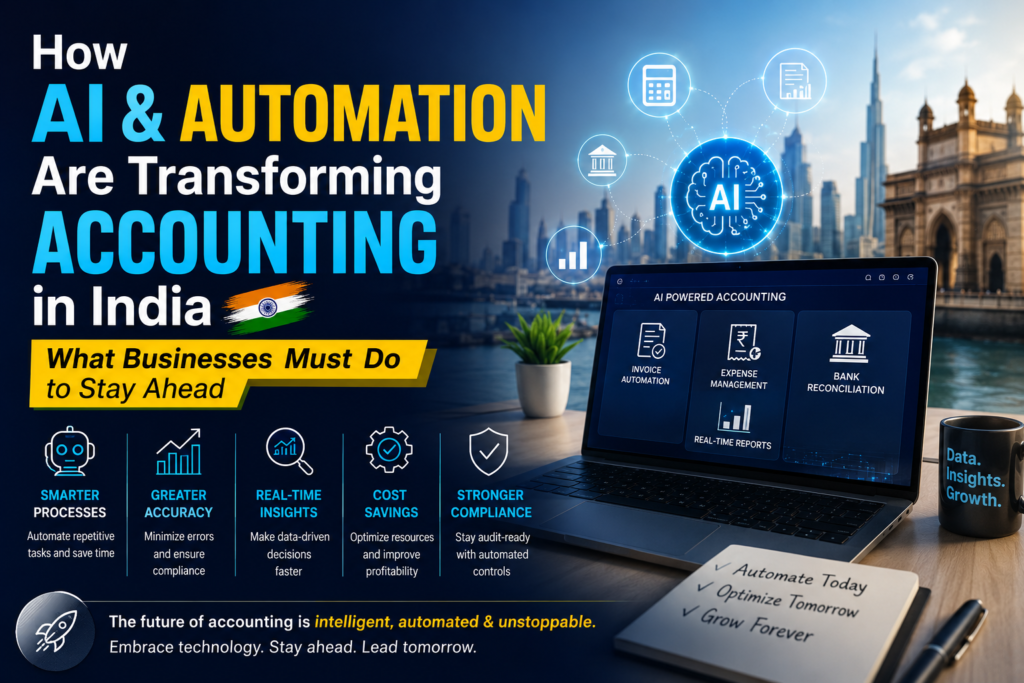
TL;DR AI and automation are fundamentally changing accounting in India by improving speed, accuracy, reporting, and compliance efficiency. However, businesses that rely entirely on software without strategic financial oversight may face compliance risks, poor decision-making, and operational blind spots. The future belongs to businesses that combine automation with expert chartered accountancy guidance. Why Accounting in India Is Rapidly Changing India’s financial and compliance ecosystem has evolved dramatically over the last decade. Businesses today operate in an environment driven by: GST digitization E-invoicing Real-time compliance monitoring Automated tax reporting Digital banking integration Cloud-based financial systems As regulatory expectations increase, traditional manual accounting methods are becoming inefficient and risky. At the same time, AI-powered accounting platforms are helping businesses: Automate repetitive financial tasks Reduce manual errors Generate real-time reports Improve operational efficiency This transformation is no longer optional. Businesses that fail to modernize their financial systems may struggle with compliance delays, reporting inefficiencies, and slower decision-making. The Rise of AI and Automation in Finance Artificial intelligence is no longer limited to large enterprises. Today, even SMEs and startups in India use automation tools for: Bookkeeping Payroll processing GST filing Bank reconciliation Invoice generation Expense tracking Modern accounting systems can now: Detect anomalies Categorize transactions automatically Predict cash-flow trends Generate financial insights This shift allows finance teams to spend less time on repetitive tasks and more time on strategic decision-making. Key Areas Where AI Is Transforming Accounting 1. Automated Bookkeeping AI-powered accounting systems can automatically: Record transactions Match invoices Categorize expenses Reconcile bank statements This reduces human error and significantly improves efficiency. Example An ecommerce business processing hundreds of daily transactions can automate reconciliation instead of manually matching records. 2. GST Compliance Automation GST compliance is one of the biggest operational challenges for Indian businesses. Automation tools now help businesses: Track GST liabilities Match invoices Reconcile input tax credit File returns faster Detect mismatches early This minimizes compliance delays and reduces notice risks. However, strategic interpretation still requires professional expertise. 3. Smart Invoice Processing AI-based OCR technology can: Read invoices automatically Extract vendor data Validate entries Reduce data-entry work This improves operational speed and reduces accounting bottlenecks. 4. Real-Time Financial Reporting Traditional reporting often happens weeks after transactions occur. Modern AI systems provide: Real-time dashboards Profitability analysis Cash-flow visibility Expense tracking Department-wise reporting Business leaders can make faster decisions using live financial data. 5. Fraud Detection & Risk Monitoring AI tools can identify: Unusual spending patterns Duplicate invoices Suspicious transactions Compliance inconsistencies This strengthens internal financial controls. Benefits of AI in Accounting for Indian Businesses Benefit Business Impact Faster processing Improved operational efficiency Better accuracy Reduced manual errors Real-time visibility Faster decision-making Automation Lower repetitive workload Better compliance tracking Reduced filing delays Scalable systems Easier business growth Risks of Over-Reliance on Automation While automation provides major benefits, businesses should avoid assuming that software can replace financial expertise entirely. Common Risks 1. Incorrect Data Interpretation AI systems depend on entered data. Incorrect configurations or classifications can create reporting errors. 2. Compliance Complexity Indian tax laws frequently change. Automated systems may not always interpret legal nuances correctly. 3. Lack of Strategic Advisory Software can generate reports, but it cannot fully advise on: Business restructuring Tax optimization Expansion planning Investment decisions Risk management 4. Cybersecurity & Data Risks Cloud-based systems require strong: Access controls Backup systems Data protection policies Why Human Expertise Still Matters Even in highly automated environments, businesses still require experienced financial professionals. A chartered accountant provides: Financial interpretation Strategic advisory Regulatory understanding Tax optimization Audit readiness Business structuring guidance AI improves execution speed. Human experts improve decision quality. How Businesses Should Adapt in 2026 Businesses that want to stay competitive should modernize their accounting approach strategically. Step 1: Automate Repetitive Processes Start with: Bookkeeping Payroll Invoice processing GST reconciliation Step 2: Use Cloud-Based Financial Systems Cloud accounting improves: Accessibility Collaboration Reporting efficiency Step 3: Build Real-Time Reporting Systems Decision-makers need live visibility into: Revenue Expenses Cash flow Tax exposure Step 4: Strengthen Compliance Monitoring Automation should support proactive compliance management, not replace oversight. Step 5: Partner With an Experienced CA Firm Technology alone cannot replace strategic financial expertise. Businesses need professional advisors who understand: Tax regulations Industry risks Financial growth planning Compliance strategy The Hybrid Future: AI + Chartered Accountants The future of accounting in India is not AI versus accountants. It is AI-enabled accountants. Modern CA firms are increasingly integrating: Automation tools Cloud accounting AI-driven reporting Digital compliance systems This hybrid model gives businesses: Speed Accuracy Scalability Strategic insight Compliance confidence Real-World Business Example Startup Example A fast-growing startup automates bookkeeping and payroll using cloud accounting tools. As the business scales, investors request: Financial due diligence Compliance verification Forecasting models Audit-ready reports The company realizes automation alone cannot meet strategic financial expectations. A professional CA firm helps structure financial operations for long-term growth. How Mittal & Co. Helps Businesses Modernize Accounting Mittal & Co. supports businesses in adopting modern accounting systems while maintaining strong compliance and financial oversight. The firm helps businesses: Implement efficient accounting workflows Improve GST compliance Strengthen financial reporting Optimize taxation Build scalable finance systems Integrate technology with strategic advisory For businesses in Pune and across India, combining automation with expert CA guidance creates a more resilient and growth-oriented financial structure. Suggested Internal Links GST Consultancy Services Virtual CFO Services Audit & Assurance Startup Advisory Accounting Outsourcing Services Conclusion AI and automation are transforming accounting in India faster than ever before. Businesses now have access to tools that improve: Efficiency Accuracy Reporting speed Compliance visibility But technology alone is not enough. The businesses that will succeed in 2026 are those that combine: Smart automation Strong financial controls Strategic advisory Professional compliance oversight AI can automate accounting tasks. Experienced chartered accountants help businesses make better financial decisions. That combination is what truly creates long-term business growth. 6. FAQ SECTION How is AI changing accounting in India? AI is improving accounting by automating bookkeeping, GST reconciliation, invoice processing, reporting, and compliance tracking. Will AI replace chartered accountants? No. AI can