
GST Data Matching & Scrutiny in 2026: Why Notices Are Increasing and How to Stay Safe
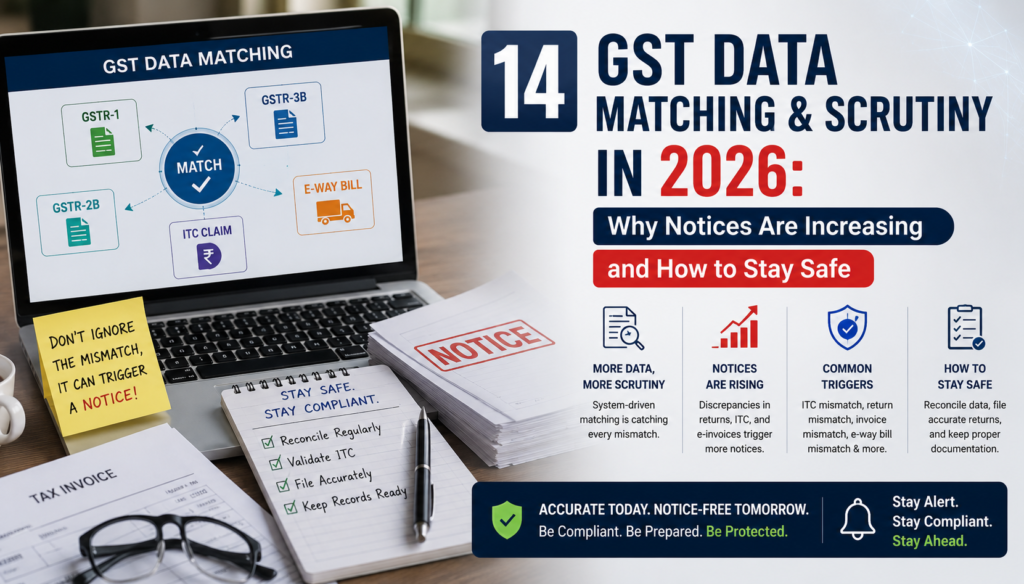
TL;DR GST scrutiny in India has become significantly stricter in 2026 due to advanced data matching systems, AI-driven compliance monitoring, e-invoicing integration, and automated reconciliation checks. Businesses are increasingly receiving notices because of: GSTR mismatches Incorrect ITC claims Vendor non-compliance E-invoice inconsistencies Delayed reconciliations Companies that implement proactive GST compliance systems and regular reconciliation processes are far better positioned to reduce notice risks and avoid financial disruption. Why GST ScrutinyIs Increasing in 2026 The GST ecosystem has evolved rapidly over the last few years. The government now has access to: Real-time invoice data E-invoicing systems Banking integrations AI-powered analytics Cross-platform transaction matching This has significantly improved the ability of tax authorities to detect: Reporting inconsistencies Fake invoicing Incorrect tax credit claims Non-compliant vendors Revenue leakages As a result, GST scrutiny notices are increasing across: SMEs Startups Ecommerce businesses Manufacturers Service providers Many businesses receive notices not because of fraud, but because of poor reconciliation and weak compliance systems. What Is GST Data Matching? GST data matching refers to the automated comparison of financial and tax data across multiple GST filings and systems. The department compares: GSTR-1 GSTR-3B GSTR-2B E-invoices E-way bills Vendor filings The objective is to identify mismatches, irregularities, and inconsistencies. Example If a business reports sales in GSTR-1 but pays lower tax in GSTR-3B, the mismatch may trigger automated scrutiny. Similarly, claiming input tax credit from a vendor who has not filed returns can create compliance exposure. Major GST Mismatches Triggering Notices 1. GSTR-1 vs GSTR-3B Mismatch One of the most common triggers in 2026 is mismatch between: Outward supplies reported in GSTR-1 Tax liability reported in GSTR-3B Common Causes Incorrect reporting Manual entry errors Delayed invoice uploads Adjustments not properly disclosed Risk This can trigger: Automated notices Tax demand queries Departmental scrutiny 2. GSTR-2B Mismatches Input tax credit claims are now heavily monitored. Businesses often face problems when: Vendors fail to file returns Vendor invoices are missing ITC is claimed incorrectly Reconciliation is delayed Why This Matters Improper ITC claims can result in: ITC reversals Interest liabilities Penalties Notice exposure 3. E-Invoicing Inconsistencies E-invoicing has increased transparency significantly. Authorities now compare: Invoice values GST returns E-way bill data Tax liability reporting Even small inconsistencies can trigger alerts. 4. Vendor Non-Compliance Many businesses assume their compliance ends after filing returns. However, vendor behavior now directly affects GST risk. Common Issues Vendors not filing returns Fake invoice chains Incorrect GSTIN usage Suspicious transaction patterns Result Businesses may lose input tax credit eligibility despite making valid purchases. 5. Incorrect Classification & Tax Rates Applying incorrect GST rates remains a major issue across industries. This commonly affects: Ecommerce sellers Manufacturers Multi-product businesses Even classification misunderstandings can create: Tax shortfall disputes Interest liabilities Retrospective scrutiny Common Reasons Businesses Receive GST Notices Top Notice Triggers in 2026 Trigger Risk Level GSTR mismatch High ITC mismatch High Delayed filing Medium Vendor non-compliance High E-invoice inconsistency High Incorrect tax classification Medium High-risk transaction patterns High How Automated GST Tracking Has Changed Compliance Earlier, GST scrutiny relied heavily on manual assessments. Now, automated systems continuously monitor: Filing patterns Invoice matching Tax payment consistency Vendor compliance behavior E-way bill movement This means businesses must maintain: Accurate records Timely reconciliations Strong documentation Real-time compliance monitoring Reactive compliance is no longer sufficient. The Financial Impact of GST Errors GST notices can create significant operational and financial pressure. Potential Consequences Interest liabilities Penalties Working capital blockage ITC reversals Audit scrutiny Increased compliance costs In severe cases, businesses may also face: Reputation damage Vendor trust issues Operational disruptions Step-by-Step Guide to Reducing GST Risk Step 1: Reconcile Monthly Businesses should reconcile: GSTR-1 GSTR-3B GSTR-2B E-invoices every month instead of waiting for annual reviews. Step 2: Monitor Vendor Compliance Track whether vendors: File returns regularly Maintain active GST registration Upload invoices properly Vendor monitoring is now critical for protecting ITC claims. Step 3: Automate GST Tracking Use: GST reconciliation software Automated mismatch alerts Compliance dashboards Automation reduces manual errors significantly. Step 4: Maintain Proper Documentation Businesses should maintain: Tax invoices E-way bills Vendor records Purchase reconciliations Audit trails Strong documentation improves notice response capability. Step 5: Conduct Periodic GST Reviews Quarterly GST health checks help identify: Reporting inconsistencies ITC risks Vendor issues Compliance gaps before notices occur. Real Business Example Manufacturing Company Scenario A manufacturing company receives a GST notice due to mismatch between: Vendor invoice uploads ITC claimed in returns The root issue was delayed reconciliation and vendor non-compliance. After implementing monthly reconciliation and automated tracking systems, the business significantly reduced compliance risks. GST Compliance Best Practices for Businesses Recommended Practices Monthly reconciliation reviews Vendor compliance tracking Automated GST reporting systems Internal GST audits Proper invoice documentation Real-time compliance monitoring Professional GST advisory support Businesses with structured compliance systems are far less likely to face major scrutiny issues. Why Professional CA Advisory Matters More in 2026 GST compliance is becoming increasingly technical and data-driven. Professional CA firms help businesses: Interpret GST provisions correctly Reduce mismatch risks Handle notices properly Conduct reconciliations Improve documentation systems Monitor compliance proactively This proactive approach reduces operational risk and improves long-term compliance stability. How Mittal & Co. Helps Businesses Stay GST-Compliant Mittal & Co. helps businesses strengthen GST compliance systems through: GST consultancy Return filing support Reconciliation reviews Notice handling Compliance audits Vendor compliance monitoring Strategic GST advisory For businesses in Pune and across India, proactive GST management is becoming essential for financial stability and operational continuity. Suggested Internal Links GST Consultancy Services Accounting & Bookkeeping Audit & Assurance Tax Advisory Services Compliance Management Solutions Conclusion GST scrutiny in 2026 is no longer limited to manual departmental reviews. Advanced data matching systems now continuously monitor: GST returns Vendor filings E-invoices ITC claims Transaction patterns Businesses that continue using weak reconciliation practices and reactive compliance systems face increasing notice risks. The safest approach is to: Maintain accurate records Reconcile regularly Monitor vendors proactively Use automation intelligently Work with experienced GST professionals In the current compliance environment, prevention is significantly more effective than notice response. 6. FAQ