
Private Limited Company Compliance Checklist Every Director Must Follow
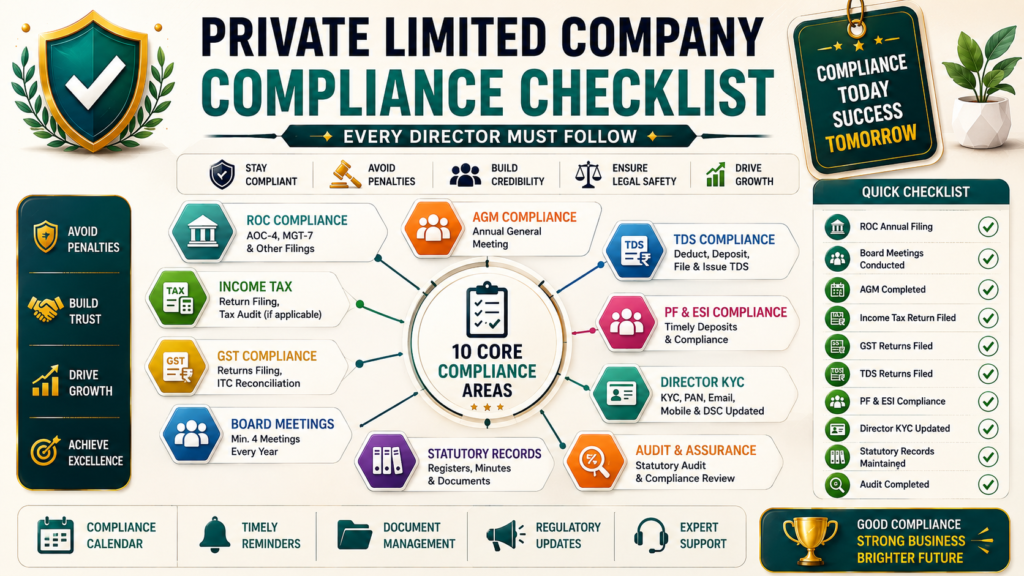
TL;DR Private limited companies in India must comply with multiple legal, tax, and regulatory requirements throughout the year. These include ROC filings, annual returns, board meetings, GST filings, TDS compliance, income tax returns, audit requirements, and director KYC obligations. Failure to comply can result in penalties, prosecution, and director disqualification. This checklist helps directors stay compliant and avoid costly mistakes. Why Compliance Matters for Private Limited Companies A private limited company enjoys several advantages, including limited liability protection, separate legal identity, easier fundraising opportunities, and increased business credibility. However, these benefits come with ongoing compliance obligations under: Companies Act, 2013 Income Tax Act GST Act Labour Laws MCA Regulations Other statutory frameworks Many directors focus heavily on business growth but overlook compliance responsibilities until notices or penalties arrive. Compliance should not be viewed as a burden. It protects the company, improves transparency, and strengthens investor confidence. Responsibilities of Company Directors Directors are responsible for ensuring that the company fulfills its statutory obligations. Their responsibilities include: Maintaining accurate financial records Conducting board meetings Filing annual returns Ensuring tax compliance Protecting shareholder interests Maintaining statutory registers Implementing internal controls Responding to regulatory notices Ignorance of compliance requirements is not considered a valid defense under the Companies Act. Complete Private Limited Company Compliance Checklist ROC Compliance Requirements The Registrar of Companies (ROC) requires companies to file various forms and annual returns. Mandatory ROC Filings Form AOC-4 Used for filing: Financial Statements Balance Sheet Profit and Loss Account Auditor Reports Form MGT-7 Used for filing: Annual Return Shareholding Details Director Information Registered Office Information Key Compliance Objective These filings provide transparency regarding the company’s financial and operational status. Board Meeting Compliance Board meetings are mandatory even for small private limited companies. Minimum Requirement A private limited company must generally hold: At least 4 Board Meetings annually Maximum gap of 120 days between two meetings Board Meeting Agenda May Include Financial performance review Compliance review Strategic decisions Budget approvals Funding discussions Risk management updates Documentation Required Notice of Meeting Attendance Register Minutes of Meeting Resolutions Passed Proper documentation is essential during inspections or audits. Annual General Meeting (AGM) Compliance Every private limited company must conduct an Annual General Meeting. AGM Objectives Adoption of Financial Statements Auditor Appointment Director-related Resolutions Shareholder Discussions Key Benefits AGMs improve governance and maintain transparency with shareholders. Income Tax Compliance Private limited companies are required to file Income Tax Returns annually. Key Tax Obligations Income Tax Return Filing Advance Tax Payments Tax Audit (if applicable) Maintenance of Books of Accounts Important Areas to Monitor Revenue recognition Expense classification Depreciation claims Related-party transactions Tax deductions Accurate tax reporting reduces scrutiny risk and ensures smooth assessments. GST Compliance If the company is registered under GST, compliance becomes an ongoing responsibility. GST Requirements GST Registration Monthly or Quarterly Returns Annual Reconciliation Invoice Compliance Input Tax Credit Reconciliation Common GST Errors Wrong GST classification Missed filing deadlines Incorrect ITC claims Vendor mismatches These errors often trigger departmental notices. TDS Compliance Tax Deducted at Source (TDS) obligations apply to many company transactions. TDS Activities Deduct TDS where applicable Deposit TDS on time File quarterly TDS returns Issue TDS certificates Common Transactions Covered Salaries Professional Fees Contractor Payments Rent Payments Commission Payments Failure to comply may result in interest and penalties. PF and ESI Compliance Companies meeting employee thresholds must comply with labour regulations. PF Compliance Employee registration Monthly PF deposits Employee record maintenance ESI Compliance Employee enrollment Monthly contributions Statutory reporting Labour compliance violations can attract inspections and financial penalties. Statutory Registers and Record Maintenance Private limited companies are legally required to maintain specific statutory records throughout the year. Essential Statutory Registers Register of Members Register of Directors Register of Charges Register of Share Transfers Register of Loans and Investments Register of Related Party Transactions Additional Records to Maintain Share Certificates Financial Statements Accounting Records Board Meeting Minutes AGM Minutes Tax Records GST Documentation Proper record maintenance helps during: ROC inspections Income Tax assessments GST audits Due diligence exercises Investor reviews Business acquisitions Director KYC Compliance Director Identification Number (DIN) holders must ensure their KYC details remain updated. Director KYC Requirements Directors should regularly verify: Mobile Number Email Address PAN Details Residential Address Digital Signature Certificate (DSC) Failure to complete Director KYC requirements may result in DIN deactivation and additional penalties. Audit Requirements Most private limited companies are subject to statutory audit requirements. Statutory Audit Objectives Verify financial accuracy Assess internal controls Identify compliance gaps Ensure regulatory adherence Improve transparency Auditor Responsibilities The auditor reviews: Financial statements Accounting policies Internal control systems Regulatory compliance Risk areas Regular audits strengthen financial governance and improve stakeholder confidence. Penalties for Non-Compliance Many directors underestimate the financial and legal consequences of missing compliance obligations. Common Consequences Financial Penalties Late filing fees can accumulate quickly across multiple forms and returns. Director Disqualification Persistent non-compliance may lead to restrictions on directors. Regulatory Notices Authorities may issue notices requiring explanations and supporting documentation. Increased Scrutiny Repeated compliance failures can trigger deeper examinations by tax and regulatory departments. Funding Challenges Investors and lenders often review compliance history before approving funding or credit facilities. Quick Compliance Checklist for Directors Use this checklist regularly throughout the year: Compliance Area Status Check ROC Annual Filing ✓ Board Meetings Conducted ✓ AGM Completed ✓ Income Tax Return Filed ✓ GST Returns Filed ✓ TDS Returns Filed ✓ PF Compliance Completed ✓ ESI Compliance Completed ✓ Director KYC Updated ✓ Statutory Registers Maintained ✓ Audit Completed ✓ Financial Statements Approved ✓ This checklist can serve as a simple monthly and quarterly compliance review tool. Best Practices to Stay Compliant Compliance becomes easier when systems are implemented proactively. Create an Annual Compliance Calendar Track all filing deadlines in advance. Include: GST dates TDS deadlines ROC filing dates Tax payment schedules Audit timelines Conduct Quarterly Compliance Reviews Quarterly reviews help identify issues before they become major problems. Review: Pending filings Tax obligations Documentation gaps Regulatory updates Maintain Digital Documentation Store important records securely. Examples: GST returns Tax filings Audit reports
Filing Your Own ITR vs Hiring a Professional: What the Numbers and the Rules Actually Say

Every year, around July, the same question does the rounds: should you file your income tax return yourself using the income tax portal, or should you get a professional to do it? With pre-filled forms, AIS/TIS data, and a much friendlier e-filing interface than a decade ago, self-filing has genuinely become easier. But “easier” and “right for your situation” are not the same thing. This article looks at both routes objectively, so you can decide which one suits your case. How self-filing actually works today The income tax portal now auto-populates a large part of your return using data from your Form 26AS, AIS (Annual Information Statement), and TIS (Taxpayer Information Summary). For someone with a single Form 16, no other income, and no investments beyond the standard deductions, the process can genuinely take fifteen to twenty minutes: Log in, select the correct ITR form (the portal often pre-selects it for you) Review pre-filled salary, TDS, and interest income Confirm deductions under Chapter VI-A if already reflected E-verify using Aadhaar OTP or net banking For this category of taxpayer, software and the portal do a reasonable job. The forms are designed for exactly this use case, and government utilities (and several free or freemium private platforms) walk you through it step by step. Where self-filing starts to strain This is exactly where most people feel confident — the form is pre-filled, the portal walks you through it, and the whole thing can be wrapped up in minutes. That sense of speed is real, but it can be misleading, because the portal doesn’t tell you when a number is technically correct yet substantively wrong. The difficulty isn’t in the act of filing; it’s in the judgment calls that filing requires, and several of these calls don’t show up as errors until much later — as interest, penalties, or a reassessment. Choosing between the old and new tax regime. This isn’t a one-time choice anymore if you have business or professional income, and even for salaried individuals, the “better” regime depends on the exact mix of deductions, HRA, home loan interest, and 80C/80D investments. Picking the wrong one isn’t flagged by the portal — it simply calculates tax on whatever you select, and the cost only becomes visible when compared with the regime you should have picked. Capital gains from equity, mutual funds, or property. Grandfathering rules for shares bought before January 2018, indexation choices, set-off and carry-forward of losses, and scrip-wise reporting for listed securities are all judgment-heavy. AIS data is often incomplete or mismatched with broker statements, with no prompt from the portal to reconcile the two. Multiple income heads. Freelance or consulting income, rental income with co-ownership, foreign income or assets, and crypto/VDA transactions each carry their own reporting quirks. Missing a foreign asset disclosure alone can attract penalties under the Black Money Act that are wildly disproportionate to the value of the asset itself. Disclosure schedules for assets, liabilities, foreign assets, and directorships. Schedule AL, Schedule FA, and the directorship disclosure are easy to skip because they don’t feel like “tax” entries, yet omitting them can trigger scrutiny entirely separate from the income computation itself. Reconciling AIS/TIS data against your own records. The pre-filled statement frequently has duplicate or misattributed entries. Filing it as-is, without checking it against bank statements, broker contract notes, and Form 16, can quietly overstate or understate income — and the mismatch only surfaces as a notice weeks or months later. Choosing the correct ITR form. The portal’s suggested form isn’t always right once you have capital gains, foreign assets, or presumptive income. Filing on the wrong form can get the entire return marked defective under section 139(9), with a limited window to fix it. Set-off and carry-forward of losses. House property loss limits, ordering rules between short-term and long-term capital losses, and the fact that a return filed late under section 139(4) forfeits the right to carry forward most losses at all — permanently — are easy to get wrong without realising it. Residential status confusion. Whether you’re Resident, Resident but Not Ordinarily Resident (RNOR), or Non-Resident depends on the number of days spent in India over the current and preceding years, not on nationality, passport, or where your salary is paid — and the thresholds change depending on whether you’re an Indian citizen leaving for employment abroad, a citizen with high Indian income visiting India, or a foreign national. Getting this wrong has wide consequences: it changes which income is even taxable in India (global income for residents, only Indian-sourced income for non-residents), which ITR schedules apply, and whether DTAA relief or foreign tax credit claims are valid. The portal doesn’t compute residential status for you — it simply accepts whatever you select, and an incorrect selection here can understate income for years where global income was actually taxable, or claim relief that wasn’t due. Variation between online (pre-filled) and offline (actual) data. A March TDS entry not yet reflected, a broker’s capital gains statement differing from AIS, or interest reported on a different accounting basis can all mean the auto-populated numbers don’t match reality. Filing purely off the portal’s data without cross-verifying your own paperwork is one of the most common ways an otherwise “clean” filing turns into a defective or under-reported return. None of this is visible at the moment of filing. The return goes through, the acknowledgment is generated, and everything looks fine — until a notice under section 143(1) or 139(9) arrives, or a mismatch triggers scrutiny, at which point what was a quick filing becomes a drawn-out correction involving interest under sections 234A/B/C, penalties, and in some cases reassessment. The speed of self-filing is genuine; what it doesn’t include is a check on whether the choices made along the way were the right ones. A real example of how this plays out. A salaried professional sold listed equity shares held for less than a year, generating a short-term capital gain. Filing the return himself on the