
Section 44AB Tax Audit: Who Is Required to Get Their Accounts Audited in 2026?
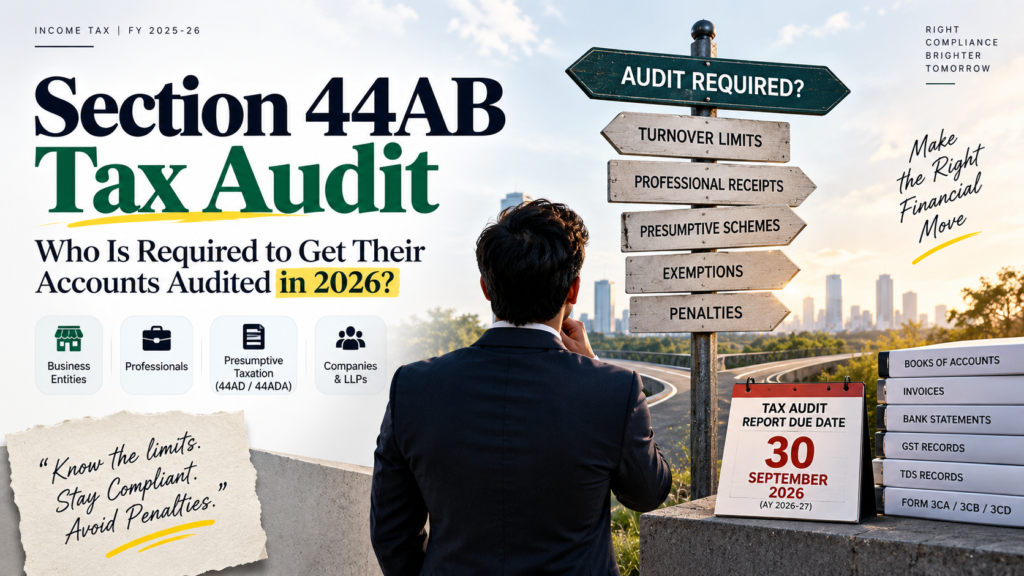
Tax audit is an important compliance requirement for businesses and professionals whose income or transactions fall within the conditions prescribed under the Income-tax Act. For 2026, businesses should not determine tax-audit applicability by looking at turnover alone. The nature of business, cash receipts, cash payments, presumptive taxation provisions and other conditions can affect whether an audit is required. Section 44AB lays down the principal tax-audit requirements for specified taxpayers. Understanding these rules before filing the income-tax return can help businesses avoid incorrect reporting, missed compliance and potential penalties. What Is a Section 44AB Tax Audit? A tax audit under Section 44AB involves examination of the taxpayer’s books of account by an eligible Chartered Accountant and reporting of prescribed particulars to the Income Tax Department. The objective is to ensure that relevant financial and tax information is properly examined and reported. A tax audit is different from a statutory audit under company law. A business may need both depending on its legal structure and circumstances. Who Is Required to Get a Tax Audit in 2026? Section 44AB broadly applies to specified persons carrying on business or profession when the conditions prescribed under the Income-tax Act are satisfied. For businesses, the commonly applicable turnover threshold is ₹1 crore. However, this threshold can increase to ₹10 crore where the prescribed conditions regarding cash receipts and cash payments are satisfied. For professionals, separate gross-receipt conditions apply. There are also specific tax-audit implications for certain taxpayers using presumptive taxation provisions. Therefore, the question is not simply: “Is my turnover above ₹1 crore?” The correct question is whether the taxpayer falls within any of the tax-audit conditions applicable to their business or profession. ₹1 Crore vs ₹10 Crore Tax Audit Limit This is one of the most important points businesses should understand. General Business Threshold Where a person carries on business and total sales, turnover or gross receipts exceed ₹1 crore, tax audit provisions can generally become applicable. Increased ₹10 Crore Threshold The threshold can increase to ₹10 crore where: Aggregate cash receipts during the relevant previous year do not exceed 5% of total receipts, and Aggregate cash payments during the relevant previous year do not exceed 5% of total payments. For the cash-receipt condition, certain receipts by cheque or bank draft that are not account-payee may also need to be considered under the applicable provisions. Businesses should therefore analyse their actual transaction records rather than assuming that a predominantly digital business automatically qualifies. Example of the ₹10 Crore Threshold Suppose a business has annual turnover of ₹7 crore. If the prescribed cash receipt and cash payment conditions are satisfied, the business may fall within the higher ₹10 crore threshold rather than becoming subject to tax audit merely because its turnover exceeds ₹1 crore. However, if the prescribed cash conditions are not satisfied, the ₹1 crore threshold may become relevant. This makes accurate classification of cash and non-cash transactions important during year-end tax planning. Tax Audit for Professionals Professionals are subject to a separate threshold under Section 44AB. Tax audit can generally become applicable where the gross receipts from the profession exceed the prescribed limit. This can cover professionals such as: Chartered Accountants Lawyers Doctors Architects Engineers Consultants Technical professionals Other notified professionals The applicability should be checked based on the relevant provisions and the professional’s specific circumstances. Tax Audit and Presumptive Taxation Presumptive taxation can significantly affect tax-audit requirements. For example, eligible businesses may consider provisions such as Section 44AD, while eligible professionals may consider Section 44ADA. However, simply being eligible for presumptive taxation does not mean that tax audit can never apply. The consequences can depend on factors such as: Whether the taxpayer opts for presumptive taxation Whether the taxpayer declares income according to the presumptive provisions Whether the taxpayer declares income below the prescribed presumptive rate Whether the relevant conditions are satisfied Businesses and professionals should therefore examine the interaction between Sections 44AB, 44AD and 44ADA before deciding how to file their return. When Can Presumptive Taxation Create an Audit Requirement? A common situation arises when an eligible taxpayer chooses not to follow the presumptive taxation mechanism and declares income below the prescribed level. Depending on the applicable provisions, the taxpayer may need to maintain books and obtain a tax audit. This is why taxpayers should not decide on presumptive taxation purely on the basis of the tax rate. The compliance consequences should also be evaluated. What Does a Tax Auditor Examine? A tax auditor examines the taxpayer’s books and relevant supporting records. The review can cover: Sales Purchases Expenses Bank transactions Cash transactions Loans and advances Fixed assets Depreciation TDS GST records Debtors Creditors Related-party transactions Business payments Disallowable expenses Tax deductions Accounting methods Other prescribed information The auditor then reports the required particulars in the applicable tax-audit report. Important Documents for Section 44AB Audit Businesses should maintain their financial records throughout the year instead of preparing everything immediately before the audit. Important records can include: Sales invoices Purchase invoices Bank statements Cash book General ledger Journal entries Expense vouchers Fixed asset register Loan statements Debtor ageing Creditor balances GST returns TDS returns Payroll records Investment details Previous year’s financial statements Previous tax-audit report, where applicable Proper documentation can make the audit process substantially smoother. GST and Tax Audit Reconciliation GST data should also be reviewed as part of year-end financial reconciliation. Businesses should compare: Books of account → GST returns → Bank records → Tax return information Differences can arise because of: Credit notes Debit notes Advances Exempt supplies Export transactions Timing differences Rounding differences Revenue recognition differences Identifying these differences before the tax audit can reduce unnecessary queries and corrections. TDS Compliance During Tax Audit TDS is another area that requires attention. A business should review: TDS deducted TDS deposited TDS returns filed Form 26AS TDS certificates Expenses subject to TDS PAN details Late deduction or payment Incorrect TDS treatment can result in tax disallowances and additional interest or other consequences. What Happens If a Tax Audit Is Required