
GST Compliance for Small Businesses: What Changes When Your Turnover Crosses the Registration Threshold
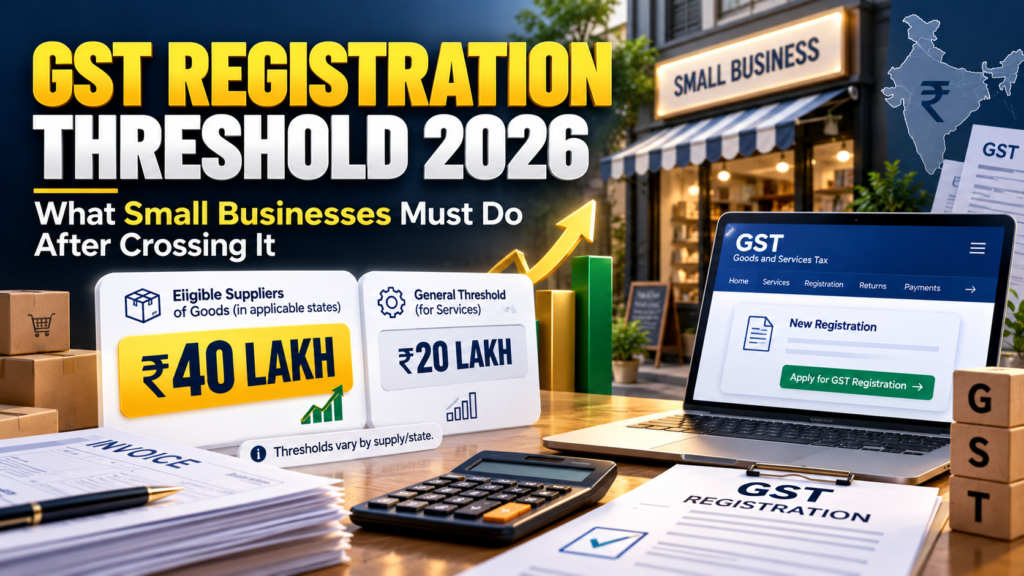
TL;DR Crossing the GST registration threshold can significantly change how a small business manages its sales, invoices, tax collection and accounting. For many businesses, the applicable threshold depends on whether they supply goods or services, the State or Union Territory in which they operate, and whether any compulsory-registration provision applies. CBIC’s current published guidance provides a threshold of ₹40 lakh for suppliers exclusively engaged in goods in eligible States, while the general threshold for services is ₹20 lakh, subject to lower thresholds in specified States and other exceptions. Once registration becomes applicable, the business may need to obtain a GSTIN, issue GST-compliant tax invoices, charge and report GST, file applicable returns, maintain records and manage Input Tax Credit. The important point is that businesses should track aggregate turnover continuously instead of waiting until year-end. What Is the GST Registration Threshold? GST registration is generally linked to a business’s aggregate turnover. Aggregate turnover is not simply the amount of taxable sales made by a business. Under the GST framework, it is calculated on an all-India basis for the same PAN and generally includes taxable supplies, exempt supplies, exports and inter-State supplies, while GST taxes themselves are excluded. Certain specified items, including inward supplies on which tax is payable under reverse charge, are excluded from aggregate turnover. The applicable threshold can vary depending on the nature of the business. For example, CBIC’s published guidance provides: ₹40 lakh threshold for suppliers exclusively supplying goods in States/UTs where the higher threshold applies ₹20 lakh threshold generally applicable to suppliers of services Lower thresholds in certain specified States Therefore, a business should not assume that the same turnover limit applies to every taxpayer. Why the Turnover Threshold Matters For a small business operating below the applicable threshold and not falling under compulsory-registration provisions, GST registration may not be mandatory. But once the business becomes liable for registration, its compliance responsibilities change. The business may need to: Apply for GST registration Obtain a GSTIN Issue tax invoices Charge applicable GST Maintain GST records File GST returns Reconcile sales Claim eligible Input Tax Credit Track GST payments Respond to GST notices, where applicable The GST Portal’s registration guidance states that the date on which registration liability arises must be entered in the registration application, and an application filed within 30 days can have registration effective from the date liability arose. What Counts Toward Aggregate Turnover? One of the most common mistakes is monitoring only taxable sales. Aggregate turnover can include: Taxable supplies Exempt supplies Export supplies Inter-State supplies Supplies made under the same PAN across India GST itself is excluded from the calculation. For example, suppose a business has: Type of Supply Annual Value Taxable sales ₹27 lakh Exempt supplies ₹5 lakh Export services ₹4 lakh Other qualifying supplies ₹3 lakh Aggregate turnover ₹39 lakh The business cannot simply look at the ₹27 lakh taxable-sales figure and conclude that its aggregate turnover is ₹27 lakh. The complete turnover position needs to be examined. The Same PAN Matters Aggregate turnover is generally considered on an all-India basis for the same PAN. This becomes particularly important where a business operates from multiple locations or has multiple registrations. For example, if the same PAN has business activities in Maharashtra and Gujarat, turnover from the relevant supplies is not simply evaluated independently as two unrelated businesses for determining aggregate turnover. CBIC’s GST guidance specifically explains that turnover across businesses under the same PAN is considered for the threshold. What Changes Once GST Registration Becomes Applicable? The transition from an unregistered business to a registered taxpayer is more than just obtaining a GST number. The business’s entire billing and accounting process may need to change. 1. GSTIN Becomes Part of Business Documentation After registration, the GSTIN becomes an important identifier for GST compliance. The business should ensure that the GSTIN and other required particulars appear correctly on applicable documents. 2. Tax Invoices Need to Be Issued A registered taxpayer generally needs to issue GST-compliant tax invoices for taxable supplies. The invoice should contain the information required under the applicable GST rules. This is different from the ordinary commercial invoice that an unregistered small business may use. 3. GST Needs to Be Accounted For Once the business becomes liable to pay GST, it must determine the applicable tax treatment of its supplies. Depending on the transaction, this can involve: CGST SGST/UTGST IGST Exempt supplies Zero-rated supplies Reverse-charge transactions The correct treatment depends on the nature and location of the supply. Does Crossing the Threshold Mean GST Applies to Every Receipt? Not necessarily. GST is based on supplies covered by the GST law, and the tax treatment can vary depending on the nature of each transaction. A business can have: Taxable supplies Exempt supplies Zero-rated supplies Non-GST supplies The registration threshold and GST liability should therefore be analysed using the applicable GST provisions rather than simply applying a fixed percentage to every bank credit. What Happens to Input Tax Credit? One of the major changes after GST registration is the potential availability of Input Tax Credit (ITC), subject to the statutory conditions and restrictions. For example, a registered business may incur GST on: Raw materials Business purchases Professional services Rent Software Office expenses Other eligible inputs and input services Where the relevant legal conditions are satisfied, eligible GST paid on business inputs can potentially be claimed as ITC. However, registration does not mean that every GST amount paid automatically becomes ITC. Businesses should verify: Valid tax invoice Supplier details Receipt of goods/services Eligibility of the expense Return/reporting requirements Applicable restrictions GST Returns Become Part of Regular Compliance Once registered, the business enters the GST return-filing system. For normal taxpayers, GSTR-1 is used to report details of outward supplies. The GST Portal states that normal and casual registered taxpayers making outward supplies generally file GSTR-1, subject to applicable exclusions such as composition taxpayers. Depending on the taxpayer’s circumstances and filing option, returns may be monthly or quarterly. This means GST compliance becomes an