Income_Tax_Reforms_Union_Budget_2025
As Financial Year 2025-26 draws to a close, it is the right time to revisit and take stock of the income tax changes applicable for this year. The Union Budget 2025, presented by Finance Minister Nirmala Sitharaman, introduced several reforms that directly impact individual taxpayers, businesses, and institutions. These changes are designed to simplify compliance, provide greater relief, and encourage investment in key sectors.
Understanding these reforms is essential for effective tax planning and ensuring timely compliance as we move into the next assessment year. Below is a consolidated summary of the Income Tax Reforms 2025 that clients should be aware of.
Revised Tax Slabs – New Regime (AY 2026-27)
Under Section 115BAC, the new regime will apply with the following slab rates:
|
Income Range
|
Tax Rate
|
|
₹0 – ₹4,00,000
|
Nil
|
|
₹4,00,001 – ₹8,00,000
|
5%
|
|
₹8,00,001 – ₹12,00,000
|
10%
|
|
₹12,00,001 – ₹16,00,000
|
15%
|
|
₹16,00,001 – ₹20,00,000
|
20%
|
|
₹20,00,001 – ₹24,00,000
|
25%
|
|
Above ₹24,00,000
|
30%
|
Section 87A Rebate – Enhanced Relief
- Rebate threshold raised to ₹12 lakh (earlier ₹7 lakh).
- Full rebate available against tax on income under normal rates.
- Marginal relief provided for incomes slightly above ₹12 lakh.
- Not applicable on special rate incomes such as capital gains.
House Property – Self-Occupied Status
From AY 2025-26, a house property will be treated as self-occupied (annual value = nil) if:
- The owner resides in it, OR
- The owner cannot occupy it due to any reason.
This widens relief compared to earlier restrictions.
Updated Returns – Extended Filing Window
- Time limit for filing updated returns u/s 139(8A) extended to 48 months (earlier 24 months).
- If notice under Section 148A is received, limit is 36 months.
- Additional tax liability u/s 140B:
- Filing between 24–36 months → 60% extra tax
- Filing between 36–48 months → 70% extra tax
Exemption for NSS Withdrawals – Senior Citizens
Withdrawals from National Savings Scheme (NSS) by senior citizens (from August 29, 2024 onwards) are exempt. Similar benefit extended to NPS Vatsalya accounts.
TDS Reforms
- Section 206AB (higher TDS for non-filers) has been omitted. Higher TDS will now apply only in non-PAN cases.
- Thresholds under various sections revised. Key highlights:
- Interest (194A): Banks/Post Office – ₹50,000 (below 60 years), ₹1,00,000 (above 60 years).
- Dividends (194): Threshold doubled to ₹10,000.
- Lottery & Horse Race Winnings (194B/194BB): Threshold now per transaction (₹10,000).
- Insurance Commission (194D): ₹20,000.
- Brokerage/Commission (194H): ₹20,000.
- Rent (194I): Plant & Machinery – ₹50,000 per month.
- Professional Fees (194J): ₹50,000.
- Compensation on Property Acquisition (194LA): ₹5,00,000.
- LRS Remittances: Other remittances – threshold raised to ₹10 lakh.
Other Key Reforms
- Presumptive taxation introduced for non-residents providing services to electronics manufacturing units.
- Tonnage tax scheme extended to inland vessels under the Indian Vessels Act, 2021.
- Start-up benefits extended to companies incorporated before April 1, 2030.
- IFSC incentives extended to ship-leasing units, insurance offices, and treasury centres (commencement cut-off extended to March 31, 2030).
- Certainty of taxation provided for Category I & II AIFs investing in infrastructure.
- Investment window for Sovereign Wealth Funds and Pension Funds extended to March 31, 2030.
- Charitable trusts/institutions – registration period increased from 5 years to 10 years, with reduced consequences for minor defaults.
Conclusion:
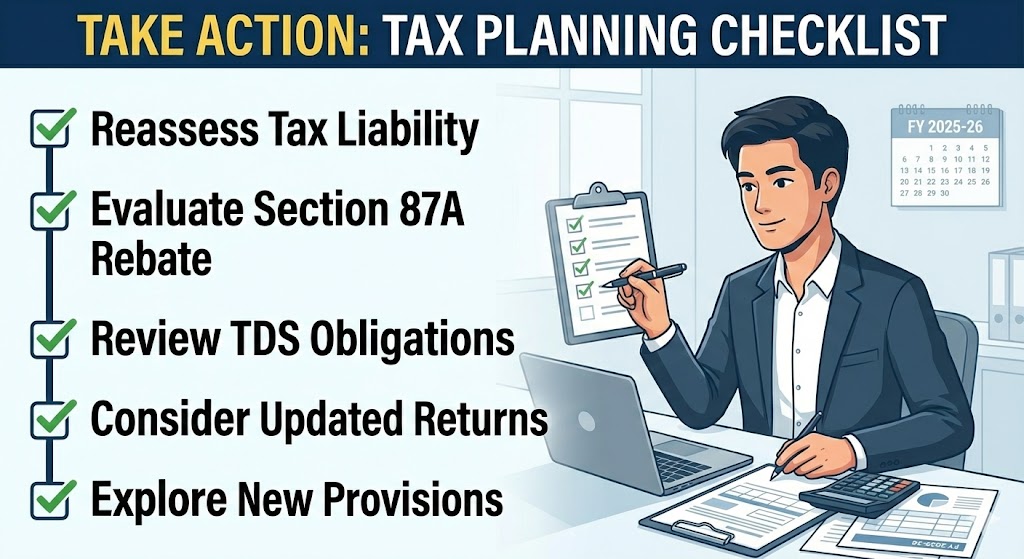
These reforms will directly impact tax planning, compliance timelines, and investment strategies. Taxpayers are advised to:
- Reassess tax liability under revised slabs.
- Evaluate eligibility for the enhanced Section 87A rebate.
- Review TDS obligations in light of revised thresholds.
- Consider implications of extended timelines for updated returns.
- Explore opportunities under new provisions for start-ups, IFSC units, and charitable institutions.