
Income Tax Act 2026: Complete Form Number Changes

Introduction: The transition from the Income Tax Act, 1961 to the Income Tax Act, 2026 has brought significant structural and procedural changes, including comprehensive renumbering, consolidation, and rationalisation of statutory forms. While the core compliance framework such as audit reports, TDS/TCS statements, certificates, declarations, and applications continues in substance, the form numbers and corresponding section references have undergone substantial revision. Tax professionals, deductors, collectors, non-profit organisations, reporting entities, and other stakeholders must carefully align their compliance systems, documentation, and reporting processes with the new form numbers applicable from 2026 onwards. A clear understanding of these changes is essential to ensure accurate filings, avoid procedural defects, and maintain seamless compliance under the new regime. Frequently Used Forms: Form No. (1962) Form No. (2026) Description Section of Act/Rule 3CA,3CB,3CD 26 Audit report and Statement of particulars Section 63 3CEA 28 Report of an accountant relating to computation of capital gains in slump sale Section 77(4) 10BA 31 Declaration for deduction for rents paid Section 134 3CEB 48 Report from an accountant relating to international transaction(s) and specified domestic transaction(s) Section 172 29B 66 Computation of Book Profit Section 206(1) 29C 67 Report for Computation of Adjusted Total Income and Alternate Minimum Tax Section 206(2) 12BA 123 Statement showing particulars of perquisites, fringe benefits, amenities, profits in lieu of salary – 12BB 124 Statement showing particulars of claims by employee for deduction of tax Section 392(5)(b) 16A 131 Certificate for tax deducted at source Section 395(4) 16B,16C,16D,16E 132 Certificate for tax deducted at source Section 395(4) 49B(1) 134 Application for allotment of TAN (Government Entity) Section 397 49B(2) 135 Application for allotment of TAN (Other Entities) Section 397 24Q 138 Quarterly statement of deduction of tax on salary/senior citizen income Sections 392 26Q 140 Quarterly statement of deduction of tax on payments other than salary Section 397(3)(b) 26QB,26QC,26QD,26QE 141 Challan-cum-statement of deduction of tax Section 393(1) 27EQ 143 Quarterly statement of collection of tax at source Section 397(3)(b) 27Q 144 Quarterly statement of deduction of tax on payments to non-residents Section 397(3)(b) 15CA 145 Information for payments to non-resident/foreign company – 15CB 146 Certificate of accountant for payments to non-resident/foreign company – 27BA 150 Form for furnishing accountant certificate Section 398(2) 26AS 168 Annual information statement – Other forms: Form No. (1962) Form No. (2026) Description Section of Act/Rule 3BB 1 Monthly statement to be furnished by a stock exchange in respect of transactions in which client codes have been modified… – 5B 2 Application for notification of a zero coupon bond under section 2(112) of the Act Section 2(112) 5BA 3 Certificate of an accountant under rule 7 Rule 7 3CT 4 Income attributable to assets located in India under section 9(10)(a) of the Act Section 9(10)(a) 3AF 5 Statement regarding preliminary expenses incurred by the assessee to be furnished under Section 44(3) of the Act Section 44(3) 3AE 6 Audit Report under section 44(6) / 51(7) of the Act Sections 44(6), 51(7) 3CG 7 Application for approval of scientific research programme under section 45(3)(c) of the Act Section 45(3)(c) 3CH 8 Order of approval of Scientific Research Programme under section 45(3)(c) of the Act Section 45(3)(c) 3CI 9 Receipt of payment for carrying out scientific research under section 45(3)(c) of the Act Section 45(3)(c) 3CJ 10 Report to be submitted by the prescribed authority to the Chief Commissioner of Income-tax after approval of scientific research programme Section 45(3)(c) 3CK 11 Application for entering into an agreement with the Department of Scientific and Industrial Research for cooperation in In-house research development facility Section 45(2) 3CL 12 Report to be submitted by the prescribed authority to the Chief Commissioner of Income-tax having jurisdiction over the company Section 45(2) 3CLA 13 Report from an accountant relating to in-house scientific research and development facility Section 45(2) 3CM 14 Order of approval of in-house research and development facility Section 45(2) 3CF 17 Application for approval of a company or institution under section 45(3)(b) and 45(4)(b) Sections 45(3)(b) 3CN 18 Application for notification of affordable housing project as specified business Section 46 3CS 19 Application for notification of semiconductor wafer fabrication manufacturing unit as specified business Section 46 3C-O 20 Application for approval of agricultural extension project Section 47(1)(a) 3CP 21 Form for notification of agricultural extension project Section 47(1)(a) 3CQ 22 Application for approval of skill development project Section 47(1)(b) 3CR 23 Form for notification of skill development project Section 47(1)(b) 3CE 24 Audit Report Section 59 3C 25 Form of daily case register – 5C 27 Details of amount attributed to capital asset remaining with the specified entity – 62 29 Certificate from amalgamated company regarding production level – 10-IA 30 Certificate of medical authority for disability, autism, cerebral palsy etc. Sections 127 56FF 33 Particulars to be furnished Section 144 10DA 34 Report for deduction in respect of additional employee cost Section 146 10CCF 35 Report for deduction in respect of Offshore Banking Units Section 147(4)(a) 10CCD 36 Certificate for Authors of certain books in receipt of Royalty Income Section 151(5) 10CCE 37 Certificate for Patentees in receipt of royalty income Section 152(5) 10H 38 Certificate of foreign inward remittance – 10E 39 Form for claiming relief Section 157(1) 10-EE 40 Exercise of option Rule 21AAA(1) 10F 41 Information to be provided Section 159(8) 10FA 42 Application for Certificate of residence Sections 159(1) 10FB 43 Certificate of residence Section 159 67 44 Statement of income from a country or specified territory outside India and Foreign Tax Credit – 3CEFA,3CEFB,3CEFC 49 Application for opting for Safe Harbour – 3CEC 50 Application for a pre-filing consultation – 3CED,3CEDA 51 Application for an Advance Pricing Agreement (APA) – 3CEF 52 Annual Compliance Report on Advance Pricing Agreement – 3CEEA 53 Form for filing particulars of past years for calculating relief in tax payable Section 206(1) 34F 55 Application for invoking mutual agreement procedure in agreements with other countries – 3CEAA 56 Information and document to be furnished by constituent entity Section 171(4) 3CEAB 57 Intimation by
Income Tax Act, 2025: A Simplified Tax Era
Introduction For more than six decades, India’s taxation framework was governed by the Income Tax Act, 1961. While it was a landmark law in its time, the Act became increasingly complex due to thousands of amendments, scattered provisions, and archaic language. Taxpayers, professionals, and businesses often struggled to interpret its dense legal text, leading to frequent disputes and compliance burdens. Recognizing these challenges, the Government of India introduced the Income Tax Act, 2025, which will come into effect from April 1, 2026. This new legislation is not about altering tax rates or due dates; it is about simplifying the tax experience. By streamlining sections, consolidating provisions, and embracing digital-first compliance, the Act aims to make taxation more transparent, predictable, and globally aligned. Legislative Journey The journey to the Income Tax Act, 2025 reflects the government’s commitment to consultation and reform: This timeline shows how the government incorporated feedback from stakeholders, industry bodies, and tax professionals to ensure the new law is practical and future-ready. Key Differences Between Income Tax Act, 1961 and 2025 Aspect Income Tax Act, 1961 Income Tax Act, 2025 Number of Sections 819+ sections (expanded over decades with amendments) 536 sections (sequentially numbered, simplified) Chapters 47 chapters 23 chapters (logically reorganized) Schedules 14 schedules 16 schedules (with tables & formulae for clarity) Terminology “Assessment Year” & “Previous Year” Unified “Tax Year” (April–March) TDS Provisions Spread across multiple sections (192–194T) Consolidated under Section 393 Virtual Digital Assets (VDAs) Narrow definition, limited scope Broader definition covering cryptocurrencies, tokenized assets, and digital value systems Default Tax Regime Section 115BAC Section 202 Presentation Style Dense legal language, fragmented structure Plain language, streamlined layout, improved accessibility Content Length ~823 pages ~622 pages (shorter, clearer) Effective Date Already in force Applicable from April 1, 2026 Why the Change Was Needed The 1961 Act had been amended nearly 65 times, with more than 4000 changes introduced through annual Finance Acts and separate Taxation Laws Amendment Bills. While these amendments were meant to keep the law relevant, they made it longer, fragmented, and harder to interpret. The 2025 Act addresses these issues by simplifying language, removing redundant provisions, and reorganizing sections logically. Key Features of the Income Tax Act, 2025 1. Introduction of ‘Tax Year’ The Act replaces the confusing terms Assessment Year and Previous Year with a single, unified Tax Year. Defined as the financial year starting April 1, this change makes it easier for taxpayers to understand which period their income and filings relate to. 2. Streamlined Structure Sections have been reduced from 819 to 536, and chapters from 47 to 23. The Act also introduces 16 schedules with tables and formulae for clarity. This structural simplification improves readability and reduces compliance errors. 3. Digital-First Enforcement The Act embraces technology by enabling faceless assessments and digital compliance. It also defines Virtual Digital Assets (VDAs) broadly, covering cryptocurrencies, tokenized assets, and cloud-based holdings. This ensures India’s tax law keeps pace with global financial innovations. 4. Simplified Compliance Provisions like Tax Deducted at Source (TDS), earlier scattered across multiple sections, are now consolidated under Section 393. This makes compliance easier for taxpayers, professionals, and authorities. 5. Dispute Resolution Framework A more robust, taxpayer-friendly mechanism has been introduced to minimize litigation and foster trust between taxpayers and authorities. Objectives of the 2025 Act The reform is guided by four core objectives: Conclusion The Income Tax Act, 2025 represents a paradigm shift in India’s tax landscape. By reducing complexity, consolidating provisions, and embracing digital realities, it empowers taxpayers with clarity and confidence. While tax rates and due dates remain unchanged, the experience of compliance is set to become smoother, more predictable, and globally aligned. This reform is not just about taxation, it is about building trust between taxpayers and the system. Guided by the vision of a developed and inclusive India, the Act lays the foundation for a transparent, efficient, and future-ready fiscal framework.
Old Regime vs New Regime u/s 115BAC – FY 2025-26 (AY 2026-27): Which Income Tax Regime Should You Choose?
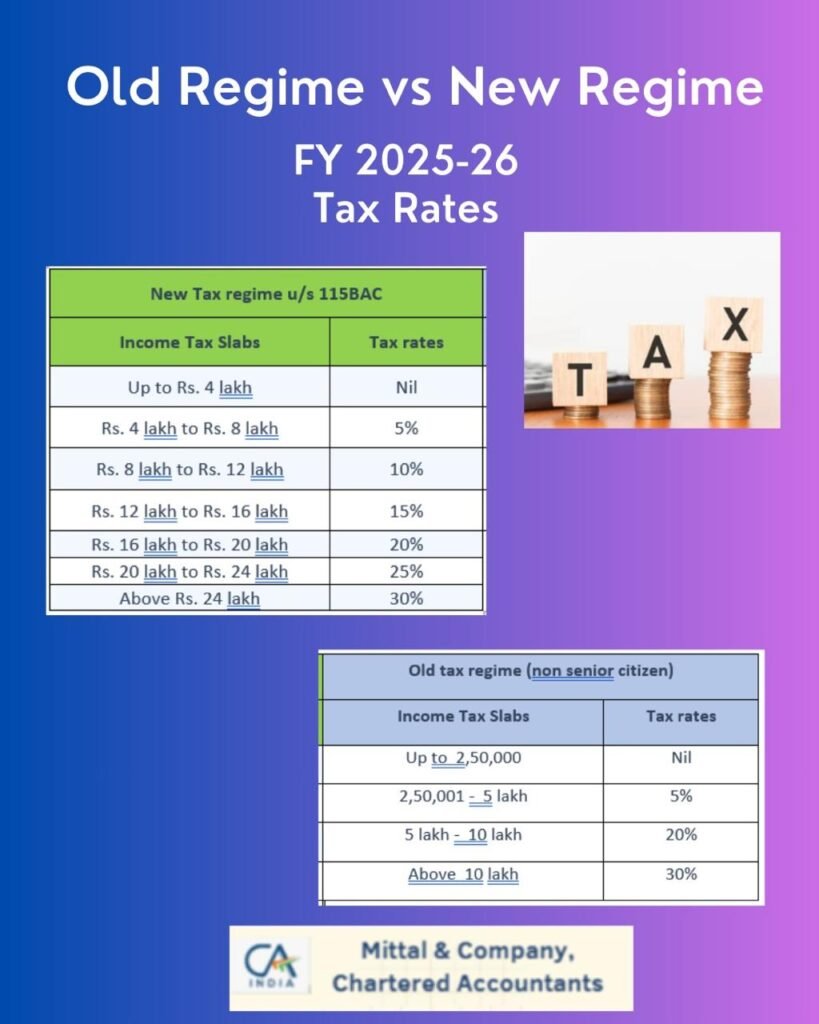
Introduction: As FY 2025-26 nears its end, taxpayers face a critical phase where accurate TDS deductions, advance tax payments, and final submission of tax declarations to their employer companies must be completed without error. At this juncture, the choice between the Old Tax Regime and the New Tax Regime becomes decisive, as it directly influences your tax liability for Assessment Year 2026-27. While the New Regime is now the default option, employees still have the flexibility to opt for the Old Regime if it proves more beneficial. Let’s understand the differences, benefits, and key factors while choosing tax regime! Tax Rates: New Tax regime u/s 115BAC Old tax regime (non senior citizen) Income Tax Slabs Tax rates Income Tax Slabs Tax rates Up to Rs. 4 lakh Nil Up to 2,50,000 Nil Rs. 4 lakh to Rs. 8 lakh 5% 2,50,001 – 5 lakh 5% Rs. 8 lakh to Rs. 12 lakh 10% 5 lakh – 10 lakh 20% Rs. 12 lakh to Rs. 16 lakh 15% Above 10 lakh 30% Rs. 16 lakh to Rs. 20 lakh 20% Rs. 20 lakh to Rs. 24 lakh 25% Above Rs. 24 lakh 30% Allowances and deductions available: Allowance / Deduction Section of IT Act New Regime Allowed? Old Regime Allowed? Leave Travel Allowance (LTA) Sec 10(5) ❌ ✅ House Rent Allowance (HRA) Sec 10(13A) ❌ ✅ Standard Deduction (Salary/Pension) Sec 16(ia) ✅ Rs. 75,000 ✅ Rs. 50,000 Entertainment Allowance (Govt. employees) Sec 16(ii) ❌ ✅ Professional Tax Sec 16(iii) ❌ ✅ Interest on Housing Loan (Self-occupied property) Sec 24(b) ❌ ✅ Rs. 2,00,000 Interest on Housing Loan (Rented property) Sec 24(b) ✅ ✅ Deduction for Investments (LIC, PPF, ELSS, etc.) Sec 80C ❌ ✅ NPS (Employer Contribution) Sec 80CCD(2) ✅ ✅ NPS (Employee Contribution) Sec 80CCD(1B) ❌ ✅ Health Insurance Premium Sec 80D ❌ ✅ Education Loan Interest Sec 80E ❌ ✅ Donations to Charitable Institutions Sec 80G ❌ ✅ Savings Interest (up to ₹10,000) Sec 80TTA ❌ ✅ Senior Citizens – Savings Interest (up to ₹50,000) Sec 80TTB ❌ ✅ Additional Depreciation (Plant & Machinery) Sec 32(1)(iia) ❌ ✅ SEZ Unit Deduction Sec 10AA ❌ ✅ Rebate Sec 87A ✅ Available if Income upto Rs. 12 Lakhs- Maximum rebate Rs. 60,000 ✅ Available if Income upto Rs. 5 Lakhs- Maximum rebate Rs. 12,500 Key points to be noted while choosing tax regime: Conclusion: The decision between the Old and New Tax Regime is not one-size-fits-all; it depends on your income structure, deductions, and long-term financial planning. The New Regime offers simplicity and higher rebates, making it attractive for those with fewer exemptions, while the Old Regime continues to reward structured tax planning and significant investments. Before filing your return for AY 2026-27, evaluate both regimes with your actual deductions and income profile. A timely, well-informed choice will not only optimize your tax liability but also ensure smooth compliance with employer submissions and year-end obligations.
Pradhan Mantri Viksit Bharat Rozgar Yojana (PMVBRY): A Complete Guide
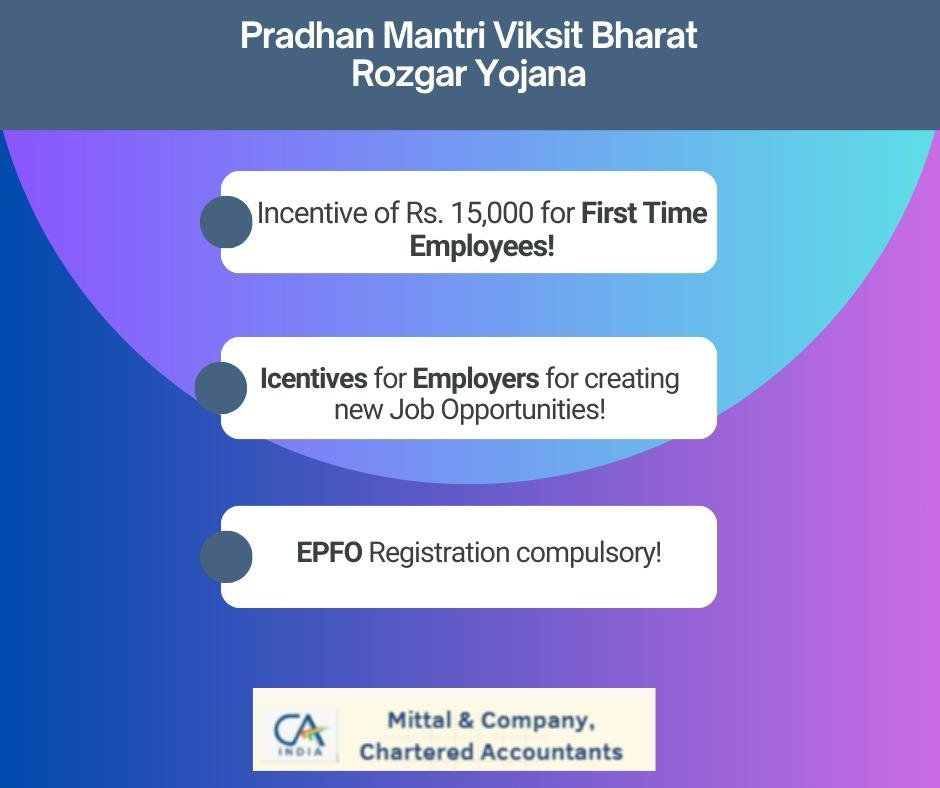
Introduction India’s vision of Viksit Bharat@2047 emphasizes employment generation as a cornerstone of development. To accelerate formal job creation, the Government of India announced the Pradhan Mantri Viksit Bharat Rozgar Yojana (PMVBRY) in the Union Budget 2024–25. Implemented by the Ministry of Labour and Employment through the Employees’ Provident Fund Organisation (EPFO), the scheme incentivizes both employees and employers, particularly in labour‑intensive manufacturing sectors. Objectives of the Scheme The PMVBRY has been designed to stimulate sustained employment creation, formalize the workforce, and enhance employability. Together, these measures aim to foster a dynamic, inclusive, and formal labour market that particularly benefits India’s youth. Applicability The scheme applies to establishments registered under the EPF & MP Act, 1952, including exempted establishments maintaining their own provident fund trusts. Key timelines: Baseline determination: Employers must meet threshold criteria to qualify: at least two additional jobs for establishments with fewer than 50 employees, and at least five for those with 50 or more. How to Apply for PMVBRY Applying for the Pradhan Mantri Viksit Bharat Rozgar Yojana (PMVBRY) is designed to be simple and fully digital, ensuring transparency and ease of compliance. Employers and employees follow slightly different steps, but the process is integrated through the official portal. For Employers: For Employees: This streamlined process ensures that employers can quickly register and claim incentives, while employees are seamlessly integrated into the formal workforce without additional paperwork. Benefits of PMVBRY For Employees (Pointers + Para) Together, these benefits make formal employment more attractive and sustainable for new entrants. For Employers (Pointers) For the Economy (Para only) At a macro level, PMVBRY strengthens India’s organized sector, expands the social security net, and contributes to GDP growth by increasing workforce participation. It is a step toward inclusive development under the vision of Viksit Bharat@2047. Incentive Payment Mechanism Payments under the scheme are made through Direct Benefit Transfer (DBT). Employees receive incentives directly into Aadhaar‑seeded bank accounts, while employers receive payments into PAN‑linked accounts. In cases where multiple establishments share the same PAN, a single nominated account is used. Incentives are disbursed within 45 days of fulfilling eligibility conditions and filing ECRs. However, payments cease if employees exit, establishments close, or fraudulent activity is detected. Compliance and Safeguards To maintain integrity, the scheme incorporates robust safeguards: This dual‑layered governance structure ensures accountability and responsiveness. Special Provisions Exempted establishments are also eligible but must file monthly returns with EPFO and ensure Aadhaar‑authenticated UANs for all employees. Seasonal industries enjoy flexibility in filing ECRs for first‑time employees, recognizing the unique nature of their operations. For calculation purposes, averages and baselines are rounded to the nearest integer, simplifying compliance. Grievance Redressal and IT Support The PMVBRY portal provides a dedicated grievance redressal mechanism. Employers and employees can raise complaints online, with escalation procedures in place for unresolved issues. Technical support is available for login problems, password resets, and data uploads. By integrating grievance handling with IT support, the scheme ensures transparency and trust. Conclusion The Pradhan Mantri Viksit Bharat Rozgar Yojana (PMVBRY) is a landmark initiative that balances the needs of employers and employees while advancing India’s employment agenda. For employers, it reduces hiring costs and encourages workforce expansion. For employees, it provides financial support, social security, and financial literacy. For the nation, it strengthens the organized sector and contributes to sustainable economic growth. By combining incentives, compliance safeguards, and digital transparency, PMVBRY represents a forward‑looking approach to job creation — one that empowers individuals, supports businesses, and drives India’s economic transformation.
GST Reforms: 2025: Part I
Introduction The year 2025 has been a landmark year for GST in India, with several important changes rolled out to make the system simpler, fairer, and more inclusive. From rationalising tax rates on essentials to correcting inverted duty structures and easing compliance for businesses, GST has undergone a series of updates that directly impact households, MSMEs, and professionals. Early in the year, the GST Council focused on sector-specific reliefs lowering rates on education supplies, healthcare products, and farming equipment to reduce costs for families and farmers. Mid-year discussions brought clarity on compliance, with faster refunds for exporters and simplified registration for small businesses. Finally, in its 56th meeting on 4th September 2025, chaired by Union Finance Minister Smt. Nirmala Sitharaman, the Council approved the most significant change: a two-slab structure of 5% and 18%, effective from 22nd September 2025. In this part, GST rate changes in 2025 are discussed. GST Council Meetings in 2025 GST Rate Structure Changes The biggest highlight is the two-slab structure of 5% and 18%. The GST rate structure in India has been rationalized following the 56th GST Council meeting, introducing GST 2.0 reforms. The revised primary GST rates now consist mainly of two slabs: 5% and 18%, replacing the earlier 0%, 5%, 12%, 18%, and 28% slabs. A higher 40% rate is applied to select luxury and sin goods, while a few niche rates like 3% and 0.25% continue to exist. Key Highlights by Sector GST Rate Change Table Goods / Services HSN/SAC (Indicative) Old Rate New Rate Date of Change Indian breads, paneer, UHT milk 0406 / 0401 5–12% Nil 22-Sep-2025 Soaps, shampoos, toothpaste, toothbrushes 3401 / 3305 / 3306 12% 5% 22-Sep-2025 Packaged namkeens, pasta, chocolates 1905 / 1806 12–18% 5% 22-Sep-2025 TVs (LCD/LED >32”), ACs, dishwashers 8528 / 8415 / 8422 28% 18% 22-Sep-2025 Cement 2523 28% 18% 22-Sep-2025 Marble, granite, sand-lime bricks 2515 / 2516 / 6810 12% 5% 22-Sep-2025 Bamboo flooring, packing cases (wood) 4409 / 4415 12% 5% 22-Sep-2025 Small cars (≤1200cc petrol, ≤1500cc diesel) 8703 28% 18% 22-Sep-2025 Two-wheelers ≤350cc 8711 28% 18% 22-Sep-2025 Auto parts, buses, trucks 8708 / 8702 / 8704 28% 18% 22-Sep-2025 Tractors 8701 12% 5% 22-Sep-2025 Tractor tyres & parts 4011 / 8708 18% 5% 22-Sep-2025 Harvesters, threshers, sprinklers, drip irrigation 8432 / 8424 12% 5% 22-Sep-2025 Bio-pesticides, natural menthol 3808 / 3301 12% 5% 22-Sep-2025 Hotel stays ≤ ₹7,500/day SAC 9963 12% 5% 22-Sep-2025 Gyms, salons, yoga services SAC 9997 18% 5% 22-Sep-2025 Notebooks, pencils, sharpeners, erasers 4820 / 9609 12% Nil 22-Sep-2025 Geometry boxes, school cartons 9017 / 4823 12% 5% 22-Sep-2025 Life-saving drugs, diagnostic kits 3004 / 9027 12% Nil 22-Sep-2025 Other medicines (Ayurveda, Homoeopathy) 3003 / 3004 12% 5% 22-Sep-2025 Spectacles, corrective goggles 9004 28% 5% 22-Sep-2025 Medical oxygen, thermometers, surgical instruments 2804 / 9025 / 9018 12–18% 5% 22-Sep-2025 Individual life & health insurance premiums SAC 9971 18% Nil 22-Sep-2025 Handicraft idols, statues, paintings, toys 9703 / 9503 12% 5% 22-Sep-2025 Manmade fibre & yarn 5503 / 5509 12–18% 5% 22-Sep-2025 Conclusion The GST updates of 2025 are more than just rate cuts — they represent a year-long effort to simplify and strengthen India’s indirect tax system. By lowering taxes on essentials, correcting duty structures, and easing compliance, these changes provide relief to households, empower MSMEs, and strengthen state revenues. In short, GST in 2025 has taken another step closer to its vision of “One Nation, One Tax” — while keeping the common man at the centre of policy.
Income Tax Reforms – Union Budget 2025
As Financial Year 2025-26 draws to a close, it is the right time to revisit and take stock of the income tax changes applicable for this year. The Union Budget 2025, presented by Finance Minister Nirmala Sitharaman, introduced several reforms that directly impact individual taxpayers, businesses, and institutions. These changes are designed to simplify compliance, provide greater relief, and encourage investment in key sectors. Understanding these reforms is essential for effective tax planning and ensuring timely compliance as we move into the next assessment year. Below is a consolidated summary of the Income Tax Reforms 2025 that clients should be aware of. Revised Tax Slabs – New Regime (AY 2026-27) Under Section 115BAC, the new regime will apply with the following slab rates: Income Range Tax Rate ₹0 – ₹4,00,000 Nil ₹4,00,001 – ₹8,00,000 5% ₹8,00,001 – ₹12,00,000 10% ₹12,00,001 – ₹16,00,000 15% ₹16,00,001 – ₹20,00,000 20% ₹20,00,001 – ₹24,00,000 25% Above ₹24,00,000 30% Section 87A Rebate – Enhanced Relief House Property – Self-Occupied Status From AY 2025-26, a house property will be treated as self-occupied (annual value = nil) if: This widens relief compared to earlier restrictions. Updated Returns – Extended Filing Window Exemption for NSS Withdrawals – Senior Citizens Withdrawals from National Savings Scheme (NSS) by senior citizens (from August 29, 2024 onwards) are exempt. Similar benefit extended to NPS Vatsalya accounts. TDS Reforms Other Key Reforms Conclusion: These reforms will directly impact tax planning, compliance timelines, and investment strategies. Taxpayers are advised to:
GST Advisory- December 2025: Negative Balances in ITC Reclaim and RCM Ledgers can block GSTR-3B Filing!
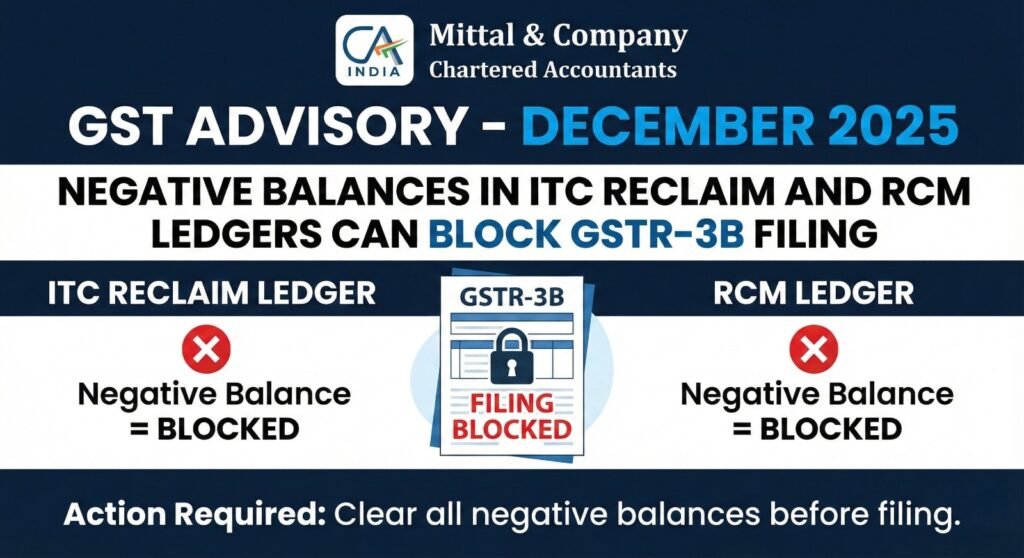
Introduction The GSTN has issued an important Advisory & FAQs on 29 December 2025 introducing strict system-level validations for Input Tax Credit (ITC) reversal, ITC reclaim, and Reverse Charge Mechanism (RCM) ITC reporting in GSTR-3B. With the implementation of the Electronic Credit Reversal and Re-claimed Statement and the RCM Liability/ITC Statement, GST compliance is now moving from disclosure-based to ledger-based auto-controls. Shortly, negative balances and excess ITC claims will not bepermitted, and GSTR-3B filing will be blocked unless discrepancies are corrected. What is the Electronic Credit Reversal and Re-claimed Statement? GSTN introduced the Electronic Credit Reversal and Re-claimed Statement in August 2023. It tracks temporary reversal of ITC and re-claim of the same on fulfilment of certain conditions. It captures the data from GSTR 3B- Table 4B(2)- temporary reversal of ITC and Table 4D(1) and 4A(5)- reclaim of ITC. Path to view:Dashboard → Services → Ledger → Electronic Credit Reversal and Re-claimed Cases where temporary ITC reversals and re-claims are made: Temporary ITC reversals and re-claims are typically required in following cases: New GSTN Validations Impacting GSTR-3B Filing GSTN has clarified that negative balances or excess ITC availment will soon not be allowed. ITC reclaimed in Table 4(D)(1) must be less than or equal to: Excess reclaim beyond this limit will block GSTR-3B filing. What is the RCM Liability/ITC Statement under GST? To streamline reporting under Reverse Charge Mechanism (RCM), GSTN introduced the RCM Liability/ITC Statement in August 2024.It captures RCM liability declared in Table 3.1(d) of GSTR-3B and ITC claimed in Table 4A(2) and 4A(3). Path to view:Services → Ledger → RCM Liability/ITC Statement New Validation for RCM ITC Claim in GSTR-3B: RCM ITC claimed in Table 4A(2) and 4A(3) must be less than or equal to: Any mismatch will result in non-submission of GSTR-3B. 4. How to file GSTR-3B if closing balance of Electronic Credit Reversal and Re-claimed Statement (ITC reclaim ledger) is already Negative? If the closing balance of the ITC reclaim ledger is negative, it indicates that excess ITC was reclaimed earlier. Therefore, to file GSTR-3B, you must reverse the excess claimed ITC in Table 4B(2) of the respective return period, up to the amount of the negative closing balance. This will allow you to correct the discrepancy and proceed with filing the return. In case there is no ITC available, this reversal declared in table 4(B)2 will be added to your liability in current period while filing GSTR-3B. Example: The closing balance of the ITC reclaim ledger for the current return period is -₹10,000, which means ₹10,000 of excess ITC has been reclaimed in earlier periods. To file your GSTR-3B, you would need to reverse this earlier excess reclaimed ITC of ₹10,000 in Table 4B(2) for the current period. How to file GSTR-3B if closing balance of RCM Liability/ITC Statement is Negative? If the closing balance of the RCM Liability/ITC Statement is negative, it indicates that excess RCM ITC has been claimed earlier. To proceed with filing, you must either pay the outstanding RCM liability in Table 3.1(d) or reduce the ITC being claimed in Table 4A(2) or 4A(3) in the current return period, equivalent the amount of the negative closing balance. Once the discrepancy is corrected, you will be able to file your return. Example: Let’s assume that the closing balance of the RCM Liability/ITC Statement is -₹5,000. This means that ₹5,000 of excess RCM ITC has been claimed earlier. To resolve this and file your GSTR-3B, you can: 1. Pay the RCM liability: You can pay additional ₹5,000 in Table 3.1(d) for the current return period to cover the excess ITC claimed. OR 2. Reduce the ITC claimed: You can reduce ₹5,000 from the RCM ITC in Table 4A(2) or Table 4A(3) for the same period, if RCM ITC is available more than ₹5,000 in current period. Once either the excess RCM liability is paid or the requisite ITC is reduced from available ITC to match the available negative closing balance, the discrepancy will be resolved, and you can proceed with filing your return. Conclusion The GST Advisory dated 29 December 2025 signals a major shift towards automated ITC governance. With ledger-based validations becoming mandatory, taxpayers must ensure real-time reconciliation of ITC reversals, reclaims, and RCM transactions. Businesses should immediately review their ITC Reclaim Ledger and RCM Liability/ITC Statement, rectify negative balances, and align GSTR-3B reporting to avoid return filing disruptions, interest, and penalties.
31st March 2026 is the cut off date for TDS/TCS Correction Statements for FY 2018-19 to FY 2023-24!
Introduction Tax Deductors and collectors are permitted under the Income Tax law to rectify errors in filed TDS/TCS returns through correction statements. However, this facility is governed by a statutory limitation period. In view of Section 397(3)(f) of the Income Tax Act, 2025, the Income Tax Department has clarified that 31 March 2026 is the final statutory cut-off date for filing TDS/TCS correction statements for certain earlier financial years. No correction statements shall be accepted beyond this date. Applicability of cut off date of 31st March, 2026 TDS/TCS correction statements for the following periods can be filed only up to 31 March 2026:: All such statements shall become time-barred on 31.03.2026 and shall not be accepted from 01.04.2026 onwards. Wordings of Section 397(3)(f) of the Income Tax Act, 2025: The Income Tax Act 1961 stands repealed w.e.f 01.04.2026 by virtue of section 536 of Income Tax Act 2025. Further, as per section 397(3)(f) of Income Tax Act, 2025, deductor/collector may deliver a correction statement in such form and verified in such manner as may be prescribed, to the prescribed authority within two years from the end of the tax year in which such statement is required to be delivered under the said clauses or under section 200 of the Income-tax Act, 1961. Consequent to the above, correction statements for FY 2018-19 (Qtr. 4), FY 2019-20 to 2022-23 (Qtr. 1 to Qtr. 4) and FY 2023-24 (Qtr. 1 to Qtr. 3) shall be accepted only up-to 31st March 2026. The same are time barred by limitation on 31.03.2026 and would not be accepted from 01.04.2026 onwards. What steps are required from the end of Tax Deductors? This advisory requires immediate review of historical TDS/TCS filings. Any unresolved discrepancies, defaults, or errors relating to the above periods must be corrected before the limitation date. Typical cases requiring TDS Corrections TDS Correction statement is required to be filed specifically in 2 cases: This may happen due to following reasons: How to check TDS defaults on TRACES How to file TDS Correction Statements There are two types of correction statements as follows: Consequences of Non-Compliance After 31.03.2026 Failure to act within the limitation period may result in: Importantly, no condonation or relaxation is permissible once the limitation period expires. Advisory & Recommended Action Conclusion The limitation prescribed under Section 397(3)(f) of the Income Tax Act, 2025 brings final closure to past TDS/TCS corrections. With 31 March 2026 being the absolute statutory cut-off date, deductors and collectors must treat this as a critical compliance deadline. Proactive review and timely corrections are essential to prevent irreversible tax credit issues and compliance exposure in the future.
Job Change and Income Tax: Common Reasons for Extra Income Tax at the time of ITR!
Introduction Changing employment during a financial year is increasingly common among salaried taxpayers. However, many employees face an unexpected additional income tax liability at the time of filing their Income Tax Return, even though TDS has been deducted by both the previous and current employers. This additional tax payable primarily arises due to independent TDS computations, progressive slab rates, and non-consolidation of salary income during the year. Let’s understand the how the exact calculations are done in such cases. 1. Independent computation of TDS by multiple employers Under Section 192 of the Income-tax Act, 1961, an employer is required to deduct TDS based only on the salary paid by it. There is no flat rate of TDS in case of salary payment. Income Tax Act states that total TDS by the employer during the year should be equal to the tax liability of the employee on his salary income received from such employer after considering investment declaration. Being an Individual, tax is calculated at slab rates. When an employee changes jobs, each employer computes TDS independently without automatic visibility of salary paid by the other employer. Ideally, employee should submit Form 12B to the new employer which declares details of salary paid by previous employer. However, it is not mandatory form and employees do not prefer disclosing such information to the new employer. Therefore, due to non-submission of Form 12B to the new employer, salary income and TDS of the previous employment are not considered, resulting in short deduction of tax for the year. 2. Impact of progressive tax slab rates on combined income India follows a progressive tax rate structure, where higher income attracts higher tax rates. While salary from each employer may individually fall within a lower tax slab, the aggregate annual salary may fall into a higher slab (for example, 20% or 30%).Since slab-wise tax is applied on total income at the time of ITR filing, the difference between tax actually deducted and tax payable becomes recoverable from the taxpayer. 3. Duplication of standard deduction under Section 16(ia) The standard deduction under Section 16(ia) (Rs. 50,000 for old regime and Rs. 75,000 for new regime) is allowed only once from total salary and not separately for each employer. However, during a job change, both employers may allow the standard deduction while computing TDS.At the time of filing the return, the Income Tax Department allows this deduction only once, thereby increasing taxable salary income and leading to additional tax liability. 6. Mismatch in tax regime selection (Old vs New Regime) During job changes, employees may opt for a different tax regime with the new employer under Section 115BAC, without aligning it with the final choice made while filing the ITR.Differences in available exemptions, deductions, and slab rates between the old and new tax regimes may lead to variance in tax liability and additional tax payable. Example: Mr. A has changed the job during the year. Following are the details: How to Avoid Additional Tax Liability When Changing Jobs Conclusion Additional income tax payable in case of a job change arises mainly due to fragmented salary information, duplicate deductions, and independent TDS calculations by employers. This is a compliance issue rather than a tax demand anomaly. To avoid unexpected tax liability, employees should ensure timely submission of Form 12B, reconcile Form 16 from all employers, evaluate the appropriate tax regime, and periodically review their total annual income. Proactive tax planning during a job transition helps in optimizing tax liability and avoiding interest and penalties at the time of filing the ITR.
BEN-2 Filing for Indian Companies – WHAT, WHO & WHEN
Form BEN-2 is one of the most scrutinised ROC filings under the Companies Act, 2013. With increasing focus on transparency and identification of real owners, Indian companies must clearly identify when BEN-2 is applicable, who qualifies as an SBO, and how to comply correctly. This article explains BEN-2 filing in a practical, audit-ready manner. 1. What is Form BEN-2? Form BEN-2 is filed by an Indian company with the Registrar of Companies (ROC) to report details of its Significant Beneficial Owner (SBO). BEN-2 is in line with international practice followed by various countries to identify persons with significant control like PSC Register in UK, BOI Reporting in US and UBO Registers in European Union and many others. In India it is mandated under: The form is filed only after the company receives Form BEN-1 from the SBO. The first onus is on SBO to provide company with BEN-1 and then the company needs to file BEN-2 with ROC. 2. Objective of BEN-2 The intent of SBO provisions is to: 3. Who is a Significant Beneficial Owner (SBO)? The most important question now is who is Significant Beneficial Owner (SBO) Under Section 90 of the Act and the SBO Rules, 2018, SBO is an individual who, directly or indirectly, holds 10% or more of: [other than solely through direct holdings, for example, Individual holding more than say 50% shares in a company in his/her own name will not qualify as SBO.] Only individuals can be SBOs. Companies, LLPs, trusts, or funds can never be SBOs themselves. 4. When is BEN-2 filing applicable? BEN-2 is applicable only when an SBO is identified. Common situations where BEN-2 applies: So, share holding in a company via corporate structure would attract filing of BEN-2. The main purpose of BEN-2 is to identify the ultimate share holder who is holding more than 10% of in the company via shares, voting rights etc. 5. When BEN-2 is NOT applicable BEN-2 is not required in the following cases: In such cases, the company should issue BEN-4 notices and maintain internal working papers. 6. BEN-2 in case of LLP shareholding If an LLP holds shares in a company: If indirect holding ≥10%, that individual is SBO and BEN-2 must be filed. Individual should submit BEN-1 to the company for further compliance at company level 7. Timeline for BEN-2 filing Event Due date Receipt of BEN-1 from SBO Day 0, Immediately Filing of BEN-2 with ROC Within 30 days Change in SBO details Within 30 days of change Late filing attracts heavy penalties. Compliance should be done in a timely manner to avoid late fees and penalties. 8. Information & documents required Details in BEN-2: Attachments: 9. Penalties for non-compliance Failure to comply with SBO provisions may result in: Due to high penalties as compared to other ROC filings, BEN-2 is considered a high-risk ROC compliance. 10. Practical compliance tips 11. Statutory Provisions Conclusion Form BEN-2 is not a routine filing. It requires careful analysis of ownership structures, especially where LLPs, foreign companies, or trusts are involved. Indian companies should adopt a documented, methodical approach to SBO compliance to avoid penalties and ROC objections. If in doubt, it is always better to document reasons for non-applicability rather than assuming as not applicable. PRACTICAL GUIDE QnA FAQ 1: Is BEN-2 required if shares are held directly by an individual? No. If shares are held directly by an individual (Indian or foreign), SBO provisions do not apply and BEN-2 is not required. FAQ 2: Is BEN-2 applicable if the shareholder is an LLP? BEN-2 is applicable only if an individual partner of the LLP ultimately holds 10% or more indirect interest in the company. FAQ 3: Is BEN-2 required if no SBO is identified? No. If no individual qualifies as SBO, BEN-2 should not be filed. The company must issue BEN-4 notices and maintain internal records in case of non-individual shareholders. FAQ 4: Does BEN-2 apply to foreign shareholders? Yes. Foreign nationality is irrelevant. Same as Indian’s, even for a foreign individual who holds 10% or more indirect interest or control, BEN-2 applies. FAQ 5: Is BEN-2 required every year? No. BEN-2 is an event-based filing and is required only: Case-Based Examples Case 1: Direct individual shareholding (No BEN-2) Mr. A directly holds 20% shares in XYZ Pvt Ltd. Result: Not an SBO → BEN-2 not applicable. Case 2: Holding through LLP (BEN-2 applicable) Indirect holding = 18% Result: Mr. B is SBO → BEN-1 + BEN-2 applicable. Case 3: Multiple partners in LLP Result: Partner A is SBO → BEN-2 applicable only for Partner A. Case 4: Foreign company structure Indirect holding = 14% Result: Mr. X is SBO → BEN-2 applicable. Case 5: Trust holding Result: Trustee treated as SBO → BEN-2 applicable. Final Practitioner Note BEN-2 filing should always be supported by a documented SBO identification note. Incorrect filing or unnecessary filing may invite ROC scrutiny. This article is intended for informational purposes for Indian companies, professionals, and compliance teams.