
Tax and ROC Compliance After the ITR Season: What Businesses Need to Complete Next
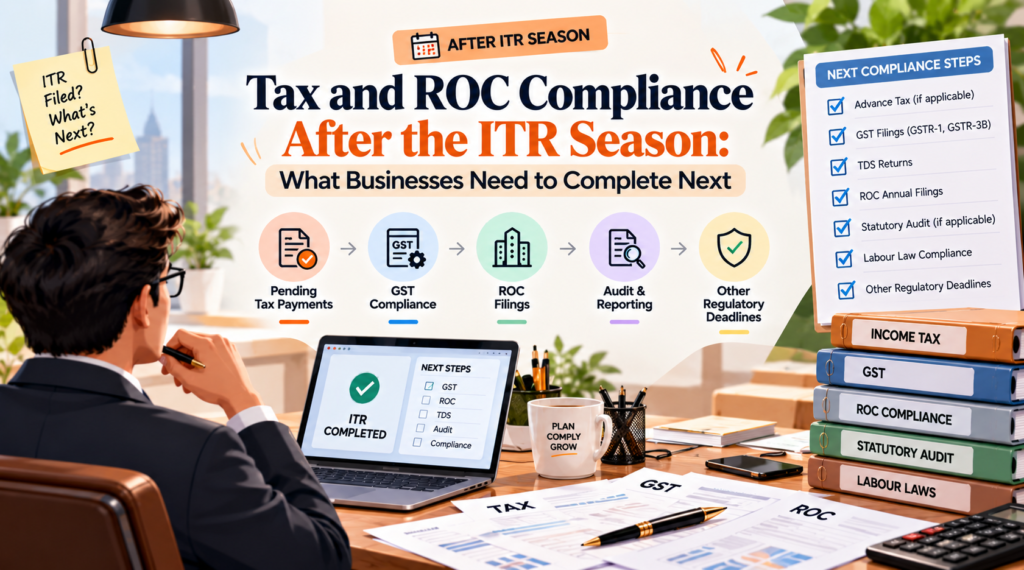
TL;DR For businesses, completing the income-tax return is only one part of the annual compliance cycle. After the ITR season, companies and other businesses may still need to address tax audit requirements, AGM compliance, financial-statement filing, annual returns, TDS reconciliation, GST reconciliation, director-related filings and other ROC obligations. The 2026 compliance cycle is particularly important because the Income-tax Act, 2025 has come into force from 1 April 2026, while tax matters relating to FY 2025–26 continue to be governed by the earlier Income-tax Act, 1961. The Income Tax Department specifically confirms that tax-audit reports for FY 2025–26/AY 2026–27 continue to use the old Act’s prescribed forms even when filed after 1 April 2026. For companies, the next major focus should be completing the AGM and subsequent MCA filings, while keeping tax, GST, TDS and corporate records properly reconciled. ITR Filing Does Not End Business Compliance Many business owners treat the filing of the income-tax return as the final compliance activity of the year. In reality, several obligations can continue after the ITR is filed. Depending on the business structure, the post-ITR period may involve: Tax audit Annual General Meeting Financial-statement filing with ROC Annual return filing TDS reconciliation GST reconciliation Director-related filings Auditor-related compliance Board documentation Statutory registers FEMA or RBI reporting Other industry-specific compliance The exact requirements depend on whether the entity is a private limited company, public company, LLP, partnership firm, proprietorship or another form of business. 1. Check Whether Tax Audit Compliance Is Complete Businesses should first confirm whether their tax-audit obligation has been completed. For FY 2025–26, the Income Tax Department states that the tax-audit report continues to be governed by the Income-tax Act, 1961 because the audit relates to AY 2026–27, even if the report is filed after 1 April 2026. For the relevant FY 2025–26 tax-audit cycle, the Department confirms the applicable thresholds remain: Business turnover exceeding ₹1 crore ₹10 crore threshold where cash receipts and cash payments each do not exceed 5% of the relevant totals Professional receipts exceeding ₹50 lakh Certain taxpayers opting out of presumptive taxation The Department states that the tax-audit report for AY 2026–27 is due on 30 September 2026 in the applicable cases. Businesses should therefore verify whether their audit report has been: Prepared Reviewed Signed Filed Properly retained with supporting records 2. Understand Which Income-Tax Act Applies 2026 requires particular care because there is a transition between two income-tax frameworks. The Income-tax Act, 2025 applies from 1 April 2026. However, transactions and compliance relating to earlier periods do not automatically shift to the new Act. For example, the Income Tax Department confirms that a tax-audit report for FY 2025–26 / AY 2026–27 continues under the Income-tax Act, 1961. Businesses should therefore avoid mixing: FY 2025–26 / AY 2026–27 with Tax Year 2026–27 when preparing compliance documents. This distinction becomes particularly important for tax audits, assessments, notices, carried-forward losses and historical tax matters. 3. Prepare for the Annual General Meeting For companies, the AGM is one of the major compliance events following the financial year-end. The AGM provides the formal platform for matters such as consideration of financial statements, auditor-related matters and other business required under the Companies Act. Before the AGM, companies should review: Financial statements Board’s Report Auditor’s Report Directors’ disclosures AGM notice Attendance records Ordinary business Special business, where applicable Shareholder approvals Minutes and supporting documents The AGM should not be treated as merely a meeting conducted to satisfy a deadline. The company’s underlying records should be ready before the meeting. 4. ROC Filing Comes After the AGM Once the financial statements are adopted and the annual return information is finalised, the company generally needs to complete the applicable ROC filings. Two major annual filings are: AOC-4 AOC-4 is used for filing financial statements and related documents with the Registrar. MCA identifies AOC-4 as the form for filing financial statements and other documents with the Registrar. MGT-7 / MGT-7A The annual return is generally filed in MGT-7, while eligible OPCs and small companies use MGT-7A. MCA’s rules specify that every company files its annual return in MGT-7 except an OPC and small company, which file MGT-7A from FY 2020–21 onwards. The exact filing deadline depends on the applicable provisions and the date of the AGM. 5. Do Not Confuse AOC-4 With MGT-7 This is a common compliance mistake. The two filings serve different purposes. AOC-4: Primarily relates to the company’s financial statements and associated documents. MGT-7 / MGT-7A: Relates to the company’s annual return and corporate information. A company may need to complete both. Therefore, completing one does not automatically mean that the annual ROC compliance cycle is complete. 6. Review Auditor-Related Compliance Companies should also verify their auditor-related records. Depending on the circumstances, businesses may need to review: Auditor appointment Auditor consent Eligibility Appointment documentation ADT-1 compliance, where applicable Auditor’s report Changes in auditor details MCA identifies ADT-1 as the form used for information to the Registrar regarding appointment of an auditor. Companies should ensure that auditor records are consistent across corporate documents and MCA filings. 7. Reconcile TDS Before Closing the Compliance Cycle Even after the ITR is filed, TDS records should be reviewed. Businesses should reconcile: Books → TDS ledger → TDS returns → Form 26AS/AIS → Tax credit Check for: Missing deductions Incorrect PAN Wrong TDS rates Short deduction Excess deduction Incorrect challan details Unmatched TDS credits Vendor disputes A mismatch discovered after ITR filing should not simply be ignored. The business should identify the reason and take the appropriate corrective action. 8. Reconcile GST and Income-Tax Turnover Another important post-ITR exercise is comparing GST turnover with financial statements and income-tax records. Businesses should review: Sales as per books GST turnover GSTR-1 GSTR-3B Annual GST records, where applicable Income-tax turnover Credit notes Debit notes Advances Exempt supplies Export turnover Not every difference is automatically an error. Timing differences, accounting treatment and the nature of supplies can explain legitimate variations. However, material unexplained differences should be investigated and documented. 9. Review