
TL;DR
For businesses, completing the income-tax return is only one part of the annual compliance cycle.
After the ITR season, companies and other businesses may still need to address tax audit requirements, AGM compliance, financial-statement filing, annual returns, TDS reconciliation, GST reconciliation, director-related filings and other ROC obligations.
The 2026 compliance cycle is particularly important because the Income-tax Act, 2025 has come into force from 1 April 2026, while tax matters relating to FY 2025–26 continue to be governed by the earlier Income-tax Act, 1961. The Income Tax Department specifically confirms that tax-audit reports for FY 2025–26/AY 2026–27 continue to use the old Act’s prescribed forms even when filed after 1 April 2026.
For companies, the next major focus should be completing the AGM and subsequent MCA filings, while keeping tax, GST, TDS and corporate records properly reconciled.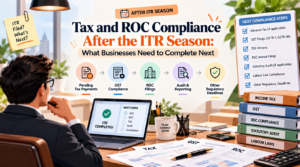
ITR Filing Does Not End Business Compliance
Many business owners treat the filing of the income-tax return as the final compliance activity of the year.
In reality, several obligations can continue after the ITR is filed.
Depending on the business structure, the post-ITR period may involve:
- Tax audit
- Annual General Meeting
- Financial-statement filing with ROC
- Annual return filing
- TDS reconciliation
- GST reconciliation
- Director-related filings
- Auditor-related compliance
- Board documentation
- Statutory registers
- FEMA or RBI reporting
- Other industry-specific compliance
The exact requirements depend on whether the entity is a private limited company, public company, LLP, partnership firm, proprietorship or another form of business.
1. Check Whether Tax Audit Compliance Is Complete
Businesses should first confirm whether their tax-audit obligation has been completed.
For FY 2025–26, the Income Tax Department states that the tax-audit report continues to be governed by the Income-tax Act, 1961 because the audit relates to AY 2026–27, even if the report is filed after 1 April 2026.
For the relevant FY 2025–26 tax-audit cycle, the Department confirms the applicable thresholds remain:
- Business turnover exceeding ₹1 crore
- ₹10 crore threshold where cash receipts and cash payments each do not exceed 5% of the relevant totals
- Professional receipts exceeding ₹50 lakh
- Certain taxpayers opting out of presumptive taxation
The Department states that the tax-audit report for AY 2026–27 is due on 30 September 2026 in the applicable cases.
Businesses should therefore verify whether their audit report has been:
- Prepared
- Reviewed
- Signed
- Filed
- Properly retained with supporting records
2. Understand Which Income-Tax Act Applies
2026 requires particular care because there is a transition between two income-tax frameworks.
The Income-tax Act, 2025 applies from 1 April 2026.
However, transactions and compliance relating to earlier periods do not automatically shift to the new Act.
For example, the Income Tax Department confirms that a tax-audit report for FY 2025–26 / AY 2026–27 continues under the Income-tax Act, 1961.
Businesses should therefore avoid mixing:
FY 2025–26 / AY 2026–27
with
Tax Year 2026–27
when preparing compliance documents.
This distinction becomes particularly important for tax audits, assessments, notices, carried-forward losses and historical tax matters.
3. Prepare for the Annual General Meeting
For companies, the AGM is one of the major compliance events following the financial year-end.
The AGM provides the formal platform for matters such as consideration of financial statements, auditor-related matters and other business required under the Companies Act.
Before the AGM, companies should review:
- Financial statements
- Board’s Report
- Auditor’s Report
- Directors’ disclosures
- AGM notice
- Attendance records
- Ordinary business
- Special business, where applicable
- Shareholder approvals
- Minutes and supporting documents
The AGM should not be treated as merely a meeting conducted to satisfy a deadline.
The company’s underlying records should be ready before the meeting.
4. ROC Filing Comes After the AGM
Once the financial statements are adopted and the annual return information is finalised, the company generally needs to complete the applicable ROC filings.
Two major annual filings are:
AOC-4
AOC-4 is used for filing financial statements and related documents with the Registrar.
MCA identifies AOC-4 as the form for filing financial statements and other documents with the Registrar.
MGT-7 / MGT-7A
The annual return is generally filed in MGT-7, while eligible OPCs and small companies use MGT-7A.
MCA’s rules specify that every company files its annual return in MGT-7 except an OPC and small company, which file MGT-7A from FY 2020–21 onwards.
The exact filing deadline depends on the applicable provisions and the date of the AGM.
5. Do Not Confuse AOC-4 With MGT-7
This is a common compliance mistake.
The two filings serve different purposes.
AOC-4:
Primarily relates to the company’s financial statements and associated documents.
MGT-7 / MGT-7A:
Relates to the company’s annual return and corporate information.
A company may need to complete both.
Therefore, completing one does not automatically mean that the annual ROC compliance cycle is complete.
6. Review Auditor-Related Compliance
Companies should also verify their auditor-related records.
Depending on the circumstances, businesses may need to review:
- Auditor appointment
- Auditor consent
- Eligibility
- Appointment documentation
- ADT-1 compliance, where applicable
- Auditor’s report
- Changes in auditor details
MCA identifies ADT-1 as the form used for information to the Registrar regarding appointment of an auditor.
Companies should ensure that auditor records are consistent across corporate documents and MCA filings.
7. Reconcile TDS Before Closing the Compliance Cycle
Even after the ITR is filed, TDS records should be reviewed.
Businesses should reconcile:
Books → TDS ledger → TDS returns → Form 26AS/AIS → Tax credit
Check for:
- Missing deductions
- Incorrect PAN
- Wrong TDS rates
- Short deduction
- Excess deduction
- Incorrect challan details
- Unmatched TDS credits
- Vendor disputes
A mismatch discovered after ITR filing should not simply be ignored.
The business should identify the reason and take the appropriate corrective action.
8. Reconcile GST and Income-Tax Turnover
Another important post-ITR exercise is comparing GST turnover with financial statements and income-tax records.
Businesses should review:
- Sales as per books
- GST turnover
- GSTR-1
- GSTR-3B
- Annual GST records, where applicable
- Income-tax turnover
- Credit notes
- Debit notes
- Advances
- Exempt supplies
- Export turnover
Not every difference is automatically an error.
Timing differences, accounting treatment and the nature of supplies can explain legitimate variations.
However, material unexplained differences should be investigated and documented.
9. Review Outstanding GST Compliance
The business should also check whether any GST-related obligations remain pending.
Depending on the taxpayer, this can include:
- GSTR-1
- GSTR-3B
- GSTR-9
- GSTR-9C, where applicable
- ITC reconciliation
- GST payments
- Refund applications
- Notices
- Demand orders
- LUT-related compliance
- E-invoice compliance
A business should not assume that filing its income-tax return resolves GST compliance.
The two systems operate separately and require separate reconciliation.
10. Review TDS and Vendor Compliance
Businesses should review their major vendors and service providers.
Particular attention may be required for:
- Contractors
- Professionals
- Rent payments
- Commission
- Interest
- Technical services
- Other specified payments
The accounting team should verify whether TDS was correctly deducted and deposited wherever applicable.
Vendor ledgers should also be reconciled before the books are finally closed.
11. Check Director and Company Information
After completing the major tax filing work, companies should review whether their corporate information is still accurate.
Check:
- Directors
- DIN status
- Registered office
- Email ID
- Phone number
- Shareholding
- KMP details
- Auditor details
- Charges
- Beneficial ownership information, where applicable
Any changes that occurred during the year may require separate MCA filings.
12. Review Charges and Loans
Companies with bank finance or secured loans should review their charge-related records.
Check whether:
- New charges were created
- Existing charges were modified
- Loans were repaid
- Charges were satisfied
- MCA records match bank documentation
MCA identifies CHG-1 for registration of creation or modification of specified charges and related charge forms for other situations.
A mismatch between bank records and MCA records should be investigated.
13. Check Board Resolutions and Statutory Registers
Annual compliance is not limited to online filings.
Companies should also ensure that internal corporate records are maintained.
These can include:
- Minutes
- Board resolutions
- AGM minutes
- Register of members
- Register of directors
- Share-transfer records
- Share certificates
- Related-party records
- Loan and investment records
- Other statutory registers
The company should be able to support information reported through its MCA filings with underlying corporate documentation.
14. Review Related-Party Transactions
Businesses should review transactions with:
- Directors
- Promoters
- Group companies
- Related entities
- Key management personnel
- Entities controlled by directors or promoters
Check whether relevant approvals, disclosures, accounting treatment and documentation have been completed.
This becomes particularly important where the business has:
- Loans to related parties
- Purchases
- Sales
- Professional fees
- Rent
- Guarantees
- Common expenses
- Inter-company transactions
15. Check FEMA and Foreign-Investment Compliance
Businesses with foreign shareholders or overseas investments should also review FEMA-related obligations.
Depending on the company’s structure and transactions, this can include:
- FDI reporting
- FLA return
- ODI reporting
- Foreign remittances
- Share transfers
- Foreign investment records
- Other RBI reporting
These requirements are separate from income-tax and ROC compliance.
Therefore, a company with foreign investment should maintain a separate FEMA compliance tracker.
16. Review Tax Notices and Outstanding Demands
After filing the ITR, businesses should continue monitoring the income-tax portal.
Check for:
- Notices
- Intimations
- Outstanding demands
- Refund issues
- Rectification requirements
- Assessment proceedings
- Reassessment-related communications
- TDS mismatches
Filing the return does not mean the taxpayer should stop monitoring the portal.
Businesses should also maintain records of responses submitted to the department.
17. Prepare for the Next Compliance Cycle
The post-ITR period is also a good time to improve internal processes.
Businesses should establish a compliance calendar covering:
| Compliance Area | What to Track |
|---|---|
| Income Tax | Returns, advance tax, notices |
| Tax Audit | Audit report and documentation |
| GST | Returns, payments, reconciliation |
| TDS | Deduction, payment and returns |
| ROC | AGM, AOC-4, MGT-7/MGT-7A |
| MCA | Director, charge and event-based filings |
| FEMA | FDI, ODI and FLA requirements |
| Accounting | Books, ledgers and reconciliations |
A central calendar can prevent multiple departments from working with different deadlines.
Common Mistakes Businesses Make After ITR Filing
Mistake 1: Assuming ITR Filing Completes Annual Compliance
Tax return filing is only one part of the overall compliance cycle.
Mistake 2: Forgetting ROC Filings
Companies may complete tax work but delay AOC-4 or annual-return compliance.
Mistake 3: Not Preparing for the AGM
Financial statements and supporting documents should be ready well before the meeting.
Mistake 4: Ignoring TDS Mismatches
TDS errors can affect both the business and its vendors.
Mistake 5: Not Reconciling GST and Books
Differences should be investigated instead of being carried forward without explanation.
Mistake 6: Mixing Old and New Income-Tax Frameworks
The 2026 transition requires businesses to identify the correct law applicable to each tax period.
Mistake 7: Ignoring Corporate Records
MCA filings should be supported by properly maintained company records.
Mistake 8: Waiting Until the Last Date
Last-minute compliance increases the risk of missing documents, DSC issues, validation errors and filing delays.
Post-ITR Business Compliance Checklist
Businesses can use this checklist after completing their ITR work:
- ITR filing status verified
- Tax audit status checked
- Tax demand/refund checked
- TDS reconciliation completed
- GST reconciliation completed
- Pending GST returns reviewed
- AGM preparation started
- Financial statements finalised
- Board’s Report reviewed
- Auditor records checked
- AOC-4 applicability checked
- MGT-7/MGT-7A applicability checked
- Director information reviewed
- Registered office details checked
- Charges reviewed
- Statutory registers updated
- Related-party transactions reviewed
- FEMA obligations checked
- Compliance calendar updated
How a Chartered Accountant Can Help
Post-ITR compliance can involve several different regulatory systems.
A Chartered Accountant can help businesses coordinate:
- Income-tax compliance
- Tax audit
- GST reconciliation
- TDS compliance
- ROC annual filings
- AGM documentation
- Accounting review
- Corporate compliance
- FEMA reporting
- Tax notices
- Financial reporting
For growing businesses, integrating these activities into one compliance calendar can reduce duplication and make it easier to identify inconsistencies between financial statements, tax returns and statutory filings.
Final Takeaway
Filing the income-tax return should be treated as one milestone, not the end of business compliance.
For companies, the period after the ITR season can involve AGM preparation, financial-statement filing, annual-return filing, auditor compliance and other ROC requirements. At the same time, businesses should reconcile TDS, GST and accounting records and review any outstanding tax or regulatory matters.
The 2026 transition between the Income-tax Act, 1961 and the Income-tax Act, 2025 makes period-specific compliance particularly important. The Income Tax Department confirms that FY 2025–26 tax-audit reporting remains under the old Act, while the new framework applies to Tax Year 2026–27.
The practical approach is simple: close the tax year, complete corporate filings, reconcile statutory records and prepare the next compliance cycle before deadlines become urgent.
FAQs
1. Is ITR filing the final compliance requirement for a company?
No. Companies can have several additional obligations, including AGM compliance, ROC filings, GST, TDS, tax audit and other statutory requirements.
2. What ROC filings are commonly required after the AGM?
Depending on the company, annual financial statements are generally filed through the applicable AOC-4 form, while the annual return is filed through MGT-7 or MGT-7A for eligible OPCs and small companies.
3. What is the difference between AOC-4 and MGT-7?
AOC-4 relates primarily to filing financial statements and associated documents, while MGT-7/MGT-7A relates to the company’s annual return.
4. Does the Income-tax Act, 2025 apply to FY 2025–26?
The Income Tax Department has clarified that FY 2025–26 / AY 2026–27 compliance remains governed by the Income-tax Act, 1961. The new Act applies from 1 April 2026 for the new tax framework.
5. What should businesses reconcile after ITR filing?
Businesses should consider reconciling books with TDS records, GST returns, bank statements, tax credits, financial statements and other statutory records.
6. Do companies need to prepare for the AGM after completing tax filing?
Yes. Companies should separately prepare the financial statements, reports, notices and other documents required for their AGM under the Companies Act.
7. Should businesses check tax notices after filing the ITR?
Yes. Filing the ITR does not eliminate the possibility of receiving an income-tax communication, demand, notice or other proceeding.
8. What should a company do if its MCA records contain outdated information?
The company should identify the nature of the change and determine whether an applicable MCA form or other corrective filing is required.