
TL;DR
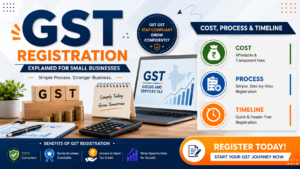
If you operate a business in India, GST registration may be mandatory depending on your turnover, business model, or interstate operations. While government GST registration itself is generally free, businesses often incur professional fees for documentation, filing, and compliance support. Most GST registrations are approved within 7–15 working days when documents are accurate and complete.
This guide explains:
- GST registration cost
- Eligibility requirements
- Required documents
- Registration process
- Timeline expectations
- Common mistakes to avoid
What Is GST Registration?
Goods and Services Tax (GST) is India’s unified indirect tax system that replaced multiple state and central taxes. Businesses that meet specific eligibility criteria must register under GST and obtain a unique GST Identification Number (GSTIN).
GST registration allows businesses to:
- Collect GST from customers
- Claim Input Tax Credit (ITC)
- Conduct interstate business legally
- Participate in government tenders
- Improve business credibility
For many startups and growing businesses, GST registration is not just a compliance requirement—it is a growth enabler.
Who Needs GST Registration in India?
Many business owners assume GST registration is required only after crossing a turnover threshold. While turnover is important, several other factors trigger mandatory registration.
GST Registration Is Mandatory If:
| Criteria | Registration Required |
|---|---|
| Interstate supply of goods | Yes |
| E-commerce seller | Yes |
| Casual taxable person | Yes |
| Input service distributor | Yes |
| Reverse charge applicability | Yes |
| Certain notified businesses | Yes |
Turnover-Based GST Registration
For Goods Suppliers
Businesses exceeding prescribed turnover limits under GST regulations must register.
For Service Providers
Service providers crossing applicable turnover thresholds must obtain GST registration.
Even if registration is not mandatory, voluntary registration can offer significant advantages.
Benefits of GST Registration for Small Businesses
Many small business owners view GST purely as a compliance burden. In reality, GST registration provides several strategic benefits.
1. Input Tax Credit Benefits
Registered businesses can claim credit on GST paid for:
- Office rent
- Equipment purchases
- Professional services
- Software subscriptions
- Business supplies
This reduces the overall tax burden significantly.
2. Increased Business Credibility
Customers, suppliers, and corporate clients often prefer working with GST-registered businesses because it reflects compliance and professionalism.
3. Expansion Opportunities
GST registration allows businesses to:
- Sell across India
- Partner with large corporations
- Join e-commerce marketplaces
- Participate in tenders
4. Easier Business Financing
Banks and financial institutions often evaluate GST filings while assessing business loan applications.
Regular GST compliance demonstrates financial discipline and transparency.
GST Registration Cost Explained
One of the most common questions entrepreneurs ask is:
“How much does GST registration cost?”
Government GST Registration Fee
The GST portal does not charge a government fee for standard GST registration.
Government Cost: ₹0
However, this does not mean businesses incur no expenses.
Professional Fees
Most businesses hire Chartered Accountants or GST consultants because documentation errors frequently cause delays or rejections.
Professional fees generally vary depending on:
- Business structure
- Documentation complexity
- Additional registrations
- Advisory requirements
- State-specific compliance needs
Typical Cost Components
| Expense | Approximate Cost |
|---|---|
| GST Registration Filing | Professional Fee Based |
| Documentation Support | Variable |
| GST Advisory | Variable |
| Compliance Setup | Variable |
| Post-Registration Assistance | Variable |
Businesses should focus on accuracy rather than choosing the lowest-cost service provider.
A registration error can cost significantly more than professional assistance.
Documents Required for GST Registration
Proper documentation is the most important factor in obtaining quick approval.
For Proprietorship Firms
Required documents typically include:
- PAN Card
- Aadhaar Card
- Passport-size photograph
- Mobile number
- Email address
- Business address proof
- Bank account details
For Companies and LLPs
Additional documents include:
- Certificate of Incorporation
- PAN of entity
- Board Resolution
- Authorization Letter
- Director KYC documents
Address Proof Documents
Accepted documents generally include:
- Electricity bill
- Property tax receipt
- Rent agreement
- NOC from owner
Ensure all documents are current and consistent.
Even small discrepancies can trigger clarification notices.
Step-by-Step GST Registration Process
Step 1: Gather Documentation
Collect all required documents before beginning the application.
Verify:
- Names match PAN records
- Addresses are accurate
- Mobile and email details are active
Step 2: Create GST Application
The application is submitted through the GST registration portal.
Information required includes:
- Business details
- Promoter information
- Business activities
- Bank information
- Authorized signatory details
Step 3: Upload Supporting Documents
Upload scanned copies of all supporting documents.
Ensure:
- Clear image quality
- Correct file formats
- Proper document categorization
Step 4: Verification Through OTP
Verification is completed using:
- Aadhaar authentication
- OTP validation
- Electronic verification methods
Step 5: Application Review
GST authorities review submitted information.
They may:
- Approve registration
- Seek clarification
- Request additional documents
Step 6: GSTIN Allocation
Upon approval, the business receives:
- GSTIN
- Registration Certificate
- Access to GST compliance activities
How Long Does GST Registration Take?
The timeline depends largely on documentation quality.
Standard GST Registration Timeline
| Stage | Expected Duration |
|---|---|
| Application Submission | 1 Day |
| Verification | 1–3 Days |
| Officer Review | 3–7 Days |
| Approval & GSTIN Issuance | 1–5 Days |
Average Total Timeline
7–15 Working Days
When documentation is complete and accurate, approval can occur even faster.
Factors That Delay GST Registration
Common reasons include:
- Incorrect PAN details
- Address mismatch
- Invalid documents
- Poor-quality uploads
- Aadhaar verification issues
- Missing NOC documents
Working with an experienced Chartered Accountant helps avoid these delays.
Common Reasons GST Applications Get Rejected
Understanding rejection reasons can save valuable time.
Frequent Mistakes
- Wrong business activity selection
- Incomplete address proof
- Incorrect legal name
- Missing authorization documents
- Invalid bank details
- Inconsistent information across documents
Most rejections are preventable through proper preparation and professional review.
GST Compliance After Registration
Obtaining a GSTIN is only the beginning. Once registered, businesses must comply with ongoing GST requirements to avoid penalties, interest, and notices from tax authorities.
Key GST Compliance Requirements
1. Timely GST Return Filing
Depending on the business type and turnover, registered taxpayers may need to file:
- GSTR-1 (Outward supplies)
- GSTR-3B (Monthly/Quarterly summary return)
- Annual GST Return
- Other applicable GST forms
Even if there are no transactions during a period, certain returns may still need to be filed.
2. Maintaining Proper Records
Businesses should maintain:
- Sales invoices
- Purchase invoices
- E-way bills
- Credit notes
- Debit notes
- Input Tax Credit records
- GST payment records
Proper recordkeeping helps during assessments and audits.
3. Accurate Input Tax Credit (ITC) Claims
Incorrect ITC claims are among the most common reasons businesses receive GST notices.
Before claiming ITC:
- Verify supplier GST compliance
- Match invoices correctly
- Ensure business-use eligibility
- Reconcile purchase records regularly
4. GST Invoice Compliance
Every GST invoice should contain:
- GSTIN
- Invoice number
- Date
- Customer details
- Tax rate
- Tax amount
- Place of supply (where applicable)
Improper invoicing can lead to compliance complications.
Why Professional GST Assistance Matters
Many entrepreneurs initially attempt GST registration independently. While the online process appears straightforward, mistakes can create long-term compliance issues.
Benefits of Working With a Chartered Accountant
Expert Eligibility Assessment
A Chartered Accountant can determine:
- Whether registration is mandatory
- Appropriate business classification
- Tax implications
- Compliance obligations
Error-Free Documentation
Professional review helps avoid:
- Rejections
- Clarification notices
- Delays
- Data inconsistencies
Faster Registration
Experienced professionals understand documentation standards and filing requirements, reducing approval delays.
Post-Registration Compliance Support
A good GST advisor provides support for:
- GST returns
- ITC reconciliation
- Compliance reviews
- Notice handling
- Tax planning
Business Growth Support
Beyond registration, Chartered Accountants help businesses with:
- Accounting systems
- Financial reporting
- Tax optimization
- Regulatory compliance
- Strategic growth planning
For startups and SMEs in Pune, partnering with an experienced CA firm often results in significant time savings and reduced compliance risk.
Conclusion
GST registration is one of the most important milestones for any growing business in India. While the government registration process is generally free, businesses should focus on accurate documentation, compliance readiness, and long-term tax efficiency rather than simply minimizing upfront costs.
For small businesses, startups, freelancers, and SMEs, GST registration provides:
- Legal compliance
- Input Tax Credit benefits
- Greater business credibility
- Expansion opportunities
- Better financing prospects
The registration process typically takes between 7 and 15 working days when documentation is complete and accurate. However, mistakes in filing, documentation, or compliance can result in delays, notices, and penalties.
Working with experienced professionals helps ensure a smooth registration process while setting up your business for long-term compliance and growth.
6. FAQ SECTION
1. Is GST registration free in India?
Answer: GST registration on the official GST portal is generally free. However, businesses often incur professional service fees when hiring a Chartered Accountant or GST consultant to assist with documentation, filing, and compliance setup.
2. How many days does GST registration take?
Answer: The timeline depends on document accuracy, Aadhaar authentication, officer verification, and whether additional clarification is requested by the GST department.
3. Is GST registration mandatory for small businesses?
Answer: Certain businesses must register regardless of turnover, such as e-commerce sellers and interstate suppliers. Others may need registration after crossing applicable turnover thresholds.
4. What documents are required for GST registration?
Answer: Documentation requirements vary by business structure. Companies and LLPs may require incorporation certificates, board resolutions, and director KYC documents in addition to basic identity and address proofs.
5. Can I apply for GST registration online?
Answer: GST registration is completed online through the GST portal. Applicants can submit forms, upload documents, complete Aadhaar authentication, and receive GSTIN electronically.
6. What happens if I don’t register under GST?
Answer: Failure to register when legally required can lead to penalties, tax liabilities, interest charges, and restrictions on claiming Input Tax Credit.
7. Can I claim Input Tax Credit immediately after GST registration?
Answer: Registered businesses can generally claim eligible ITC on business-related purchases, provided suppliers comply with GST requirements and documentation is maintained correctly.
8. Why should I hire a Chartered Accountant for GST registration?
Answer: A Chartered Accountant helps with eligibility assessment, documentation review, registration filing, compliance setup, and post-registration GST management, reducing the risk of notices and penalties.