
From 1961 to 2025: Understanding TDS Obligations During Transition

Introduction The transition from the Income-tax Act, 1961 to the Income-tax Act, 2025 marks a significant shift in how tax deduction at source (TDS) obligations are governed. For deductors, the key lies in understanding the timing of credit or payment, as this determines which Act applies. While the substantive provisions such as rates and thresholds remain unchanged, the transition introduces new section references, reporting requirements, and compliance adjustments. This blog addresses common queries around the transition, ensuring clarity for professionals handling contracts, payments, and system updates during FY 2026–27. A. OBLIGATION TO DEDUCT — TRANSITION 1. What is the fundamental rule for determining which Act governs TDS obligations during the transition? Ans. The Act governing TDS depends on when the “earlier of the event of credit or payment” occurs. If the earlier event occurs on or before 31st March, 2026, the Income-tax Act, 1961 will be applicable. However, if the earlier event occurs on or after 1st April, 2026, the provisions of the Income-tax Act, 2025 shall be applicable. Example: Professional fees credited in March, 2026 in books. However, payment is made in April, 2026. In this situation, provisions of the Income-Tax Act, 1961 will be applicable and TDS must be deducted in March, 2026. Advance payment made in March, 2026. However, it is credited in books in April, 2026. In this situation, provisions of the Income-tax Act, 1961 will be applicable and TDS must be deducted in March, 2026. 2. If a deductor has an ongoing contract with monthly payments, how does the deductor handle the switch from the old Act to the new Act? Ans. The deductor applies the old Act for all payments/credits up to and including 31st March, 2026, and will apply the new Act for payments/credits from 1st April, 2026 onwards. There is no need to amend the contract merely because the new Act is commencing on 1st April, 2026. The deductor is required to apply the applicable TDS provision based on the date of credit or payment, whichever is earlier. Example: M/s. XYZ Ltd. has a monthly housekeeping contract with M/s. ABC Cleaning Services. Payments for March 2026 (credited on 31.03.2026) → TDS obligation shall be under Section 194C of old Act. Payment for April 2026 (credited on 30.04.2026) → TDS obligations shall be under Section 393(1) [Table: Sl. No. 6(i)] of the new Act. Rates and thresholds remain the same under both the Acts. 3. Has there been any change in the rates of TDS under the new Act? Ans. No. The TDS rates and monetary thresholds for all categories of payments have been retained as they are under the Income-tax Act, 1961. The consolidation of TDS provisions under Section 393 is a simplified tabular presentation and not a change in TDS rates or tax policy. 4. What happens if a deductor erroneously deducts TDS quoting the old Act section number for a payment made after 01.04.2026? Ans. Although the substantive provisions—such as the applicable rate and threshold—remain unchanged, citing the old section number (for example, Section 194C instead of Section 393(1) [Table: Sl. No. 6(i)]) may lead to processing errors at the time of filing the TDS return. In such cases, the deductor may be required to submit a correction statement to rectify the section reference. 5. A company makes payment to a contractor on 28 March 2026. Which Act governs TDS in this situation? Ans. The TDS provisions of the Income-tax Act, 1961 shall apply, since the triggering event—being the payment or credit of income, whichever is earlier—occurred prior to 1 April 2026. The commencement of the Income-tax Act, 2025 does not affect liabilities or obligations that arose under the 1961 Act in respect of tax years beginning before 1st April, 2026. 6. Interest income is credited in the account of payee on 31 March 2026 but paid in April 2026. Which Act will govern the TDS on such interest payments? Ans. The TDS provisions of the Income-tax Act, 1961 shall apply, since the triggering event—being the payment or credit of income, whichever is earlier—occurred prior to 1 April 2026. The subsequent date of deposit of TDS or payment of interest does not alter the governing law once the triggering event has occurred. 7. Are tax deductors required to modify their ERP and payroll systems after commencement of Income Tax Act, 2025? Ans. Yes. Systems are required to be updated to reflect new section numbering, terminology, and reporting requirements under the Income Tax Act, 2025. B. DEPOSIT OF TDS — TIMELINES AND COMPLIANCE 8. What are the due dates for depositing TDS with the Government during the transition year i.e. FY 2026-27? Ans. The due dates for depositing the TDS for non-government deductors remain the same under both the Acts. For the transition phase, the due dates for depositing TDS are tabulated as under: Non-Government Deductors January 2026 to February 2026 → 7th of next month (IT Act, 1961 – Rule 30) March 2026 → 30th April, 2026 (IT Act, 1961 – Rule 30) April 2026 onwards → 7th of next month (IT Act, 2025 – Rule 218 of Income-tax Rules, 2026) Government Deductors January 2026 to February 2026 → 7th of next month (with challan) / Same Day (without challan) (IT Act, 1961 – Rule 30) March 2026 → 7th April, 2026 (with challan) / Same Day (without challan) (IT Act, 1961 – Rule 30) April 2026 onwards → 7th of next month (with challan) / Same Day (without challan) (IT Act, 2025 – Rule 218 of Income-tax Rules, 2026) Challan-cum-TDS statement (Form 26QB /26QC /26QD/ 26QE under the old Act): Due date of depositing TDS is 30 days from end of month in which TDS was made. These due dates remain same in the new Act. 9. If tax was deducted in March 2026 but the deposit is made in May 2026, will there be a late deposit consequence? Ans. Yes. The due date for depositing the tax deducted in the month of March 2026 is 30th April,
Rule 14A – CGST Rules, 2017, a Simplified GST Registration Scheme

In pursuance of Rule 14A of the Central Goods and Services Tax (CGST) Rules, 2017, a Simplified GST Registration Scheme has been introduced in Nov 2025 to reduce the compliance burden and enhance the ease of doing business for small taxpayers. As per Rule 14A (Option for taxpayers having a monthly output tax liability below the prescribed threshold limit), any person who, on his own assessment, feels that his total output tax liability on the supply of goods or services, or both, to registered persons will not exceed Rs.2.5 lakh per month (including CGST, SGST/UTGST, IGST, and Compensation Cess) shall be eligible to register under this scheme. However, a person registered under this rule in a State or Union Territory shall not be eligible to obtain another registration in the same State or Union Territory under this rule against the same PAN. Key Features Implemented on the GST Portal: While applying for registration in FORM GST REG-01, applicants should select “Yes” under the “Option for Registration under Rule 14A.” in Business detail page The remaining parts of FORM GST REG-01 are identical to those used for regular registration. Aadhaar authentication is mandatory for the Primary Authorized Signatory and at least one Promoter/Partner. Registration shall be granted electronically within three working days from the date of generation of the Application Reference Number (ARN), subject to successful Aadhaar authentication. As this simplified GST registration comes with the condition of output tax liability not exceeding Rs.2.5 lakh per month, a facility to withdraw from registration under Rule 14A is provided for taxpayers who become ineligible to continue under the scheme i s provided which is outlined below. 1. Who can apply for OPT OUT Active Taxpayers who are registered under Rule 14A, may apply for OPT OUT in accordance with the provisions of the law. 2. How to apply on the GST Portal After login, navigate to: Services -> Registration -> Application for Withdrawal from Rule 14A The link will be visible only if the taxpayer is registered under Rule 14A and is active. The field “Option for registration under Rule 14A” will be selected as “No” by default. Enter “Reason for withdrawal from Rule 14A”. Proceed to Aadhaar Authentication tab for Aadhaar Authentication of Primary Authorised Signatory and one Promoter/Partner. 3. Key pre-conditions The registered person shall not be allowed to file Form GST REG-32 unless he has furnished, (a) returns for a period of minimum three months, if Form GST REG-32 is filed before 1st April, 2026; (b) returns for a period of minimum one tax period, if Form GST REG-32 is filed on or after 1st April, 2026; (c) all the returns due for the period from the effective date of registration till the date of filing of Form GST REG-32. (d) No amendment or cancellation application for registration availed under rule 14A should be pending. (e) No proceedings under Section 29 (cancellation of registration) for registration availed under rule 14A should be initiated or pending. 4. Aadhaar authentication Based on data analysis, the taxpayer will have to undergo either OTP based Aadhaar authentication or Biometric based Aadhaar Authentication. Authentication is required for: Primary Authorised Signatory (mandatory), and At least one Promoter/Partner (where applicable). ARN will be generated only after successful Aadhaar authentication. 5. Important timelines Draft application must be submitted within 15 days of creation. Aadhaar/Biometric authentication must be completed within 15 days from submission. If authentication is not completed within the prescribed time, ARN will not be generated. 6. Restrictions during processing While Form GST REG-32 is pending after submission, Taxpayer cannot file Core amendment, noncore amendment and Self-cancellation application. 7. Post-Sanction of Opt-Out The taxpayer who has received an order in Form GST REG-33 allowing withdrawal shall be able to furnish the details of output tax liability on supply of goods or services or both made to registered persons, exceeding the output tax liability of Rs.2.5 lakhs, from the first day of succeeding month in which the said order has been issued. 📌 Conclusion The Simplified GST Registration Scheme Rule 14A of the Central Goods and Services Tax (CGST) Rules, 2017 provides significant relief to small taxpayer from the time-consuming procedure involved in regular GST registration and enabling registration in 3 days. Additionally, the scheme provides flexibility through an easy opt-out mechanism, allowing taxpayers to smoothly transition to the regular GST framework as their business grows and they become ineligible to continue under the simplified scheme. Blog By : Mittal & Co.
ITR 1 to 4 Changes for FY 2025-26 (AY 2026-27)- applicable for Individuals and HUFs
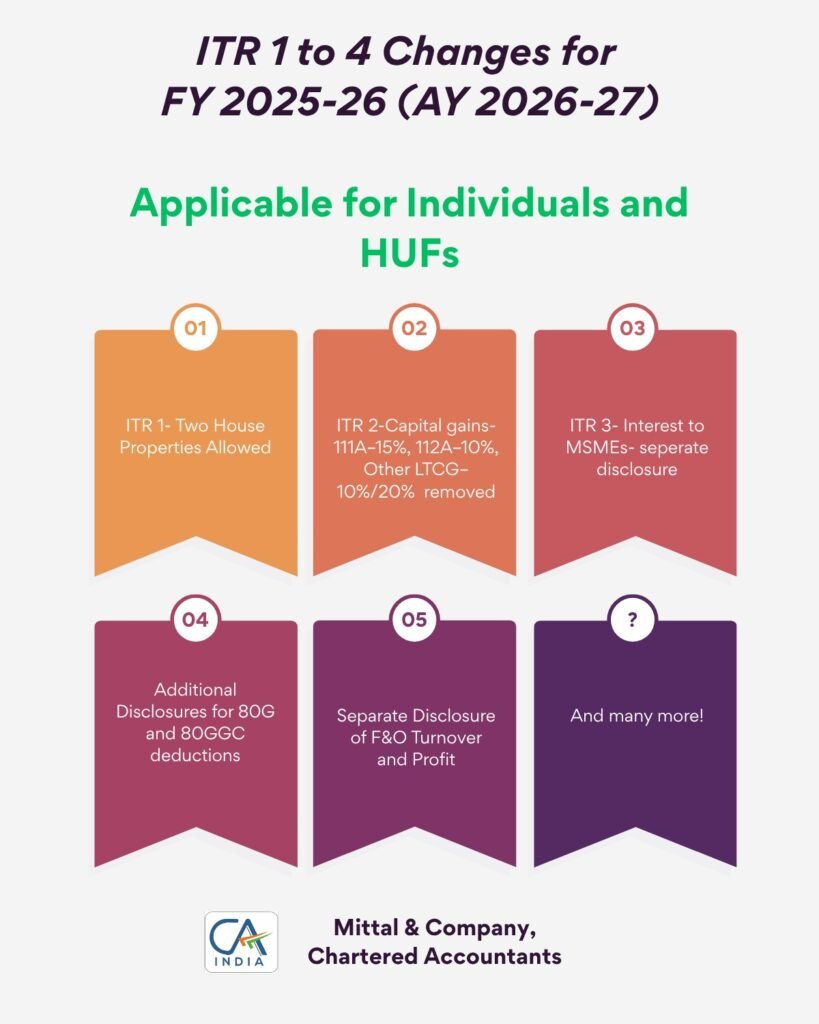
The Income Tax Return (ITR) forms for AY 2026-27 have been significantly revised by the Central Board of Direct Taxes (CBDT). These changes are not just cosmetic; they reflect deeper compliance requirements, expanded disclosure norms, and alignment with evolving tax provisions. In this blog, we’ll explore the updates in ITR 1, ITR 2, ITR 3, and ITR 4, with explanations wherever necessary, so taxpayers and professionals can better understand the implications. 🏠 ITR 1 (Sahaj) ITR 1 is the simplest form, meant for salaried individuals, pensioners, and those with limited income sources. However, FY 2025-26 brings notable changes: 1. Secondary Address & Contact Details Taxpayers must now provide a secondary address along with secondary mobile and email IDs. This ensures better communication and helps the tax department track multiple residences (office, residential, or filing address). 2. Representative Assessee Details If the return is filed by a representative assessee (for example, in case of minors, deceased taxpayers, or incapacitated individuals), their name, email, and contact number must be disclosed. This adds accountability and transparency. 3 . Two House Properties Allowed Previously, ITR 1 permitted reporting of only one house property. Now, taxpayers can report two house properties. This is a major relaxation, as many individuals own more than one property. 4. Detailed House Property Reporting Taxpayers must provide complete details such as: Property address Tenant details (PAN/Aadhaar mandatory if TDS claimed) Housing loan interest Co-ownership share This ensures accurate computation of income/loss under the head “House Property.” 📈 ITR 2 ITR 2 is used by individuals and HUFs not having income from business or profession. The changes are substantial: 1. Capital Gains Schedule Simplified Questions related to sale dates before 23rd July 2025 have been removed, as they are no longer relevant. Older tax rates such as 111A–15%, 112A–10%, Other LTCG–10%/20% have been removed. This aligns with updated tax provisions where only current applicable rates remain. 2. New Income Section for Non-Residents Section 115A(1)(a)(iiaa) introduced: Income received by non-residents as referred in the second proviso to section 194LC(1). Tax rate: 9%. Applicability: This covers specific interest income received by non-residents from certain borrowings. 3. Additional Reporting for Deductions 80G (Donations): Taxpayers must now provide transaction reference numbers (UPI/Cheque/IMPS/NEFT/RTGS) and IFSC codes. This ensures traceability of donations. 80GGC (Political Contributions): Name and PAN of the political party must be disclosed. This strengthens transparency in political funding. 💼 ITR 3 ITR 3 is for individuals and HUFs having income from profits and gains of business or profession. The changes here are extensive and technical. 1. MSME Act Reporting Interest disallowable under section 23 of the Micro, Small and Medium Enterprises Development Act, 2006 must be reported separately. Explanation: Section 23 disallows interest payable beyond the prescribed period to MSMEs. By mandating disclosure, the government ensures compliance with MSME payment norms. 2. Business/Profession Updates Section 44BBD added. Description: Section 44BBD deals with presumptive taxation for income of foreign companies from services in connection with exploration of mineral oils. Applicability: Non-resident companies providing services or facilities in connection with prospecting/exploration of mineral oils can declare income on a presumptive basis (10% of gross receipts). Impact: Indian entities engaging foreign service providers must ensure proper reporting under this section. 3. Simplified Tax Audit Applicability Questions related to tax audit applicability based on turnover have been simplified. This reduces confusion for businesses hovering around audit thresholds. 1. Manufacturing & Trading Account Turnover and income from Futures and Options (F&O) must be disclosed separately. Explanation: F&O transactions are considered business income. Separate disclosure ensures clarity in speculative vs. non-speculative income. 2. Profit & Loss Account Enhancements Presumptive income of non-residents under sections 44B, 44BB, 44BBA, 44BBC, 44BBD must be disclosed separately. Income credited to P&L but not chargeable to tax must also be shown separately. 3. Deductions & Exemption More disability categories added under 80DD & 80U. State Sikkim included under section 80IE (tax holiday for certain undertakings). 4. Income from Firms Interest and remuneration received from firms must be disclosed separately. 📊 ITR 4 (Sugam) ITR 4 is for individuals, HUFs, and firms (other than LLPs) opting for presumptive taxation under sections 44AD, 44ADA, or 44AE. The changes are focused on financial particulars and tax regime choices. Financial Particulars Investments must now be shown separately in the financial details section. This ensures better visibility of asset holdings. Tax Regime Switching (Form 10IEA) Questions have been updated to accommodate cases where taxpayers re-opt into the new regime after previously choosing the old regime. Explanation: Section 115BAC allows taxpayers to choose between old and new regimes. Form 10IEA is used to opt out of the new regime. The updated questions ensure proper disclosure when taxpayers switch regimes multiple times. ✨ Key Takeaways ITR 1: Expanded to allow two house properties, with detailed reporting of tenants and loans. ITR 2: Simplified capital gains schedules, new non-resident income section, and stricter donation reporting. ITR 3: Major compliance updates including MSME Act disclosures, presumptive taxation under 44BBD, F&O reporting, and expanded deductions. ITR 4: Investments must be separately reported, and regime-switching disclosures refined. 📌 Conclusion The changes across ITR 1–4 for AY 2026-27 reflect the government’s push for greater transparency, accountability, and alignment with evolving tax laws. Taxpayers must be prepared for more detailed disclosures, especially in areas like house property, capital gains, MSME payments, and presumptive taxation. For professionals, these updates mean more diligence in preparing returns, verifying supporting documents, and ensuring compliance with new reporting norms. For taxpayers, it’s a reminder that even “simpler” forms like ITR 1 and ITR 4 now demand comprehensive information. Blog By – Mittal & Co.
Buying a House in FY 2026-27? File TDS with New Form 141 instead of old Form 26QB!

🏠 Introduction Buying a new house? Starting 01 April 2026, the Income Tax Department has introduced Form 141 as a consolidated challan-cum-statement for TDS reporting. This replaces Form 26QB, which was earlier applicable for property transactions. Now, all PAN-based TDS reporting is streamlined under Form 141. 📄 What is Form 141? Form 141 is a unified challan-cum-statement introduced under the Income Tax Act, 2025. If agreement/ payment date is on or before 31st March, 2026, old Form 26QB is applicable. Form 141 is applicable for transaction date on or after 01st April, 2026. It consolidates earlier forms (26QB, 26QC, 26QD, 26QE). It has following annexures: Schedule A: TDS on rent paid by an Individual/HUF Schedule B: TDS on transfer of immovable property Schedule C: TDS on payments made by an Individual/HUF to contractors or professionals Schedule D: TDS on transfer of Virtual Digital Assets (VDA) by an Individual/HUF For property transactions, Schedule B of Form 141 applies. It must be filed online via PAN login on the e-filing portal. Applicable only for resident deductees. 🆕 Key Updates in Form 141 Single Buyer, Multiple Sellers – One Form If there is one buyer and multiple sellers, only one Form 141 needs to be filed. However, if there are multiple buyers, then separate Form 141 filings are required for each buyer. Proportion of Agreement Value The buyer must specify the proportion of agreement value attributable to each seller. This ensures clarity in reporting and accurate allocation of TDS liability. Instalment-Based Payments Where property consideration is paid in instalments, details of previous Form 141 filings for earlier instalments must be provided. This creates a linked compliance trail and prevents duplication or omission of TDS entries. 📅 Applicability Effective Date: 01 April 2026 Applicable From: FY 2026-27 onwards Scope: Deduction of TDS on transfer of immovable property under Section 393(1). Threshold: TDS applies if property value exceeds ₹50 lakh. 🛠️ Steps for Filing Form 141 (Schedule B) Login to the e-filing portal with PAN credentials. Navigate to e-File → e-Pay Tax → Income Tax Act, 2025 → New Payment → Form 141. 3. Select Schedule B: 4. Select Deductee Type (Corporate/Non-Corporate). 5.Enter Deductor details (auto-populated from profile). 6.Fill Transaction Details: Type of property (Land/Building) Address of property Date of agreement & registration Stamp duty value & consideration amount Mode of payment (lump sum/instalments) Details of all buyers (PAN, share %) Details of all sellers (PAN, share %) 7. Enter TDS details (auto-calculated based on transaction). 8.Preview, confirm, and make payment via bank portal. 9.Download Challan Receipt for records. 🔄 Key Changes: Form 26QB vs Form 141 (Schedule B) Aspect Form 26QB Form 141 (Schedule B) Applicability Only property transactions Consolidated across property, rent, contractors, VDA Effective FY Till FY 2025-26 From FY 2026-27 Filing Mode Separate form for each transaction Unified portal tile, schedule-based Multiple Deductees Limited handling Allows multiple deductees of same type Validation Basic checks Enhanced validations (stamp duty, instalments, PAN type) Law Reference Section 194-IA Section 393(1) under IT Act, 2025 ✅ Conclusion With Form 141 (Schedule B), property buyers must adapt to a new unified TDS reporting system from FY 2026-27. While the filing process is similar to 26QB, the new form offers better validations, consolidated reporting, and simplified compliance. Buyers should ensure they are familiar with the updated steps to avoid penalties and maintain smooth compliance. Blog By : Mittal & Co.
Filing March 2026 GST Return? Here Are Some Year-End Checkpoints!
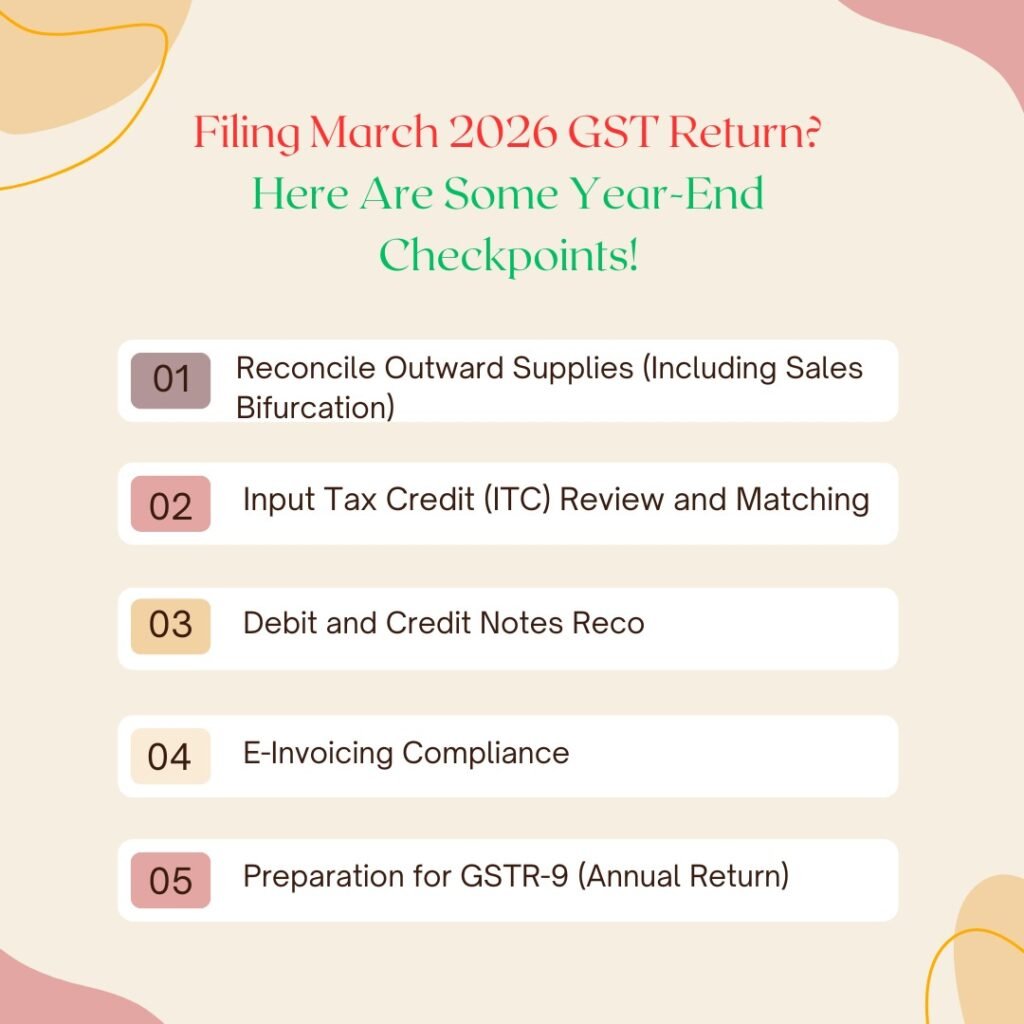
Introduction As the financial year 2025–26 comes to a close, businesses across India are gearing up to file their March 2026 GST returns. This filing is not just another monthly compliance task; it is the final checkpoint before transitioning into FY 2026–27. The March return consolidates the year’s transactions, reconciles input tax credits (ITC), and sets the stage for annual returns. Missing critical steps now can lead to penalties, blocked credits, or even notices from the GST department. To help you navigate this crucial filing, here are five detailed year-end checkpoints that every business should prioritize. 1. Reconcile Outward Supplies (Including Sales Bifurcation) Outward supply reconciliation is the backbone of GST compliance. It ensures that the turnover reported in GSTR-1 (sales data) matches the tax liability declared in GSTR-3B. But beyond simple reconciliation, March filing requires careful classification of sales. B2B Sales: Verify that all invoices issued to registered businesses carry the correct GSTIN and tax details. Errors here can block ITC for your customers and invite disputes. B2C Sales: Distinguish between B2C (small) and B2C (large) transactions. Large B2C invoices (above ₹2.5 lakh) require detailed reporting with place of supply. Exempt Supplies: Ensure exempt, nil-rated, or non-GST supplies are properly disclosed. These affect ITC reversals and annual return disclosures. Export Sales: Exports are zero-rated but must be backed by shipping bills and LUT (Letter of Undertaking). Reconcile customs data with GSTR-1 to avoid mismatches. Action Point: Prepare a reconciliation sheet that bifurcates sales into B2B, B2C, Exempt, and Export categories. This not only ensures accuracy in March returns but also simplifies annual return preparation. 2. Input Tax Credit (ITC) Review and Matching ITC is one of the most scrutinized areas in GST compliance. March 2026 is your last chance to claim eligible ITC for FY 2025–26. Match ITC with GSTR-2B: Cross-check ITC claimed in GSTR-3B with supplier invoices reflected in GSTR-2B. Any mismatch can lead to ITC denial. Reverse Ineligible ITC: Blocked credits under Section 17(5); such as motor vehicles, personal expenses, or employee-related costs must be reversed. Reverse ITC related to exempt supplies: ITC related to exempt supplies and proportionate common ITC shall be reversed. Vendor Compliance: Your ITC depends on vendors filing their returns correctly. Communicate with suppliers to ensure timely reporting. Year-End Adjustments: Claim pending ITC before March 31, 2026. Action Point: Use reconciliation tools or ERP reports to match ITC with GSTR-2B. Document reversals and maintain audit-ready records. 3. Debit and Credit Notes Year-end adjustments often require issuing debit or credit notes to correct invoices, discounts, or returns. These adjustments directly impact tax liability and must be reconciled before March filing. Debit Notes: Increase taxable value or tax liability when undercharged earlier. Credit Notes: Reduce taxable value or tax liability for returns, discounts, or overcharges. Reconciliation: Ensure all debit/credit notes are issued, reported in GSTR-1, and adjusted in GSTR-3B. Documentation: Maintain supporting records for each note to withstand scrutiny during audits. Action Point: Prepare a summary of all debit and credit notes issued during FY 2025–26. Reconcile them with outward supplies and ensure liability adjustments are reflected in March returns. 4. E-Invoicing Compliance By March 2026, e-invoicing is mandatory for businesses above specified turnover thresholds. Non-compliance can lead to penalties and denial of ITC for customers. Validation: Ensure all invoices above the threshold are generated through the Invoice Registration Portal (IRP). Reconciliation: Match e-invoices with GSTR-1 outward supplies to avoid discrepancies. Audit Trail: Maintain digital records of e-invoices for at least six years, as required under GST law. Vendor Communication: Confirm that vendors subject to e-invoicing are compliant, as their lapses can affect your ITC. Action Point: Conduct a year-end review of e-invoicing compliance. Validate invoice data with IRP acknowledgments and reconcile with GSTR-1. 5. Preparation for GSTR-9 (Annual Return) The return data flows directly into GSTR-9 (Annual Return) and GSTR-9C (Reconciliation Statement). Accuracy now saves audit trouble later. Data Accuracy: Ensure outward supplies, ITC, debit/credit notes, and e-invoices are correctly reported in March returns. Reconciliation: Match annual turnover in books with cumulative GSTR-1 and GSTR-3B data. Audit Trail: Prepare supporting documentation for auditors, including reconciliation reports and vendor communications. Early Drafting: Begin drafting GSTR-9 using reconciled March data. This proactive step reduces last-minute stress and errors. Action Point: Treat March filing as the foundation for annual return preparation. The cleaner your March data, the smoother your GSTR-9 filing will be. Key Takeaways Outward Supplies: Reconcile sales with bifurcation into B2B, B2C, Exempt, and Export. ITC: Match with GSTR-2B, reverse ineligible credits, and claim pending ITC before March 31. Debit/Credit Notes: Issue and reconcile all adjustments before filing. E-Invoices: Validate compliance with IRP and reconcile with GSTR-1. GSTR-9 Prep: Use March data as the foundation for annual return accuracy. Conclusion Filing the March 2026 GST return is more than a compliance ritual; it is the final opportunity to reconcile your books, claim eligible ITC, and prepare for the annual return. By focusing on these five checkpoints; outward supplies, ITC, debit/credit notes, e-invoices, and GSTR-9 preparation; businesses can avoid penalties, reduce audit risks, and ensure a smooth transition into FY 2026–27. Treat your March filing as a year-end health check for your business, and you’ll enter the new financial year with confidence, clarity, and compliance. Blog By : Mittal & Co.
The Income Tax Act, 2025: Understanding the Tax Year Transition
Introduction India’s tax landscape is undergoing one of its most significant transformations in decades. With the Income Tax Act 2025 set to replace the Income-tax Act, 1961 from 1 April 2026, taxpayers, professionals, and businesses must prepare for a new era of compliance. The 1961 Act, though robust, had become layered with amendments, provisos, and explanations over six decades. This complexity often made compliance cumbersome and interpretation difficult. The 2025 Act seeks to simplify the framework, reduce disputes, and align India’s tax system with global best practices. Among the many changes, one of the most impactful is the introduction of the “Tax Year” concept, which replaces the traditional Assessment Year (AY) system. This shift eliminates the dual-year references that often confused taxpayers and professionals. This blog explores the Tax Year concept in detail through a structured FAQ format, helping you understand how it works, why it matters, and what it means for compliance in the transition period. Q1. What is a Tax Year? A Tax Year is a 12-month period aligned with the financial year (April–March). It replaces the term “Previous Year” used under the old Act. Income earned during this period is assessed in the same year, unlike the earlier system where assessment happened in the following year. Example: Under ITA 1961: Income earned in FY 2025-26 → assessed in AY 2026-27. Under ITA 2025: Income earned in FY 2026-27 → assessed in Tax Year 2026-27. This alignment makes compliance more intuitive and eliminates the need to juggle two different year references. Q2. How is it different from Assessment Year (AY)? Under the 1961 Act, taxpayers had to deal with two terms: Previous Year → the year in which income was earned. Assessment Year → the year following the Previous Year, in which income was assessed. This dual terminology often caused confusion. The 2025 Act simplifies matters by using Tax Year as a single reference point. Key Difference: AY system: Income earned in one year, assessed in the next. Tax Year system: Income earned and assessed in the same financial year reference. This change reduces interpretational disputes and makes tax communication clearer for both taxpayers and professionals. Q3. Is there any missing year during the transition? No, the transition is seamless. FY 2025-26 → governed by ITA 1961, assessed in AY 2026-27. FY 2026-27 onwards → governed by ITA 2025, assessed in Tax Year 2026-27. There is no skipped year or overlap. The government has ensured that the shift is smooth, with clear savings and repeal provisions under Section 536 of ITA 2025. Q4. Can a Tax Year be shorter than 12 months? Yes. In cases where a business or source of income begins mid-year, the Tax Year will run from the start date until the end of that financial year. Example: If a business is set up on 1 December 2026, its Tax Year will be 1 Dec 2026 – 31 Mar 2027. This ensures that income is captured accurately without requiring artificial extensions or overlaps. Q5. What happens to references of Tax Years before 1 April 2026? Section 536(3) of ITA 2025 clarifies that references to Tax Years before 1 April 2026 correspond to “Previous Year” under ITA 1961. Example: “Tax Year 2024-25” in ITA 2025 → “Previous Year 2024-25” under ITA 1961 → assessed in AY 2025-26. This transitional provision ensures continuity and avoids confusion when interpreting older references. Q6. Do businesses need to change their accounting periods? No. Since the Tax Year is aligned with the financial year, businesses do not need to alter their accounting periods or financial statements. This is a crucial point for companies, as it avoids disruption in reporting cycles and ensures that compliance remains consistent with existing accounting practices. Q7. How does the Tax Year concept benefit small taxpayers? For small taxpayers, the biggest advantage is simplicity. No need to interpret layered provisions. No confusion between Previous Year and Assessment Year. Easier to align tax compliance with financial planning. By reducing reliance on professional interpretation for basic compliance, the Tax Year system empowers individuals and small businesses to manage their obligations more independently. Q8. How will the e-filing portal handle the transition? From July 2026, the e-filing portal will support dual compliance: Filing returns for AY 2026-27 under ITA 1961 (old forms). Paying advance tax for Tax Year 2026-27 under ITA 2025. This dual-track system ensures that taxpayers can meet obligations under both Acts without disruption. Q9. What happens to pending proceedings under the old Act? Pending assessments, appeals, and reassessments for years prior to 1 April 2026 will continue under ITA 1961 until resolution. This means that while taxpayers will comply with ITA 2025 for new income, they may still have obligations under ITA 1961 for earlier years. The coexistence of both Acts during the transition period is a practical necessity. Q10. How does the Tax Year concept align with global practices? Many countries already use a system where the tax year aligns directly with the financial year. By adopting this model, India reduces complexity and aligns its tax framework with international standards. This makes compliance easier for multinational corporations and enhances India’s attractiveness as a business destination. Conclusion The Income Tax Act, 2025 represents a bold step towards a modern, simplified, and globally aligned tax regime. The Tax Year concept is at the heart of this transformation, eliminating the dual-year confusion of the old system and making compliance more straightforward. For taxpayers, professionals, and businesses, the key takeaway is that income earned in a financial year will now be assessed in the same financial year reference; the Tax Year. This clarity reduces disputes, simplifies compliance, and empowers taxpayers to manage their obligations with greater confidence. As India transitions to this new framework from 1 April 2026, it is essential for all stakeholders to familiarize themselves with the Tax Year system, understand its implications, and prepare for dual compliance during the transition year. The journey from the Income-tax Act, 1961 to the Income Tax Act, 2025 is not just
New TDS Payment Workflow from 01st April, 2026
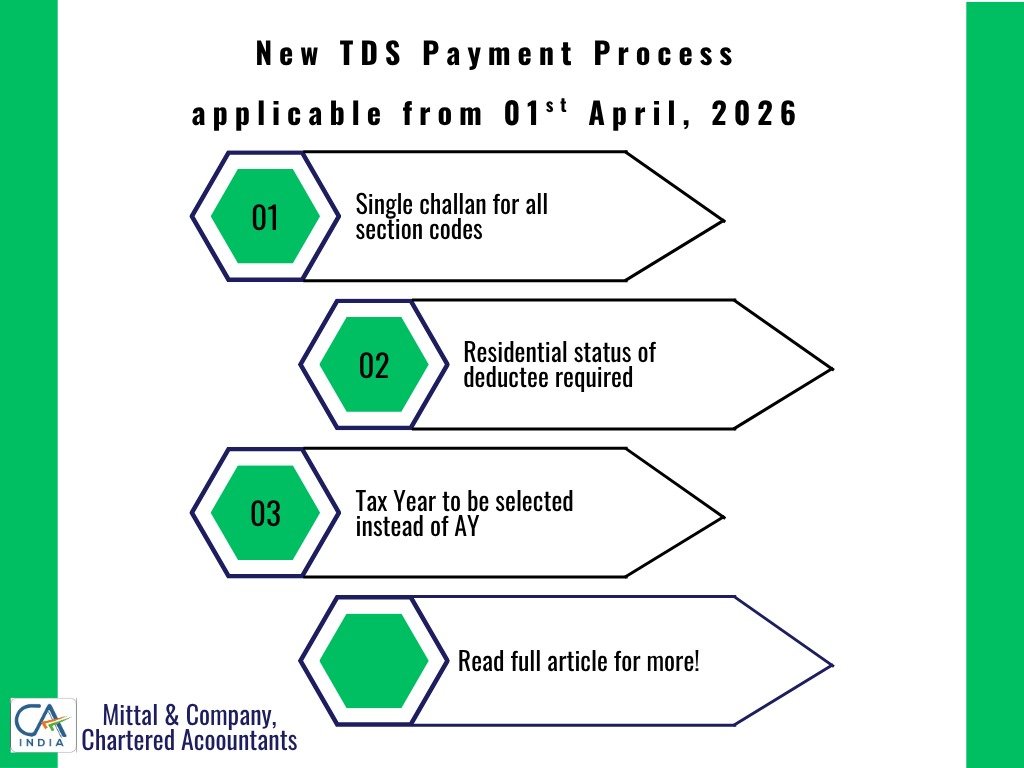
Introduction From April 1, 2026, the Income Tax portal has undergone a significant transformation to align with the provisions of the Income Tax Act, 2025, while still retaining the utilities of the Income Tax Act, 1961. One of the most notable changes is the revamped process for TDS payments. The portal now distinctly separates payments for FY 2025-26 and earlier from those applicable to Tax Year 2026-27 onwards. This shift is designed to bring greater clarity, compliance accuracy, and user convenience. In this blog, we’ll walk through the step-by-step process for both timelines so that deductors can adapt smoothly to the new system. TDS payment process for FY 2025-26 and previous years Step 1: Login to incometax.gov.in using TAN credentials Step 2: Go to E-file>> E-pay tax Step 3: Select “Income Tax Act, 1961”: Step 4: Click “New payment”: Step 5: Select AY and click “Pay TDS/TCS”: Step 6: Select section, major head, enter amount and make the payment. TDS payment for FY 2026-27 and onwards Step 1: Login to incometax.gov.in using TAN credentials Step 2: Go to E-file>> E-pay tax Step 3: Select “Income Tax Act, 2025”: Step 4: Click “New payment”: Step 5: Select TY and click “Pay TDS/TCS”: Step 6: Select major head and residential status of deductee i.e. payee: Step 7: Add description of the payments and amount of TDS. You can add multiple payment descriptions i.e. section codes in one challan: Step 8: Enter other amounts such as interest, late fee: Step 9: Check preview: Step 10: Make the payment through your payment gateway. Difference points in payment process Step FY 2025-26 & Before (Act, 1961) FY 2026-27 Onwards (Act, 2025) Act Selection Select Income Tax Act, 1961 Select Income Tax Act, 2025 Year Selection Select Assessment Year (AY) Select Tax Year (TY) Residential status of deductee Required Not required Payment Description Single section per challan Multiple payment descriptions (section codes) allowed in one challan Additional Amounts Enter Interest/late fee for each section separately amount only Enter Interest/ late fee in total after sections selection Conclusion The revamped TDS payment process marks a pivotal step in modernizing tax compliance. By introducing separate workflows for pre-2026 and post-2026 payments, the Income Tax portal ensures that users can navigate obligations under both the Income Tax Act, 1961 and the new Income Tax Act, 2025 with ease. While the changes may initially feel unfamiliar, the structured steps and enhanced features; such as multiple payment descriptions in a single challan; are designed to simplify compliance and reduce errors. Staying updated and adapting to these changes will empower deductors to manage their responsibilities confidently in the new tax era. Blog By : Mittal & Co.
31st March 2026 – The Compliance Finish Line
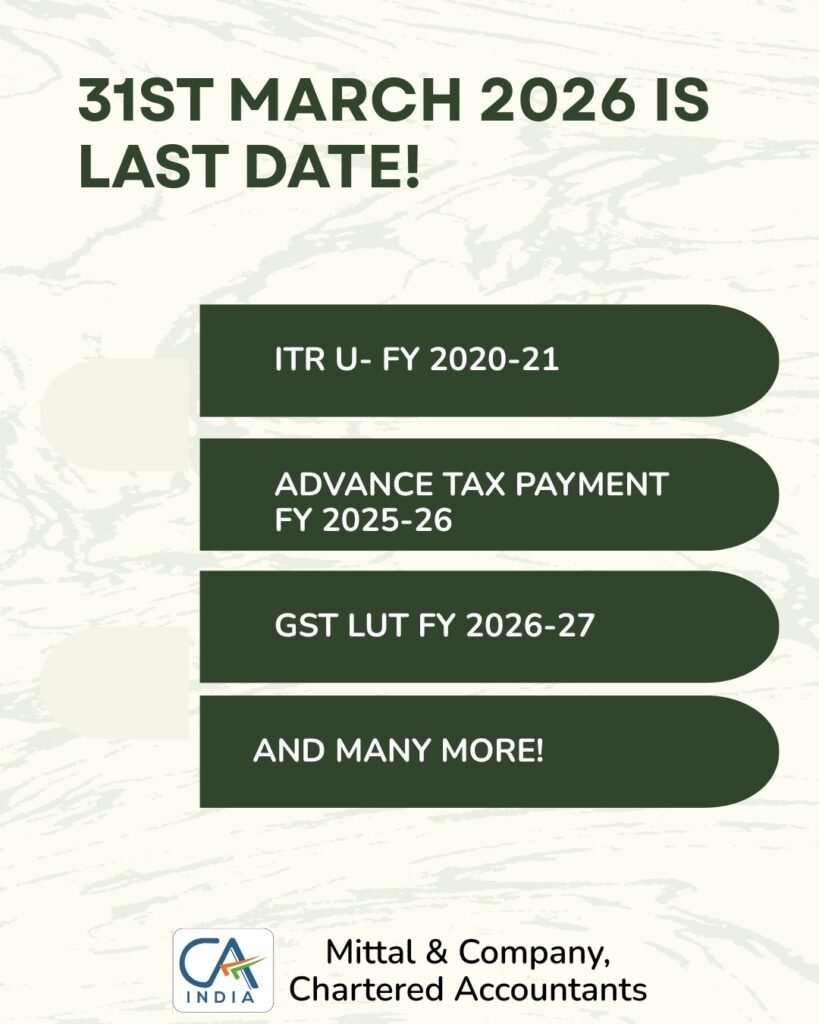
As the financial year 2025–26 draws to a close, 31st March 2026 emerges as one of the most important dates in the compliance calendar for taxpayers, businesses, and professionals across India. This date is not just symbolic of the end of the fiscal year; it is the final checkpoint for multiple statutory obligations. From filing updated income tax returns to renewing GST undertakings, depositing TDS, and completing corporate filings, the deadline is packed with responsibilities. Failing to meet these obligations can result in penalties, interest, disallowance of deductions, or even regulatory scrutiny. On the other hand, timely compliance ensures smooth closure of accounts, maximizes tax benefits, and sets the stage for a clean start to FY 2026–27. Let’s explore the major categories of compliances due by 31st March 2026. 💰 Income Tax Compliances Income tax obligations are among the most critical tasks to be completed before the year-end. For individuals and businesses alike, 31st March is the last opportunity to settle pending matters. 1. Filing Updated Returns (ITR-U) Taxpayers who missed filing or made errors in their returns for FY 2020-21 have until 31st March 2026 to submit an Updated Return (ITR-U). This facility allows correction of omissions or misreporting, but comes with additional tax liability. Missing this deadline means losing the chance to do past filings. Following is the additional tax liability to be paid for filing ITR U of further years after 31st March 2026. FY Additional Tax Liability if filed before 31st March, 2026 Additional Tax Liability if filed after 31st March, 2026 FY 2020-21 70% of additional tax (tax + interest ) Can not be filed FY 2021-22 60% of additional tax (tax + interest ) 70% of additional tax (tax + interest ) FY 2022-23 50% of additional tax (tax + interest ) 60% of additional tax (tax + interest ) FY 2023-24 25% of additional tax (tax + interest ) 50% of additional tax (tax + interest ) FY 2024-25 25% of additional tax (tax + interest ) 25% of additional tax (tax + interest ) 2. Tax-Saving Investments To claim deductions in old regime u/s 80C, 80CCD, and 80D, investments must be made before 31st March. Eligible options include: PPF (Public Provident Fund) SSY (Sukanya Samriddhi Yojana) NPS (National Pension Scheme) ELSS (Equity Linked Savings Scheme) Life insurance premiums, tuition fees Mediclaim 3. Foreign Tax Credit (Form 67) Taxpayers with overseas income must file Form 67 for AY 2025-27 before 31st March 2026 to claim relief under Double Taxation Avoidance Agreements (DTAA). Without this, foreign tax credits cannot be availed, leading to double taxation. 4. Advance Tax Payments The final instalment of advance tax must be paid by 31st March. Non-payment or short payment results in interest under Sections 234B and 234C 🏢 GST Compliances For businesses registered under GST, the year-end brings several obligations that must be completed before 31st March. 1. Renewal of LUT (Letter of Undertaking) Exporters making zero-rated supplies must renew their LUT (Form RFD-11) for FY 2026-27 before 31st March, 2026. Without renewal, they may be required to pay IGST upfront on exports. 2. Opting for Composition Scheme (CMP-02) Small businesses eligible for the composition scheme must file CMP-02 by 31st March to opt in for FY 2026–27. This scheme simplifies compliance but restricts input tax credit. 3. Invoice Series Reset Businesses must start a new invoice numbering series from 1st April 2026. Resetting ensures clarity and compliance with GST rules. 4. ITC Reversals and Reconciliations Year-end reconciliation of Input Tax Credit (ITC) is crucial. Businesses must reverse ineligible credits and ensure books match with GSTR-2B. Failure to reconcile can lead to notices and penalties. 📑 TDS/TCS Compliances Tax Deducted at Source (TDS) and Tax Collected at Source (TCS) obligations are time-sensitive and must be completed before the fiscal year closes. 1. TDS Corrections The last date of filing TDS correction statements from FY 2018-19 Q4 till FY 2023-24 Q3 is 31st March, 2026. If you miss this date, there is no possibility for correcting any mistakes and whole demand becomes payable. 2. Year-End Reconciliation It is essential to reconcile TDS/TCS entries with books of accounts. This ensures accuracy and avoids mismatches during assessments. ⚠️ Risks of Missing Deadlines Financial Penalties: Late fees, interest, and disallowance of deductions. Lost Tax Benefits: Investments made after 31st March won’t qualify for FY 2025–26 deductions. Audit & Scrutiny: Increased risk of notices and compliance burdens in FY 2026–27. ✅ Conclusion 31st March 2026 is not just another date; it’s the compliance finish line. From income tax filings to GST renewals, TDS deposits, and corporate obligations, this deadline ensures a clean closure of FY 2025–26. By acting now, individuals secure tax benefits, businesses avoid penalties, and professionals enter FY 2026–27 with confidence and clarity. Treat this date as your final checkpoint; because compliance today means peace of mind tomorrow. BLOG BY : Mittal & Co.
GST LUT Filing: Don’t Miss the 31st March 2026 Deadline

Introduction Exports are the backbone of India’s trade economy, and the Goods and Services Tax (GST) framework has streamlined compliance for exporters. One of the most critical enablers in this system is the Letter of Undertaking (LUT). By furnishing a LUT, exporters can supply goods or services without paying Integrated GST (IGST) upfront, thereby avoiding cash flow blockages and refund delays. With the financial year 2026–27 approaching, exporters must remember that the deadline to furnish LUT for FY 2026–27 is 31st March 2026. Missing this deadline means exporters will need to pay IGST on exports and later claim refunds; a cumbersome process that can tie up working capital. This blog answers the most frequently asked questions (FAQs) about LUT, helping businesses stay compliant and avoid last-minute hassles. 1.What is a LUT under GST? A Letter of Undertaking (LUT) is a declaration filed online by exporters under GST. It allows them to export goods or services without paying IGST at the time of supply. Instead of paying tax upfront and claiming refunds later, exporters can directly make zero-rated supplies. This mechanism simplifies compliance and ensures liquidity for businesses engaged in international trade. A Letter of Undertaking (LUT) is a declaration filed online by exporters under GST. It allows them to export goods or services without paying IGST at the time of supply. Instead of paying tax upfront and claiming refunds later, exporters can directly make zero-rated supplies. This mechanism simplifies compliance and ensures liquidity for businesses engaged in international trade. 2. Who can furnish a LUT? All registered taxpayers under GST who intend to export goods or services or supply to Special Economic Zones (SEZs) without payment of IGST. Exceptions: Taxpayers who have been prosecuted for tax evasion exceeding ₹2.5 Crores under the CGST Act/IGST Act/Existing law are not eligible to furnish LUT. They must instead furnish a bond with a bank guarantee. 3. What is the validity of a LUT? A LUT is valid for one financial year. Exporters must renew it annually before the start of the new financial year. 👉 For FY 2026–27, the LUT must be furnished by 31st March 2026. 4. How can LUT be furnished online? The process is entirely digital via the GST portal: Log in to the GST portal. Navigate to Services → User Services → Furnish LUT. Fill in Form GST RFD-11 with export details. Upload the declaration and authorized signatory details. Submit using Digital Signature Certificate (DSC) or Electronic Verification Code (EVC). Once submitted, the LUT is generally auto-approved unless there are eligibility concerns. 5. What documents are required for LUT filing? Form GST RFD-11 (available on the GST portal). Self-declaration confirming no prosecution for tax evasion above ₹250 lakh in the last five years. Details of authorized signatory. Witness information (if applicable). 6. What happens if LUT is not furnished? If an exporter fails to furnish LUT before the deadline: They must pay IGST on exports. Later, they can claim refunds, but this process delays liquidity and blocks working capital. Refund claims also involve additional compliance and scrutiny, which can be avoided by timely LUT filing. 7. Can LUT be rejected? Yes, LUT can be rejected if: The exporter has been prosecuted for tax evasion exceeding ₹250 lakh in the past five years. The declaration contains incorrect or misleading information. In most cases, however, LUT is auto-approved upon submission. 8. Is LUT required for deemed exports? No. LUT applies only to zero-rated supplies such as exports and supplies to SEZs. Deemed exports (like supplies to EOUs or specified projects) follow different refund provisions and do not require LUT. 9. Can LUT be amended after submission? No. Once filed, LUT cannot be edited. If errors occur, exporters must furnish a fresh LUT with correct details. 10. What are the benefits of furnishing LUT? No upfront IGST payment on exports. Improved cash flow and liquidity. Simplified compliance compared to bonds with bank guarantees. Faster processing of export transactions. 11. What is the penalty for non-compliance? While there is no direct penalty for not furnishing LUT, the consequence is financial: Exporters must pay IGST upfront. Refund claims may take weeks or months, impacting working capital. Non-compliance can also attract scrutiny during audits. 12. How does LUT impact SEZ supplies? Supplies to SEZs are treated as zero-rated under GST. Exporters can furnish LUT to make such supplies without paying IGST. This ensures smooth transactions with SEZ units and avoids refund delays. 13. Is LUT applicable for services exports? Yes. LUT is equally applicable for exporters of services. Whether you are an IT company exporting software services or a consultancy firm serving overseas clients, furnishing LUT allows you to avoid IGST payment on invoices. 14. What is the difference between LUT and Bond? LUT: Available to all exporters except those prosecuted for major tax evasion. Requires only a declaration. Bond: Mandatory for exporters not eligible for LUT. Requires furnishing a bond with a bank guarantee, which increases compliance cost and effort. 15. What is the timeline for LUT approval? LUT is generally auto-approved upon submission. Exporters can download the acknowledgment from the GST portal immediately. In rare cases, if scrutiny is required, approval may take a few days. 16. What should exporters keep in mind for FY 2026–27? The deadline is 31st March 2026. Furnish LUT well in advance to avoid last-minute portal issues. Keep documentation ready and ensure authorized signatory details are updated. Verify acknowledgment after submission to confirm approval. Conclusion The Letter of Undertaking (LUT) is a vital compliance requirement for exporters under GST. It ensures that businesses can export goods and services without paying IGST upfront, thereby safeguarding liquidity and simplifying compliance. For FY 2026–27, the deadline to furnish LUT is 31st March 2026. Exporters should act early, file online through the GST portal, and avoid the pitfalls of refund delays. By staying proactive, businesses can ensure smooth operations, uninterrupted exports, and better financial management. In short, furnishing LUT is not just a compliance requirement; it is a strategic move to
TDS Correction Deadline 31 March 2026 Guide
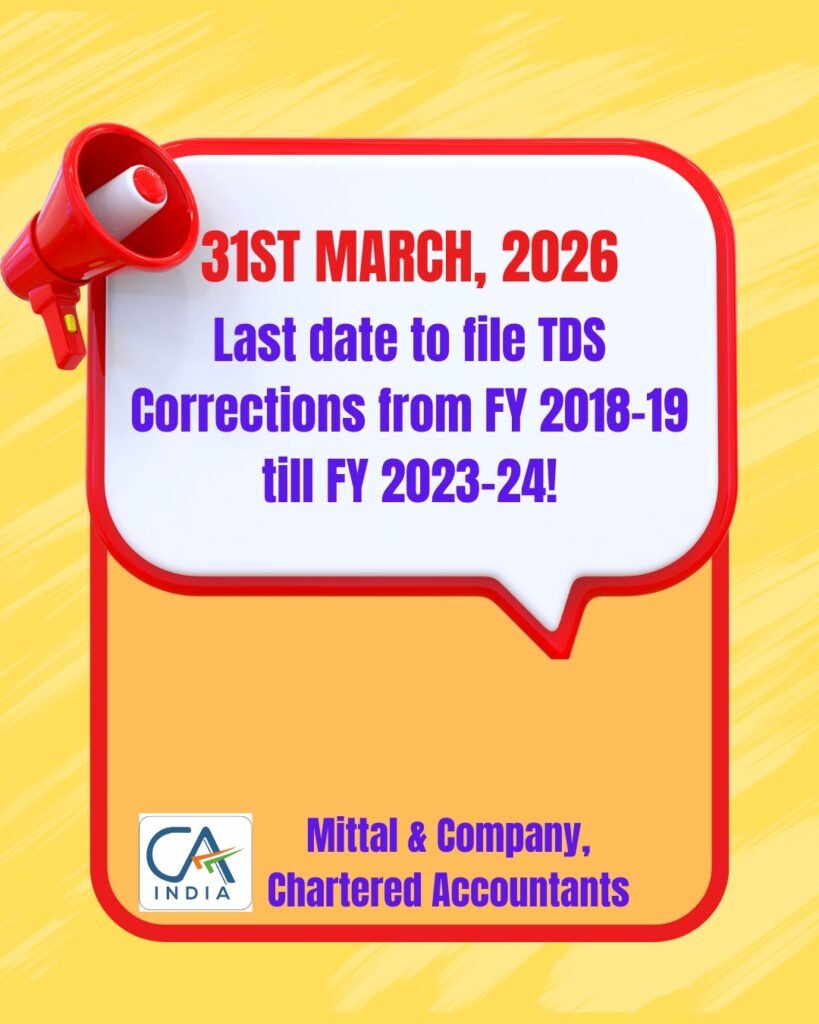
Introduction The Central Board of Direct Taxes (CBDT) has announced that 31st March 2026 will be the final cut‑off date for filing correction statements for past TDS and TCS returns, covering financial years 2018–19 to 2023–24; after this date, no further rectifications will be permitted, making it imperative for deductors and collectors to review their filings, identify errors, and ensure accuracy before the window closes permanently. Applicable Period This compliance deadline applies to correction statements for six financial years: FY 2018–19-Q4 FY 2019–20 FY 2020–21 FY 2021–22 FY 2022–23 FY 2023–24- Q1 o Q3 For many organizations, these years represent a mix of challenges and transitions; digitization of compliance processes, pandemic‑related disruptions, and evolving reporting formats. The CBDT’s move ensures closure of legacy data, allowing the Income Tax Department to streamline records and focus on current and future filings. Methods of TDS/TCS Correction Online Corrections via TRACES Portal The TRACES (TDS Reconciliation Analysis and Correction Enabling System) portal enables deductors and collectors to file corrections directly online. This method is particularly useful for smaller, straightforward fixes such as updating PAN details, correcting challan mismatches, or revising deductee information. Offline Corrections Using Conso File For bulk or complex corrections, deductors can download the Consolidated (Conso) File from TRACES. This file contains all transactions reported in the original statement. Corrections can be made offline using approved software, and the corrected file is then re‑uploaded to TRACES. Both methods ensure that corrected data flows seamlessly into taxpayers’ Form 26AS and Annual Information Statement (AIS), safeguarding their ability to claim credits and refunds. Process of TDS/TCS Correction A structured approach is essential to avoid last‑minute chaos. The correction process typically involves three key steps: Defaults Checking – After filing TDS/TCS statements, TRACES generates default reports highlighting mismatches or errors. Deductors must review these carefully to identify issues such as incorrect challan details or PAN mismatches. Download Justification Report – The justification report provides a detailed breakdown of defaults, including the nature of errors and the sections under which they fall. This report is the roadmap for corrections, guiding deductors on what needs to be fixed. File Corrections – Corrections are then filed either online or offline. Once processed, the corrected data updates taxpayer records, ensuring proper credit of taxes. Deductors should maintain documentation of corrections filed, acknowledgments received, and supporting evidence for audit purposes. Frequently Noticed Errors Errors in TDS/TCS filings are common, and many recur across organizations. Some of the most frequently noticed issues include: Wrong or Inoperative PAN: Incorrect PAN entries prevent tax credits from reflecting in the deductee’s account. Inoperative PANs, especially after the PAN‑Aadhaar linkage mandate, can also cause mismatches. Incorrect Section Codes: Deductors sometimes apply the wrong section while reporting deductions, leading to compliance discrepancies. Challan Mismatches: Errors in challan number, BSR code, or date can result in unmatched payments. Salary Annexure Mistakes (Q4): For the fourth quarter, salary annexure errors—such as incorrect reporting of exemptions or allowances—are common. Deductee Details: Mistakes in names, addresses, or amounts deducted can cause mismatches in AIS. Identifying and correcting these errors before the deadline is critical to avoid compliance risks. Why the 31st March 2026 Deadline Matters The CBDT’s decision to fix a final deadline carries significant implications: Closure of Past Years: This is the last chance to clean up six years of filings. After March 2026, no corrections will be entertained. Impact on Taxpayers: Uncorrected errors may lead to denial of credits or delays in refunds, directly affecting taxpayers. Compliance Risk: Deductors who fail to correct errors may face queries during assessments or audits, as mismatched data often triggers scrutiny. System Efficiency: By closing corrections, the Income Tax Department reduces the burden of managing legacy data, ensuring smoother administration. Conclusion The 31st March 2026 deadline is more than just a compliance date—it is a decisive step toward accuracy and finality in tax records. Deductors and collectors must treat this as a priority, acting well in advance to avoid last‑minute hurdles. Timely corrections will safeguard deductors from penalties and scrutiny while ensuring taxpayers receive accurate credit for taxes paid. For businesses, professionals, and individuals alike, this is the last opportunity to clean up six years of data. By acting now, stakeholders can avoid complications, build trust in compliance systems, and contribute to a smoother tax administration process. BLOG BY – MITTAL & CO.