
Supreme Court Clarifies: No GST on Assignment of MIDC Leasehold Rights

📌 Introduction The Supreme Court of India has delivered a landmark judgment that will have far-reaching consequences for industries across Maharashtra and beyond. By upholding the Bombay High Court’s ruling, the apex court has confirmed that assignment of leasehold rights in industrial land allotted by the Maharashtra Industrial Development Corporation (MIDC) does not attract GST. This decision provides much-needed clarity for businesses, developers, and investors who have long grappled with uncertainty over whether such transactions constitute a “supply” under GST law. The ruling not only reduces compliance burdens but also strengthens confidence in industrial land transactions, ensuring smoother restructuring and investment flows. ⚖️ Background of the Dispute To understand the significance of this ruling, it is important to revisit the context: MIDC’s role: The Maharashtra Industrial Development Corporation is a statutory body that allots industrial plots to businesses on a leasehold basis. These plots are critical for setting up factories, warehouses, and other industrial units. Assignment of rights: Often, the original allottee of a plot assigns their leasehold rights to another party. This may occur during mergers, acquisitions, or simple business restructuring. Revenue’s stance: Tax authorities argued that such assignments amounted to a “supply of service” under GST, thereby attracting tax liability. Bombay High Court ruling: The High Court rejected this interpretation, holding that mere assignment of leasehold rights does not constitute a taxable supply. The Revenue challenged this ruling before the Supreme Court, filing a Special Leave Petition (SLP). 🏛️ Supreme Court’s Observations The Supreme Court dismissed the Revenue’s SLP, thereby affirming the Bombay High Court’s judgment. The Court’s observations are crucial: No automatic GST liability Assignment of leasehold rights in industrial land is not a taxable supply under GST. The transaction is essentially a transfer of rights already granted by MIDC, not a fresh supply of goods or services. Nature of transaction matters The Court emphasized that the assignment is a continuation of existing rights, not a new contractual arrangement that creates taxable value. Relief for industries This ruling removes ambiguity and prevents unnecessary litigation for businesses dealing with industrial land. It ensures that industrial transactions are not burdened with additional tax costs that could discourage investment. 📊 Implications for Businesses The judgment has wide-ranging implications for industries, developers, and investors: ✅ Clarity in compliance: Businesses can now confidently assign leasehold rights without worrying about GST liability. ✅ Reduced litigation: The ruling curtails disputes between taxpayers and authorities over interpretation of “supply.” ✅ Boost to industrial transactions: Easier transfer of leasehold rights will encourage smoother industrial restructuring, mergers, and acquisitions. ✅ Investor confidence: By removing tax uncertainty, the ruling strengthens investor trust in industrial land deals. 🔍 Expert Insights Tax professionals and industry experts view this ruling as a progressive step in aligning GST law with the realities of industrial land transactions. Distinction between rights and services: The judgment underscores the importance of distinguishing between transfer of existing rights and provision of new services. Precedent for other states: The ruling sets a precedent for similar disputes in other states where industrial development corporations allot land on leasehold terms. Policy alignment: It reflects judicial sensitivity to the fact that GST should not be applied in a manner that hampers industrial growth. 📚 Legal Reasoning Simplified For compliance professionals, the Court’s reasoning can be broken down into simple terms: Supply under GST: Defined broadly to include sale, transfer, barter, exchange, license, rental, lease, or disposal made for consideration. Assignment of leasehold rights: This is not a fresh lease or license; it is merely a transfer of rights already granted by MIDC. Absence of new consideration: Since no new service is being provided, the transaction does not fall within the ambit of “supply.” Thus, the Court concluded that GST cannot be levied on such assignments. 🏭 Industry Perspective From an industry standpoint, this ruling is a game-changer: Manufacturers and exporters: Can restructure operations without worrying about GST on land transfers. SMEs and startups: Gain easier access to industrial plots through assignment, without additional tax burdens. Real estate developers: Can plan industrial parks and clusters with greater clarity on tax treatment. 📌 Compliance Takeaways (Quick Reference Table) Transaction Type GST Applicability Court’s View Impact on Business Fresh lease from MIDC GST applicable Considered supply Normal compliance Assignment of leasehold rights No GST Not a taxable supply Relief for industries Sale of freehold land No GST Land excluded from GST Standard exemption Transfer during M&A No GST (if leasehold assignment only) Covered by ruling Easier restructuring 📢 Practical Guidance for Businesses Review contracts: Ensure that assignment agreements clearly state that rights are being transferred, not fresh services provided. Maintain documentation: Keep MIDC allotment letters, assignment deeds, and court references handy for audit purposes. Educate teams: Compliance and finance teams should be briefed on this ruling to avoid misinterpretation. Plan restructuring confidently: Businesses can now restructure or transfer industrial plots without factoring in GST costs. 📌 Conclusion The Supreme Court’s affirmation of the Bombay High Court ruling marks a major victory for industry stakeholders. By holding that assignment of MIDC leasehold rights does not amount to a taxable supply under GST, the Court has provided much-needed clarity and relief. This decision not only reduces compliance burdens but also strengthens investor confidence in industrial land transactions. For businesses, it’s a reminder that legal clarity can unlock smoother workflows and reduce tax risks. Blog By – Mittal & Co.
GST Audit vs GST Compliance in India: Which Service Does Your Pune Business Actually Need?
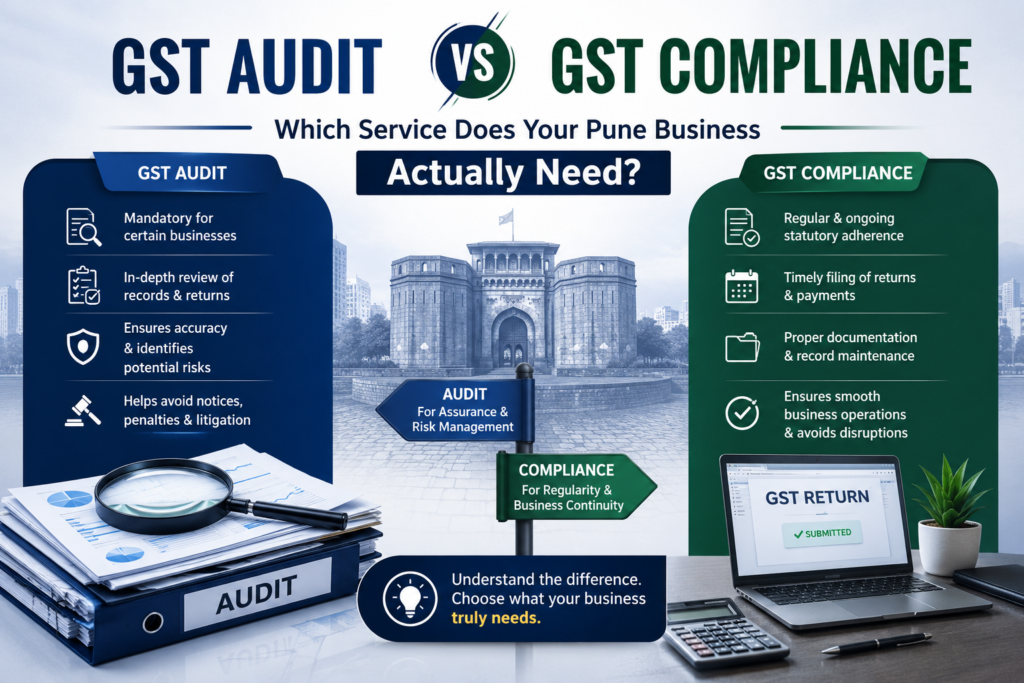
Many businesses confuse GST audit with GST compliance, even though both services solve very different problems. In simple terms: GST compliance focuses on ongoing filing, reconciliation, reporting, and adherence to GST regulations. GST audit focuses on reviewing GST records, identifying discrepancies, assessing risks, and ensuring reporting accuracy. Most SMEs and startups in Pune primarily need structured GST compliance support. Businesses with higher transaction complexity, reconciliation issues, notices, or internal control gaps often require deeper GST audit assistance. This guide explains: The difference between GST audit and GST compliance Which service your business actually needs Common GST risks businesses face How professional GST consultants improve compliance accuracy Why GST Management Has Become More Complex in 2026 GST compliance in India has evolved significantly over the last few years. Businesses now deal with: E-invoicing requirements Real-time invoice matching Input tax credit reconciliation Vendor compliance tracking Automated GST scrutiny systems Departmental data analytics As GST systems become more technology-driven, even small reporting inconsistencies can trigger: GST notices ITC reversals Penalties Delayed refunds Compliance scrutiny For businesses in Pune’s growing startup and SME ecosystem, maintaining accurate GST records has become operationally critical. Understanding GST Compliance GST compliance refers to the ongoing process of ensuring that a business follows GST regulations correctly and consistently. This is a recurring operational function. GST Compliance Typically Includes GST registration support Monthly and quarterly return filing GSTR-1 preparation GSTR-3B filing Input tax credit reconciliation Vendor reconciliation E-invoice compliance GST payment calculations Record maintenance Notice response support Why GST Compliance Matters Strong compliance systems help businesses: Avoid penalties Reduce reconciliation mismatches Maintain clean tax records Improve vendor relationships Ensure uninterrupted ITC claims Businesses with weak compliance structures often face repeated operational disruptions. Understanding GST Audit GST audit is a detailed review and verification process that evaluates whether GST records and filings are accurate, complete, and compliant with GST law. Unlike routine compliance, GST audit focuses on: Risk identification Error detection Transaction verification Process review Compliance gap analysis GST Audit Typically Covers Invoice verification GST reconciliation analysis ITC validation Tax liability review Classification checks Reverse charge mechanism review Documentation verification Internal process assessment Purpose of GST Audit GST audits help businesses: Detect reporting inconsistencies Identify compliance risks Prepare for scrutiny Improve internal controls Reduce future disputes For growing businesses, audits act as preventive risk management tools rather than just corrective exercises. GST Audit vs GST Compliance: Key Differences Criteria GST Compliance GST Audit Objective Ongoing compliance management Detailed compliance review Frequency Monthly/Quarterly Periodic or need-based Focus Filing & reporting Risk assessment & verification Nature Operational Analytical Outcome Timely compliance Compliance validation Complexity Moderate High Best For Most businesses Businesses with risk exposure Which Businesses Need GST Compliance Services? Almost every GST-registered business requires compliance support. This includes: Startups SMEs E-commerce businesses Service companies Manufacturers Professional firms Businesses That Particularly Need Structured Compliance Startups Startups often lack dedicated internal tax teams. Outsourced GST compliance improves: Filing accuracy Operational focus Compliance consistency SMEs SMEs handling multiple vendors and invoices require structured reconciliation systems to avoid mismatches. Multi-State Businesses Businesses operating across states face: Place-of-supply complexity Multi-registration management Interstate reconciliation challenges Which Businesses Require GST Audit Support? While not every business needs continuous GST audit support, several business categories benefit significantly from periodic reviews. Businesses Facing GST Notices If your business has: ITC mismatches Return discrepancies Vendor inconsistencies a GST audit can help identify root causes quickly. High-Transaction Businesses Businesses with large invoice volumes often require deeper reconciliation reviews and transaction validation. Rapidly Growing Companies As operations scale, GST complexity increases. Audits help strengthen internal compliance systems. Businesses Preparing for Funding or Due Diligence Investors increasingly review: Tax compliance history GST accuracy Regulatory exposure Poor GST controls can negatively impact credibility. Common GST Mistakes Businesses Make Delayed Reconciliation Businesses frequently postpone reconciliation activities, leading to: ITC mismatches Vendor conflicts Incorrect filings Depending Entirely on Internal Staff Single-person dependency creates operational risks and increases the chance of unnoticed errors. Ignoring Vendor Compliance Vendor filing inconsistencies directly affect input tax credit eligibility. Treating GST as a Filing-Only Activity GST management involves: Process discipline Documentation Continuous monitoring Internal controls Not just return submission. How Professional GST Consultants Help Businesses Professional GST consultants improve: Compliance consistency Reporting accuracy Documentation quality Risk management Reconciliation efficiency They also help businesses respond proactively to regulatory changes. Why Pune SMEs & Startups Outsource GST Management Pune has a rapidly expanding ecosystem of: Startups IT companies Manufacturers Service businesses Many growing businesses prefer outsourcing GST functions because it: Reduces operational burden Improves compliance quality Provides expert guidance Ensures process continuity How to Choose the Right GST Service Partner Businesses should evaluate GST consultants based on: Evaluation Area Importance GST expertise High Reconciliation capability High Industry experience High Technology adoption High Responsiveness High Audit support Medium Advisory capability High Mittal & Co. GST Support Services Mittal & Co. provides GST-related services including: GST registration GST return filing GST reconciliation Audit support Tax advisory Compliance management Accounting and bookkeeping support (camittal.com) The firm’s service structure aligns with startups, SMEs, and businesses seeking centralized compliance and advisory support. Final Thoughts GST compliance and GST audit are not interchangeable services. GST compliance helps businesses maintain ongoing regulatory discipline. GST audit helps businesses identify risks, validate reporting accuracy, and strengthen internal controls. Most businesses require structured GST compliance support as a foundation. As transaction complexity grows, periodic GST audits become increasingly important. For Pune businesses seeking organized GST management, compliance consistency, and advisory-focused support, firms like Mittal & Co. position themselves as integrated compliance and financial advisory partners. (camittal.com) Internal Linking Suggestions “GST filing services in Pune” “accounting and bookkeeping services” “tax audit services” “virtual CFO services” “business compliance consultants” 6. FAQ SECTION What is the difference between GST audit and GST compliance? GST compliance involves routine filing and reconciliation activities, while GST audit focuses on reviewing GST records, identifying discrepancies, and assessing compliance risks. Is GST audit mandatory for all businesses? Not all businesses require formal GST audits regularly, but many businesses benefit from periodic GST
GSTN Advisory: Enhancements to the e-Way Bill System (Effective May 20, 2026)
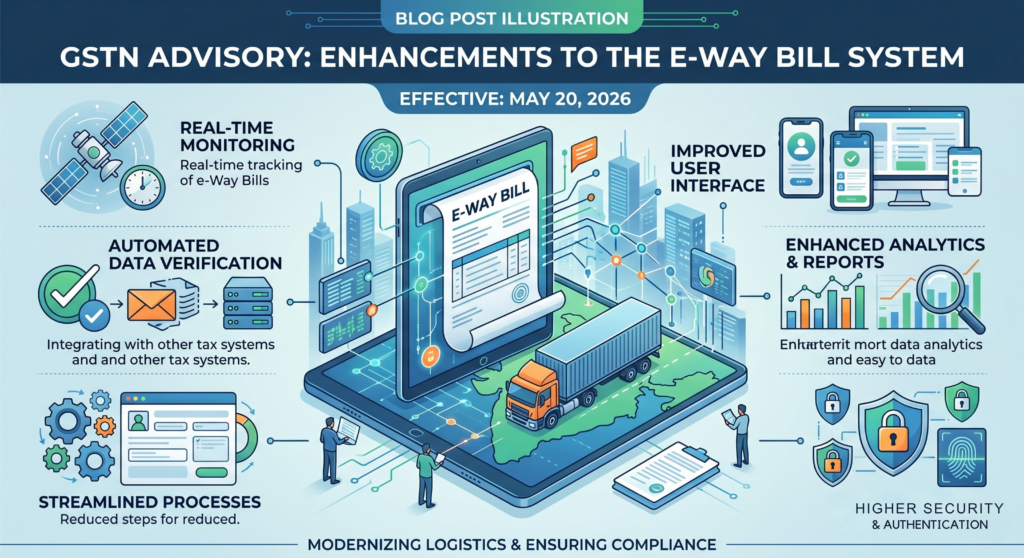
GSTN Advisory: Enhancements to the e-Way Bill System (Effective May 20, 2026) 📖 Introduction The Goods and Services Tax Network (GSTN) has rolled out a significant advisory introducing new features and compliance requirements in the e-Way Bill (EWB) system. These changes, effective from May 20, 2026, aim to strengthen traceability, improve compliance, and streamline workflows for taxpayers, transporters, and ERP/API integrators. The e-Way Bill system has always been a cornerstone of GST compliance, ensuring transparency in the movement of goods. With these updates, GSTN is addressing long-standing challenges such as open-ended bills, incomplete consignee details, and manual closure delays. Businesses must adapt quickly to avoid compliance lapses and leverage the new features for smoother operations. 🔑 Key Updates in the Advisory Mandatory Capture of “Ship To GSTIN” One of the most impactful changes is the mandatory entry of the “Ship To GSTIN” field in Bill-To/Ship-To transactions. What’s new? Every Bill-To/Ship-To transaction must now include the GSTIN of the consignee. If the consignee is unregistered, the value “URP” (Unregistered Person) must be entered. Why this matters? Ensures accurate identification of delivery destinations. Reduces data gaps in tracking goods movement. Strengthens audit trails for compliance officers. Voluntary e-Way Bill Closure Facility GSTN has introduced a voluntary closure option for e-Way Bills, allowing stakeholders to close bills once goods are delivered. Who can close? Supplier Recipient Transporter Driver/authorized person (via registered mobile number) Closure methods: By e-Way Bill number By date Key rules: Bills can be closed same day or next day after delivery. Closure is supported via portal and APIs. Benefits: Prevents misuse of open-ended bills. Improves transparency in goods movement. Reduces compliance risks during audits. API and System Integration Readiness To support ERP vendors, GSPs, and ASPs, GSTN has released updated API specifications. Sandbox availability: APIs are already live in the Sandbox environment for testing. Production deployment: Scheduled by June 15, 2026. Action points for integrators: Access updated APIs. Conduct sandbox testing. Configure ERP/GSP systems for compliance. Action Required by Stakeholders To ensure smooth compliance, businesses and partners must act promptly: Taxpayers & Businesses Update ERP systems to capture Ship To GSTIN. Train staff on closure workflows. Monitor compliance deadlines. Transporters Familiarize drivers with closure options. Ensure mobile numbers are registered. Use closure facility to avoid open-ended bills. ERP Vendors & GSPs Integrate updated APIs. Conduct sandbox testing before June 15. Provide training and support to clients. 📊 Benefits of the Update These changes bring multiple advantages across the compliance ecosystem: For Businesses: Reduced audit risks. Improved accuracy in consignee details. Streamlined closure process. For Transporters: Greater control over bill lifecycle. Reduced liability for open-ended bills. For GSTN & Authorities: Enhanced traceability. Stronger compliance enforcement. Better data integrity. ✅ Key Takeaways Ship To GSTIN mandatory in Bill-To/Ship-To transactions. Voluntary closure facility improves transparency and reduces misuse. API readiness critical for ERP/GSP integrators before June 15, 2026. Stakeholders must update systems and train teams to avoid compliance lapses. 📖 Conclusion The GSTN advisory marks a major step forward in strengthening compliance and operational efficiency within the e-Way Bill system. By mandating “Ship To GSTIN” and introducing voluntary closure, GSTN ensures better traceability, reduced misuse, and smoother workflows. Businesses should act promptly to: Update ERP/API systems Train staff on closure workflows Adopt new compliance practices These proactive measures will not only ensure compliance but also enhance trust and transparency in the GST ecosystem.
Claiming ITC Refunds in 2026? Upload Annexure B from offline utility and not PDF!
Introduction On May 18, 2026, the GSTN introduced a significant change in the way taxpayers file refund applications involving accumulated Input Tax Credit (ITC). Until now, Annexure‑B was uploaded in PDF format, which limited automation and system‑based verification. To streamline the process, a standardized Annexure‑B Offline Utility has been deployed on the GST portal. This Excel‑based utility ensures uniformity, reduces manual errors, and enables automated validation of invoices with GSTR‑2B. This blog explains the new requirements, structure, and functionality of the Annexure‑B Offline Utility, along with practical guidance for taxpayers filing refund applications under specific categories. Applicability of Annexure‑B Offline Utility Taxpayers must now furnish Annexure‑B through the prescribed offline utility for refund claims involving accumulated ITC under the following categories: Exports of Goods/Services without payment of tax (excluding electricity) Supplies made to SEZ Unit/SEZ Developer without payment of tax ITC accumulated due to Inverted Tax Structure [Clause (ii) of first proviso to section 54(3)] Export of Electricity without payment of tax (accumulated ITC) This change ensures that refund applications across these categories follow a uniform reporting format. Features of the Offline Utility The Annexure‑B Offline Utility is designed to simplify data entry and enhance accuracy. Key features include: Excel‑based format for invoice‑wise reporting. Mandatory segregation of invoices HSN/SAC‑wise and by category of input supply (Inputs, Input Services, Capital Goods). Each line item must include taxable value, tax amount, and ITC eligibility under section 17(5). Capacity of 10,000 entries per file; taxpayers can use multiple files if required. Clear validation rules to prevent duplicate entries. Structure of the Utility The utility contains two main tables: Table 1 – Reversal Details Captures ITC reversals under Rules 38, 42, 43, and section 17(5). Includes other reversals reported in Table 4(B)(2) of GSTR‑3B. Table 2 – HSN/SAC‑wise Inward Invoice Details Requires invoice‑wise reporting of ITC claimed in GSTR‑3B. Segregation by HSN/SAC code and category of input supply. Handling Complex Invoices Invoices often contain multiple categories of supplies or multiple HSN/SAC codes. In such cases: Split the invoice into separate line items. Each line item must represent one category mapped to one HSN/SAC code. Distribute invoice value and tax amounts proportionately across line items. This ensures accurate reporting and avoids mismatches during validation. Duplicate Document Validation To prevent duplication, the system validates invoices based on: Supplier GSTIN Invoice Number Invoice Date Category of Input Supply HSN/SAC If all these parameters are identical, only one line item should be reported. Multiple entries under identical parameters will be rejected. Reporting ITC Reversals Taxpayers must carefully report ITC reversals: Reversals under Rules 38, 42, 43 and section 17(5) must be reported as per GSTR‑3B. Other reversals reflected in Table 4(B)(2) of GSTR‑3B must also be included. When multiple files are used, reversal amounts should be entered only in the final file. The system recalculates consolidated Net ITC after all JSON files are uploaded. Uploading Annexure‑B JSON File Once the offline utility is completed: Generate the Annexure‑B JSON file. Upload it on the RFD‑01 screen under “Statement of invoices (Unutilized ITC)”. Proceed with validation and submission. Post‑Upload Validation The system validates uploaded invoices against GSTR‑2B: Invoices up to October 2024: No validation with GSTR‑2B; system displays a generic message but accepts entries. Invoices from November 2024 onwards: Strict validation against GSTR‑2B. Valid invoices appear in the Valid Documents Report. Mismatches or failures appear in the Invalid Documents Report. This ensures that refund claims are supported by verified invoices. Practical Notes for Using the Utility Taxpayers should keep in mind the following: Copy‑paste functionality is enabled for dropdown values, but values must match exactly. Close older versions of the utility before using the new one. Avoid unnecessary spaces in fields (e.g., supplier name). Do not edit JSON files directly; regenerate them from the utility if changes are required. Do not rename JSON files after generation, as this may cause upload issues. Line‑Item Upload Limits The system currently allows: 10,000 line items per file. 25 files per refund application. A total of 2,50,000 line items per application. If the number of invoices exceeds this limit, taxpayers can upload up to 2,50,000 line items through the utility and submit the remaining invoices as supporting documents in PDF format. Future enhancements are expected to support higher‑volume data ingestion. Benefits of the Annexure‑B Offline Utility The new system offers several advantages: Automation: Enables system‑based validation of invoices. Uniformity: Standardized format across refund categories. Accuracy: Reduces manual errors and duplication. Efficiency: Handles large volumes of data with structured reporting. Transparency: Provides clear reports of valid and invalid documents. Conclusion The introduction of the Annexure‑B Offline Utility marks a major step toward automation and efficiency in GST refund processing. By mandating invoice‑wise reporting, HSN/SAC segregation, and system‑based validation, the utility ensures transparency, accuracy, and faster processing of refund applications involving accumulated ITC. Taxpayers should familiarize themselves with the utility, carefully follow instructions, and validate entries before generating JSON files. With these enhancements, refund applications can now be filed more smoothly, reducing delays and ensuring compliance with GST regulations. Blog by : Mittal & Co.
Top Accounting & Bookkeeping Services in Pune for SMEs & Startups
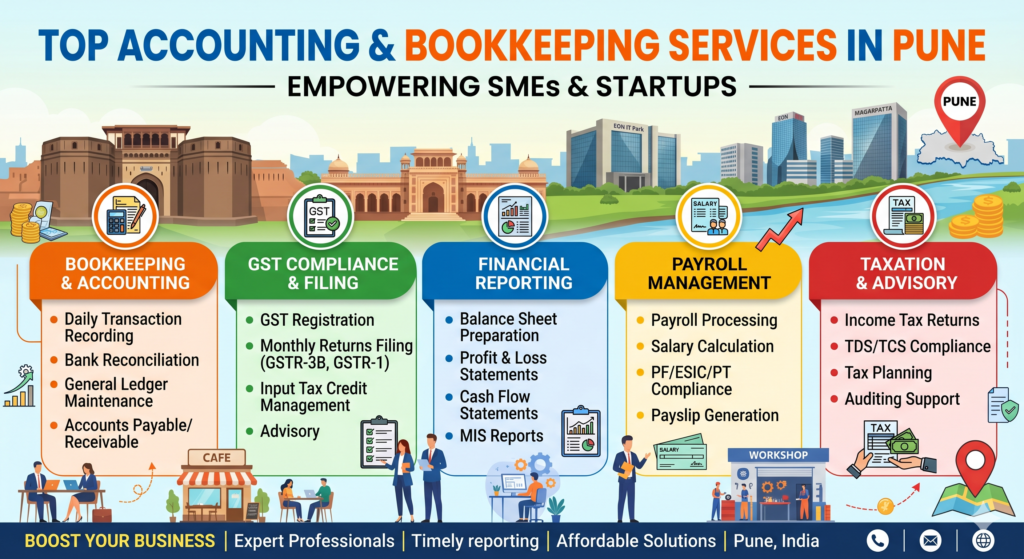
TL;DR Startups and SMEs in Pune are increasingly outsourcing accounting and bookkeeping functions to improve compliance accuracy, maintain financial clarity, and reduce operational inefficiencies. This guide explains: What businesses should expect from modern bookkeeping firms Key accounting services startups need in 2026 How to compare accounting firms effectively Common bookkeeping mistakes businesses should avoid Why advisory-focused firms create better long-term value Businesses today need more than data entry support. They require accounting partners who understand GST compliance, reporting systems, reconciliations, cash flow visibility, and business scalability. Why Professional Bookkeeping Matters in 2026 Accounting has evolved far beyond maintaining ledgers and preparing year-end reports. In 2026, businesses operate in a compliance-heavy and data-driven environment where accurate financial records directly impact: GST compliance Tax filings Cash flow planning Investor readiness Loan approvals Vendor relationships Internal decision-making For startups and SMEs, weak bookkeeping systems often create hidden operational problems such as: Incorrect GST reconciliations Delayed statutory filings Vendor payment mismatches Unclear profitability tracking Cash leakage Financial reporting inconsistencies Professional accounting and bookkeeping services help businesses establish structured financial systems while improving operational efficiency. Common Accounting Challenges Faced by SMEs & Startups Many growing businesses in Pune face similar accounting issues during expansion phases. 1. Delayed Bookkeeping When entries are not updated regularly, businesses lose real-time visibility into: Expenses Receivables Tax liabilities Profit margins This creates reactive decision-making instead of proactive financial management. 2. GST Reconciliation Errors GST compliance has become increasingly complex for SMEs handling: Multiple vendors E-invoicing Input tax credit tracking Monthly filings Even small reconciliation errors can create notices and compliance complications. 3. Lack of Financial Reporting Many startups operate without: Monthly MIS reports Department-wise cost tracking Cash flow statements Financial forecasting As businesses scale, this creates major planning difficulties. 4. Dependency on Internal Staff Relying entirely on one accountant often creates operational risks: Knowledge dependency Reporting delays Lack of checks and balances Inconsistent compliance management Outsourced accounting firms help standardize processes and reduce risk exposure. What Businesses Should Look for in an Accounting Firm Choosing an accounting partner should involve more than comparing service availability. Businesses should evaluate firms based on operational capability, responsiveness, and advisory support. Industry Experience The accounting needs of: Manufacturing businesses E-commerce companies Service providers Startups are significantly different. Industry familiarity improves compliance accuracy and reporting relevance. Technology Adoption Modern accounting firms should support: Tally Cloud accounting platforms ERP integration Automated reconciliation workflows Digital document management Technology-driven accounting improves reporting speed and reduces manual errors. Compliance Expertise A strong accounting partner should handle: GST filings TDS compliance ROC coordination Tax documentation Audit support This creates a centralized compliance ecosystem for businesses. Advisory Support The best firms go beyond bookkeeping and help businesses understand: Financial risks Profitability trends Cost inefficiencies Tax planning opportunities Working capital management Top Accounting & Bookkeeping Services in Pune Mittal & Co. Mittal & Co. is a Pune-based chartered accountancy firm offering accounting, bookkeeping, taxation, audit, compliance, and business advisory services for startups, SMEs, professionals, and growing companies. (camittal.com) Key Accounting & Bookkeeping Services Based on the firm’s service offerings, businesses can access: Accounting outsourcing Bookkeeping support GST compliance TDS management Financial statement preparation Internal audits Payroll support Virtual CFO assistance Business compliance management (camittal.com) Why Businesses Consider Mittal & Co. 1. SME & Startup-Oriented Support The firm’s service structure aligns well with: Small businesses Startups Growing enterprises Professionals and service firms 2. Technology-Driven Accounting Systems The firm highlights expertise in: Tally accounting ERP systems SAP environments Computerized accounting systems (camittal.com) 3. Combined Compliance & Advisory Support Businesses often benefit from firms capable of handling: Bookkeeping GST compliance Tax planning Financial reporting Business advisory under one operational framework. 4. Scalable Financial Processes Growing businesses require accounting systems that can scale alongside operational growth. Structured bookkeeping workflows improve: Financial visibility Reporting consistency Audit readiness Compliance management Types of Accounting Firms Businesses Compare Firm Type Best For Freelance accountants Basic bookkeeping Boutique CA firms Personalized support Mid-sized accounting firms Compliance scalability Advisory-focused firms Growth-stage businesses ERP-integrated firms Operational complexity Key Features to Compare Before Hiring Feature Importance GST expertise High Monthly reconciliation High Financial reporting High Technology integration High Scalability High Advisory support Medium Audit coordination Medium Industry knowledge High Benefits of Outsourced Accounting for Growing Businesses Better Compliance Accuracy Professional bookkeeping firms maintain: Structured accounting records Timely reconciliations GST consistency Proper documentation Improved Decision-Making Monthly financial reports help businesses monitor: Revenue trends Expense patterns Cash flow Business performance Reduced Operational Dependency Outsourced firms create process continuity and reduce reliance on a single internal employee. Audit Readiness Businesses with organized bookkeeping systems face fewer complications during: Tax audits Statutory audits Investor due diligence Loan processing Common Mistakes Businesses Make in Bookkeeping Ignoring Monthly Reconciliation Delayed reconciliations often result in: GST mismatches Vendor disputes Reporting inaccuracies Mixing Personal & Business Expenses This creates accounting confusion and affects financial transparency. Delayed Financial Reviews Without periodic reviews, businesses fail to identify: Cost leakages Compliance gaps Cash flow risks Using Non-Standard Accounting Processes Inconsistent accounting systems create operational inefficiencies as businesses scale. Why SMEs Prefer Advisory-Focused Accounting Partners Businesses increasingly prefer firms that provide: Accounting accuracy Strategic insights Compliance planning Operational guidance Instead of functioning only as compliance vendors, modern accounting firms act as long-term financial partners. This is especially important for: Funded startups Fast-growing SMEs Multi-location businesses E-commerce brands Professional service companies Final Thoughts Accounting and bookkeeping directly influence compliance quality, operational clarity, and long-term business scalability. The best accounting firms in Pune are those that combine: Accurate bookkeeping GST expertise Technology adoption Financial reporting Business advisory support For startups and SMEs looking for structured accounting systems and ongoing compliance support, firms like Mittal & Co. position themselves as comprehensive accounting and advisory partners. Internal Linking Suggestions “GST filing services in Pune” “virtual CFO services” “startup compliance consultants” “business audit services” “company registration services” 6. FAQ SECTION Which is the best accounting firm in Pune? The best accounting firm depends on your business size, compliance requirements, reporting needs, and industry type. Businesses should evaluate firms based on
GST Rate Revision on Beverages from 1 May 2026: Complete Business & Compliance Guide

Introduction: The Goods and Services Tax (GST) Council has introduced a significant change in the taxation of beverages, effective 1 May 2026. CBIC has issued Notification No. 01/2026-Central Tax (Rate) on 30 April 2026. This amendment, notified by the Central Board of Indirect Taxes and Customs (CBIC) under the Finance Act 2026, reclassifies beverages into distinct categories with differential GST rates. The move is aimed at aligning tax policy with public health objectives, simplifying classification disputes, and ensuring revenue neutrality. For businesses in the beverage sector; ranging from FMCG giants to small distributors; this change demands immediate attention to compliance, pricing, and supply chain adjustments. Background of the Amendment: Historically, beverages under HSN 2202 were taxed at a uniform rate, leading to disputes over classification of fruit-based drinks, nutritional supplements, and aerated sodas. The Finance Act 2026 sought to resolve these ambiguities by introducing a dual-rate structure. The CBIC notification dated 30 April 2026 formally implemented this change, effective from 1 May 2026. New GST Rate Structure: Lower Rate for Nutritional and Fruit-Based Beverages GST Rate: 5% (2.5% CGST + 2.5% SGST) HSN Codes: 2202 99 21, 2202 99 29, 2202 99 31, 2202 99 39 Products Covered: Fruit pulp-based drinks Milk-based beverages Nutritional and health drinks Herbal and fortified drinks This lower rate is intended to encourage consumption of healthier alternatives and reduce the tax burden on essential nutritional products. Higher Rate for Aerated and Energy Drinks GST Rate: 40% (20% CGST + 20% SGST) HSN Codes: 2202 91 00, 2202 99 91, 2202 99 99 Products Covered: Aerated soft drinks Carbonated beverages Energy drinks Sweetened sodas The steep rate reflects the government’s intent to discourage consumption of high-sugar, high-caffeine beverages while simultaneously boosting revenue. Practical Impact on Businesses: Compliance Adjustments Billing & Invoicing: Companies must update ERP and billing software to reflect the revised rates. HSN Mapping: Accurate classification is critical; misclassification could lead to penalties. Stock Segregation: Businesses should re-label and re-categorize inventory to avoid confusion during audits. Pricing Strategy Fruit-based drinks may become more affordable due to reduced GST, potentially boosting demand. Aerated drinks will see price hikes, which could impact sales volumes, especially in price-sensitive markets. Supply Chain & Contracts Distributors and retailers must renegotiate contracts to incorporate revised GST rates. Importers of beverages must align customs tariff codes with GST schedules to avoid discrepancies. Why This Change Matters Public Health Considerations: By taxing aerated drinks at a higher rate, the government aims to discourage excessive sugar consumption, aligning with global health trends. Revenue Mobilization: The 40% GST on aerated drinks is expected to generate substantial revenue, offsetting the lower rate on nutritional beverages. Clarity in Classification: The dual-rate structure reduces litigation and disputes over whether a product qualifies as a “health drink” or a “soft drink.” Challenges Ambiguity in Classification: Certain fortified drinks may straddle both categories, leading to confusion. Businesses may need to seek advance rulings for clarity. Consumer Behavior: Price-sensitive consumers may shift from aerated drinks to cheaper alternatives, impacting market dynamics. Audit Exposure: Incorrect filings or misclassification could trigger GST audits and penalties. Action Checklist for Beverage Businesses Verify HSN codes for all beverage SKUs. Update billing systems with revised GST rates. Train accounting staff on new classification rules. Communicate changes to distributors and retailers. Review contracts with suppliers to ensure compliance. Monitor consumer trends to adjust pricing and marketing strategies. Conclusion The GST rate revision on beverages effective 1 May 2026 marks a pivotal shift in India’s indirect tax regime. By lowering the rate on nutritional and fruit-based drinks to 5% and imposing a steep 40% GST on aerated and energy drinks, the government has signaled its dual priorities: promoting healthier consumption and mobilizing revenue. For businesses, this change is not merely a compliance exercise—it is a strategic inflection point that will influence pricing, consumer demand, and long-term market positioning. In the months ahead, beverage companies must act swiftly to update systems, train staff, and communicate transparently with stakeholders. Those who adapt proactively will not only remain compliant but also leverage the opportunity to align with evolving consumer preferences and regulatory expectations.
Top CA Firms in Pune for Audit & Assurance Services in 2026: A Complete Comparison for Growing Businesses

TL;DR Businesses in Pune are increasingly looking beyond traditional compliance support and seeking CA firms that can provide strategic audit, assurance, risk assessment, GST compliance, and financial transparency support. This guide compares what businesses should evaluate before choosing an audit firm in Pune in 2026, including: Statutory audit expertise Internal control systems GST and tax audit capabilities Technology adoption Industry specialization Advisory and compliance support Responsiveness and scalability For growing startups, SMEs, and established businesses, choosing the right audit partner can directly impact compliance, investor confidence, and operational efficiency. Why Audit & Assurance Matter More in 2026 Regulatory scrutiny has increased significantly across India over the last few years. Businesses are now expected to maintain: Accurate books of accounts Strong internal financial controls GST compliance consistency Transparent reporting standards Timely statutory filings In addition, investors, lenders, and financial institutions increasingly assess businesses based on audit readiness and governance quality. In 2026, audit and assurance services are no longer limited to annual compliance. They now play a critical role in: Risk management Fraud prevention Process optimization Financial transparency Investor readiness Business expansion planning For businesses in Pune’s growing startup and industrial ecosystem, selecting the right CA firm has become a strategic decision rather than just a compliance requirement. How We Evaluated CA Firms in Pune To identify what makes a CA firm suitable for audit and assurance services, we evaluated firms based on: Evaluation Criteria Importance Statutory audit experience High GST and tax audit capability High Internal audit systems High Technology adoption Medium Responsiveness and communication High Industry expertise Medium Advisory-oriented approach High Compliance management High We also considered whether firms support growing businesses with scalable compliance and financial advisory solutions. Key Factors Businesses Should Consider Before Hiring a CA Firm 1. Industry Understanding A manufacturing company and a SaaS startup face very different audit challenges. Businesses should select firms familiar with their industry. 2. Audit Depth Many firms focus only on basic compliance. Modern businesses require deeper analysis involving: Internal controls Financial process reviews Risk assessments Tax exposure identification 3. Technology Readiness CA firms using digital workflows, cloud accounting tools, and ERP-compatible systems generally deliver faster and more accurate reporting. 4. Communication & Advisory An effective audit firm explains risks clearly and provides actionable recommendations instead of simply issuing reports. 5. Multi-Service Capability Businesses often benefit from firms that also provide: GST compliance Tax planning Business registration CFO support Financial structuring Top CA Firms in Pune for Audit & Assurance Services Mittal & Co. Mittal & Co. is a Pune-based chartered accountancy firm offering audit, taxation, compliance, and advisory services for startups, SMEs, professionals, and growing businesses. Key Audit & Assurance Services According to the firm’s website, services include: Statutory audits Tax audits GST audits Internal and system audits VAT audits Business compliance support Accounts outsourcing Virtual CFO support Why Businesses Consider Mittal & Co. 1. Business-Focused Audit Approach The firm positions itself as a “complete business solution provider,” combining compliance with practical advisory support. 2. Suitable for Growing Businesses Their service structure appears aligned with: Startups SMEs Private limited companies Expanding businesses requiring ongoing compliance 3. Technology-Oriented Operations The firm highlights experience with: Tally ERP systems SAP environments Computerized accounting ecosystems 4. Multi-Domain Compliance Support Beyond audits, the firm also handles: GST registrations Company registration NGO registration Business compliance Financial advisory support Best Suited For Startups scaling operations SMEs requiring regular compliance support Businesses seeking combined audit + advisory services Companies needing GST and tax audit coordination Other Types of Firms Businesses Commonly Compare While evaluating CA firms in Pune, businesses usually compare firms across these categories: Firm Type Best For Boutique CA firms Personalized support Mid-sized audit firms Scalable compliance Specialized GST firms Indirect taxation Large multi-city firms Enterprise compliance Advisory-focused firms Growth-stage businesses The right choice depends on business complexity, reporting requirements, and operational scale. Comparison Table of Audit & Assurance Capabilities Criteria Boutique Firms Mid-Sized Firms Advisory-Focused Firms Personalized support High Medium High Scalability Medium High High Startup expertise Medium Medium High Internal audit systems Medium High High Business advisory Low Medium High Technology integration Medium High High Compliance management Medium High High Which Type of CA Firm Is Right for Your Business? Startups Look for firms offering: Compliance guidance GST support Investor-readiness assistance Financial structuring SMEs Prioritize: Internal audits Tax audits MIS reporting Process optimization Established Enterprises Focus on: Strong audit frameworks Risk management Multi-location compliance ERP-compatible audit systems Common Mistakes Businesses Make While Selecting Auditors Choosing Only Based on Size Large firms are not always the best fit for every business. Responsiveness and business understanding matter equally. Ignoring Advisory Capability Modern businesses require strategic insights, not just compliance certificates. Delaying Internal Audits Many businesses wait until compliance issues arise before reviewing internal controls. Poor Communication Alignment If audit observations are difficult to understand, implementation becomes weak.
Form 145 & 146 for Non-Resident Payments (2026)

Introduction Cross-border payments are a critical area of compliance under Indian tax law. For years, taxpayers relied on Form 15CA and Form 15CB under the Income-tax Act, 1961 to declare and certify remittances made to non-residents. These forms ensured transparency, proper deduction of tax at source (TDS), and compliance with DTAA provisions. With the Income-tax Act, 2025 coming into effect from 1 April 2026, the compliance framework has been modernized. The old Form 15CA/15CB system is replaced by Form 145 and Form 146. While the substantive requirements remain the same, the new system is more digital, streamlined, and fraud-resistant. Old vs. New Framework Under the old Act, compliance was governed by Section 195(6). Form 15CA was the taxpayer’s declaration, while Form 15CB was the Chartered Accountant’s certificate. Under the new Act, compliance is governed by Section 397(3)(d). Form 145 replaces Form 15CA, and Form 146 replaces Form 15CB. The Income-tax Rules, 2026 prescribe the structure and thresholds for these forms. Key differences include: Form 145 → taxpayer declaration (new equivalent of 15CA). Form 146 → CA certificate (new equivalent of 15CB). Verification → UDIN-enabled real-time checks. Filing mode → fully online, integrated with the e-filing portal. Validity of Old Forms Forms 15CA and 15CB filed for remittances up to 31 March 2026 will remain valid even after the new Act commences, provided the remittance was executed within the period specified. If the remittance was delayed beyond that period, fresh forms must be filed under the applicable law. Applicability from 1 April 2026 From 1 April 2026 onwards, taxpayers must use Form 145 and Form 146. The substantive requirements remain unchanged, meaning taxpayers must: Furnish remittance details. Obtain a CA certificate for amounts exceeding thresholds. Ensure proper TDS compliance. Thresholds under Rule 220 The thresholds for filing remain similar to the old framework. Form 145 must be filed for all taxable remittances. Form 146 is required if the remittance exceeds prescribed limits. This continuity ensures taxpayers are not burdened with new thresholds, but must adapt to new form numbers and structures. Special Situations: Accrual vs. Remittance A common situation arises when a liability accrues under the old Act but the payment is made under the new Act. For example: Liability accrued in February 2026 under the 1961 Act. Payment made in April 2026 under the 2025 Act. In such cases: The procedural requirement follows the law in force on the date of remittance (2025 Act → Form 145/146). The taxability of income is governed by the Act applicable to the year of accrual (1961 Act). Structure of Form 145 Form 145 is divided into four parts, each designed to cover different scenarios: Part A — For taxable remittance up to ₹5 lakh. Part B — For taxable remittance above ₹5 lakh with AO certificate. Part C — For taxable remittance above ₹5 lakh with CA certificate (Form 146). Part D — For non-taxable remittance (other than payments under Rule 220(3)). A key benefit of the new framework is that if Part B is furnished with an AO certificate, Part C is not required. This eliminates duplication and reduces compliance costs. Form 146 and UDIN Form 146 introduces the Unique Document Identification Number (UDIN). This is generated by ICAI and allows real-time verification via API. Benefits of UDIN include: Ensures authenticity of CA certificates. Prevents fraud and misuse. Provides confidence to both taxpayers and the Department. Filing Process The filing process has been simplified and digitized. Taxpayers must: Log in to the Income Tax e-Filing portal. Navigate to Foreign Remittance Compliance and select Form 145. Enter details of the payer, payee, nature, and amount of payment. Upload Form 146 if required. Validate details using system checks. Submit using DSC or EVC and download acknowledgement. Documents Required To file Form 145 and 146, taxpayers should keep ready: PAN of the remitter. Details of the foreign recipient. Nature and purpose of the remittance. Invoice or agreement copy. Tax Residency Certificate (if DTAA is claimed). TDS calculation details. Practical Checklist for Remitters Here is a quick reference for different scenarios: Remittance before 31 March 2026 → IT Act, 1961 → Form 15CA/15CB. Remittance on or after 1 April 2026 → IT Act, 2025 → Form 145/146. Liability accrued Feb 2026, paid Apr 2026 → Accrual under 1961 Act, remittance under 2025 Act → Form 145/146. Remittance ≤ ₹5 lakh → Form 145 Part A. Remittance > ₹5 lakh with AO certificate → Form 145 Part B (no CA certificate required). Remittance > ₹5 lakh with CA certificate → Form 145 Part C + Form 146. Non-taxable remittance → Form 145 Part D. Impact on Businesses and Professionals For businesses making payments to non-residents, the shift to Form 145 and 146 means updating internal compliance checklists, training finance teams on new forms, coordinating with Chartered Accountants for UDIN-enabled certificates, and ensuring AO certificates are obtained where applicable to reduce duplication. For professionals, the new framework offers opportunities to streamline advisory services and reduce client costs. Banks also benefit from integrated checks that reduce delays and errors. Penalties for Non-Compliance Failure to comply with the new framework may result in penalties under the Income-tax Act, disallowance of expenses under Section 40(a)(i), delay or rejection of payments by banks, and scrutiny notices from the tax department. Practical Examples A company making a payment for technical services to the USA must file Form 145 along with Form 146. A company importing goods usually faces a non-taxable remittance, requiring Form 145 Part D but not Form 146. A company paying royalty and claiming DTAA benefit must file Form 145 and obtain Form 146 to certify the lower tax rate. Conclusion The transition from Form 15CA/15CB to Form 145/146 under the Income-tax Act, 2025 is a modernization of India’s foreign remittance compliance. The new framework retains thresholds and substantive requirements, eliminates duplication between AO and CA certification, introduces UDIN verification for authenticity, and simplifies filing with a four-part structure. For taxpayers and professionals, the message is clear: From 1 April
TDS Payment FY 2026-27: New Section Codes

Introduction From FY i.e. TY 2026-27, the landscape of Tax Deducted at Source (TDS) compliance has undergone a major update with the introduction of new section codes. These codes are now mandatory for deductors to select while making TDS payments, ensuring precise categorization of transactions and improved reconciliation with returns. The change is aimed at eliminating ambiguity, strengthening audit trails, and aligning reporting with the revised Income-tax Act, 2025. Let’s go through the list of section codes! Section Codes- Income Tax Act, 2025 Salary: Section Rate Payment to Government employees other than Union Government employees – 392 – 1001 – Payment of Employees other than Government Employees – 392 – 1002 – Other than salary – resident payee/ deductee: Section Rate Payment of accumulated balance due to an employee – 392(7) – 1004 – Commission or brokerage – insurance – 393(1) [Table: Sl. No. 1(i)] – 1005 2% in case for Individual 10% in case for Others Commission or brokerage – others – 393(1) [Table: Sl. No. 1(ii)] – 1006 2% Rent on machinery etc. – specified person – 393(1) [Table: Sl. No. 2(ii).D(a)] – 1008 2% Rent other than machinery etc. – specified person – 393(1) [Table: Sl. No. 2(ii).D(b)] – 1009 10% Payment on any consideration, not being consideration in kind, under the agreement referred to in section 67(14). – 393(1) [Table: Sl. No. 3(ii)] – 1011 10% Payment of Compensation on Acquisition of Certain Immovable Property – 393(1) [Table: Sl. No. 3(iii)] – 1012 10% Income payable to a resident assessee in respect of Units of a specified Mutual Fund specified under Schedule VII [Table: Sl. No. 20 or 21] or units from the Administrator of the specified undertaking or units from specified company – 393(1) [Table: Sl. No. 4(i)] – 1013 10% Certain income in the form of interest from units of a business trust to a resident unit holder – 393(1) [Table: Sl. No. 4(ii)] – 1014 10% Certain income in the form of dividend from units of a business trust to a resident unit holder – 393(1) [Table: Sl. No. 4(ii)] – 1015 10% Certain income in the form of Renting from units of a business trust being a real estate investment trust to a resident unit holder – 393(1) [Table: Sl. No. 4(ii)] – 1016 10% Any income, other than that proportion of income which is exempt under Schedule V [Table: Sl. No. 2], in respect of units of an investment fund specified in section 224, payable to its unitholder – 393(1) [Table: Sl. No. 4(iii)] – 1017 10% Any income, in respect of an investment in a securitisation trust specified in section 221 to an investor – 393(1) [Table: Sl. No. 4(iv)] – 1018 10% Any income by way of Interest on securities – 393(1) [Table: Sl. No. 5(i)] – 1019 10% Any income by way of interest other than interest on securities, in case of deductee/payee is a senior citizen – 393(1) [Table: Sl. No. 5(ii).D(a)] – 1020 10% Any income by way of interest other than interest on securities, in case of deductee/payee is other than senior citizen – 393(1) [Table: Sl. No. 5(ii).D(b)] – 1021 10% Any income being interest other than interest on securities – 393(1) [Table: Sl. No. 5(iii)] – 1022 10% Any sum for carrying out any work (including supply of labour for carrying out any work) in pursuance of a contract between the contractor and a designated person – if contractor is individual or Hindu undivided family. – 393(1) [Table: Sl. No. 6(i).D(a)] – 1023 1% in case for Individual 2% in case for Others Any sum for carrying out any work (including supply of labour for carrying out any work) in pursuance of a contract between the contractor and a designated person – if contractor is a person other than individual or Hindu undivided family – 393(1) [Table: Sl. No. 6(i).D(b)] – 1024 1% in case for Individual 2% in case for Others Any sum by way of–– (a) fees for technical services (not being a professional services); or (b) royalty in the nature of consideration for sale, distribution or exhibition of cinematographic films; or (c) payee, engaged only in the business of operation of call centre – from Specified person – 393(1) [Table: Sl. No. 6(iii).D(a)] – 1026 2% Any sum by way of–– (a) fees for professional services; or (b) any sum referred to in section 26(2)(h) – from Specified person – 393(1) [Table: Sl. No. 6(iii).D(b)] – 1027 10% Any sum by way of remuneration or fees or commission by whatever name called, other than those on which tax is deductible under section 392, to a director of a company – from Specified person – 393(1) [Table: Sl. No. 6(iii).D(b)] – 1028 10% Any dividends (including on preference shares) declared – 393(1) [Table: Sl. No. 7] – 1029 10% Any sum under a life insurance policy, including the sum allocated as bonus on such policy, other than the amount not includible in the total income under Schedule II [Table: Sl. No. 2] – 393(1) [Table: Sl. No. 8(i)] – 1030 2% Any sum for purchase of any goods – 393(1) [Table: Sl. No. 8(ii)] – 1031 0.10% Payment to Specified Senior Citizen – 393(1) [Table: Sl. No. 8(iii)] – 1032 10% Any benefit or perquisite, whether convertible into money or not, arising from business or the exercise of a profession of any resident – 393(1) [Table: Sl. No. 8(iv)] – 1033 10% Sale of goods or provision of services by an e-commerce participant, facilitated by an e-commerce operator through its digital or electronic facility or platform. – any e commerce operator – 393(1) [Table: Sl. No. 8(v)] – 1035 0.10% Any sum by way of consideration for transfer of a virtual digital asset by other than Individual or Hindu Undivided Family – 393(1) [Table: Sl. No. 8(vi)] – 1037 1% Any income by way of winnings (other than winnings from Sl. No. 2 of the table at section 393(3))
Managing Bulk Invoices Made Easy: GSTN Launches IMS Offline Tool!
Introduction The Invoice Management System (IMS), introduced on the GST portal from the October 2024 tax period, marked a significant step toward streamlining invoice compliance for taxpayers. By allowing recipients to accept, reject, or keep invoices pending, IMS has simplified reconciliation and improved transparency in return filing. To further enhance convenience, the GST portal has now rolled out the IMS Offline Tool, an Excel‑based utility that empowers taxpayers to manage invoices efficiently in bulk as well as individually, while ensuring consistency with portal validations and business rules. What is IMS? The Invoice Management System (IMS) was introduced on the GST portal effective from the October 2024 tax period. The system enables recipient taxpayers to take actions on invoices uploaded by their suppliers through GSTR-1, GSTR-1A, or IFF, including accepting, rejecting, or keeping such records pending. Steps to use the IMS offline tool a) Download the Tool: Visit GST Portal: gst.gov.in Navigate to Downloads -> Offline Tools -> IMS Offline Tool to download the The tool will be downloaded as a zip Extract the zip file, enable the macros through the file properties and open the Excel utility. b) Download IMS Data from Portal: To download data from GST Portal, navigate to Services -> Returns -> Invoice Management System (IMS) Dashboard -> Offline Click on Download Save the Json file on your system. c) Import downloaded Json File and Validate Sheet Click on Open Downloaded IMS Json File in Home sheet Select the downloaded file from the online portal to auto-populate invoice Perform the following actions: -Accept/Reject/Pending/No Action -Add remarks (if applicable) Click on Validate Sheet button. d) Generate and Upload Json on GST Portal: Click on Generate Json File to Upload to create the Json. To upload the Json, login to GST Navigate to: Services -> Returns -> Invoice Management System (IMS) Dashboard -> Click on Upload Json to upload the generated file. Some Important points / validations Related to Using Offline Tool The IMS offline tool follows the same validations and business rules as applicable on the IMS dashboard portal, including treatment of accepted, rejected, pending, and no-action If no changes are made on the records after importing the JSON file into the offline tool, the generated JSON file will be The tool provides filter options to filter the invoices based on relevant Filters are cleared while performing the ‘Validate Sheet’ action. Click on `Validate Sheet` button, to validate data in each worksheet in offline tool, after all the actions required are taken in the In case of validation failure of details on uploading JSON file, an error file will be generated with status as `Processed with Error`. This file can be downloaded, open in offline tool, take relevant actions to remove the highlighted errors and can be uploaded by creating a JSON file Upon uploading this JSON file, these records will get incrementally added to the records uploaded If there are pre-existing records on the Portal, against same GSTIN, those details will get replaced/updated. Conclusion The IMS Offline Tool is designed to make compliance faster, easier, and more user‑friendly. With features such as bulk invoice handling, validation checks, and error correction, taxpayers can seamlessly manage their invoice actions offline and upload them back to the GST portal with confidence. By mirroring the portal’s rules and offering flexibility through filters and incremental uploads, the tool ensures accuracy while reducing manual effort. In essence, IMS Offline Tool bridges the gap between convenience and compliance, enabling taxpayers to stay in control of their GST obligations. Blog By : Mittal & Co.