
31st March 2026 is the cut off date for TDS/TCS Correction Statements for FY 2018-19 to FY 2023-24!
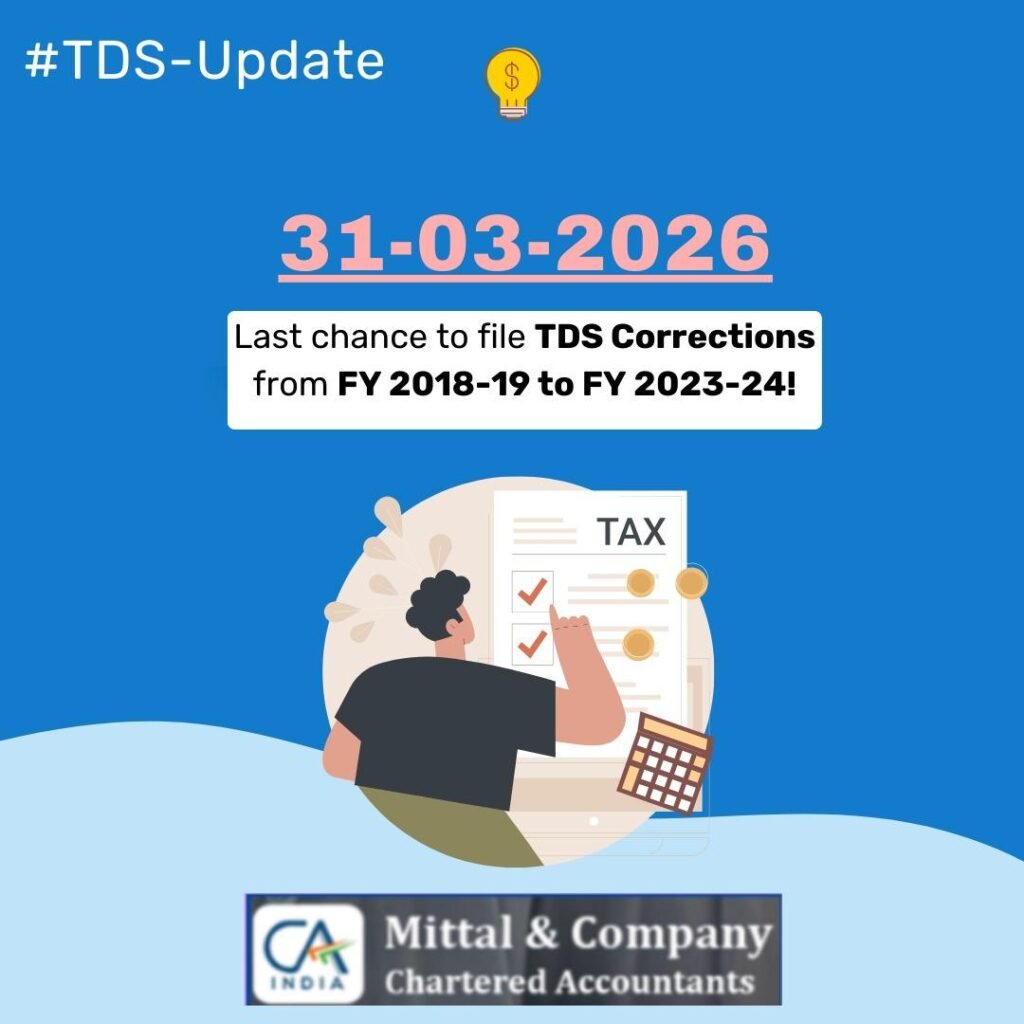
Introduction Tax Deductors and collectors are permitted under the Income Tax law to rectify errors in filed TDS/TCS returns through correction statements. However, this facility is governed by a statutory limitation period. In view of Section 397(3)(f) of the Income Tax Act, 2025, the Income Tax Department has clarified that 31 March 2026 is the final statutory cut-off date for filing TDS/TCS correction statements for certain earlier financial years. No correction statements shall be accepted beyond this date. Applicability of cut off date of 31st March, 2026 TDS/TCS correction statements for the following periods can be filed only up to 31 March 2026:: All such statements shall become time-barred on 31.03.2026 and shall not be accepted from 01.04.2026 onwards. Wordings of Section 397(3)(f) of the Income Tax Act, 2025: The Income Tax Act 1961 stands repealed w.e.f 01.04.2026 by virtue of section 536 of Income Tax Act 2025. Further, as per section 397(3)(f) of Income Tax Act, 2025, deductor/collector may deliver a correction statement in such form and verified in such manner as may be prescribed, to the prescribed authority within two years from the end of the tax year in which such statement is required to be delivered under the said clauses or under section 200 of the Income-tax Act, 1961. Consequent to the above, correction statements for FY 2018-19 (Qtr. 4), FY 2019-20 to 2022-23 (Qtr. 1 to Qtr. 4) and FY 2023-24 (Qtr. 1 to Qtr. 3) shall be accepted only up-to 31st March 2026. The same are time barred by limitation on 31.03.2026 and would not be accepted from 01.04.2026 onwards. What steps are required from the end of Tax Deductors? This advisory requires immediate review of historical TDS/TCS filings. Any unresolved discrepancies, defaults, or errors relating to the above periods must be corrected before the limitation date. Typical cases requiring TDS Corrections TDS Correction statement is required to be filed specifically in 2 cases: This may happen due to following reasons: How to check TDS defaults on TRACES How to file TDS Correction Statements There are two types of correction statements as follows: Consequences of Non-Compliance After 31.03.2026 Failure to act within the limitation period may result in: Importantly, no condonation or relaxation is permissible once the limitation period expires. Advisory & Recommended Action Conclusion The limitation prescribed under Section 397(3)(f) of the Income Tax Act, 2025 brings final closure to past TDS/TCS corrections. With 31 March 2026 being the absolute statutory cut-off date, deductors and collectors must treat this as a critical compliance deadline. Proactive review and timely corrections are essential to prevent irreversible tax credit issues and compliance exposure in the future.
Job Change and Income Tax: Common Reasons for Extra Income Tax at the time of ITR!
Introduction Changing employment during a financial year is increasingly common among salaried taxpayers. However, many employees face an unexpected additional income tax liability at the time of filing their Income Tax Return, even though TDS has been deducted by both the previous and current employers. This additional tax payable primarily arises due to independent TDS computations, progressive slab rates, and non-consolidation of salary income during the year. Let’s understand the how the exact calculations are done in such cases. 1. Independent computation of TDS by multiple employers Under Section 192 of the Income-tax Act, 1961, an employer is required to deduct TDS based only on the salary paid by it. There is no flat rate of TDS in case of salary payment. Income Tax Act states that total TDS by the employer during the year should be equal to the tax liability of the employee on his salary income received from such employer after considering investment declaration. Being an Individual, tax is calculated at slab rates. When an employee changes jobs, each employer computes TDS independently without automatic visibility of salary paid by the other employer. Ideally, employee should submit Form 12B to the new employer which declares details of salary paid by previous employer. However, it is not mandatory form and employees do not prefer disclosing such information to the new employer. Therefore, due to non-submission of Form 12B to the new employer, salary income and TDS of the previous employment are not considered, resulting in short deduction of tax for the year. 2. Impact of progressive tax slab rates on combined income India follows a progressive tax rate structure, where higher income attracts higher tax rates. While salary from each employer may individually fall within a lower tax slab, the aggregate annual salary may fall into a higher slab (for example, 20% or 30%).Since slab-wise tax is applied on total income at the time of ITR filing, the difference between tax actually deducted and tax payable becomes recoverable from the taxpayer. 3. Duplication of standard deduction under Section 16(ia) The standard deduction under Section 16(ia) (Rs. 50,000 for old regime and Rs. 75,000 for new regime) is allowed only once from total salary and not separately for each employer. However, during a job change, both employers may allow the standard deduction while computing TDS.At the time of filing the return, the Income Tax Department allows this deduction only once, thereby increasing taxable salary income and leading to additional tax liability. 6. Mismatch in tax regime selection (Old vs New Regime) During job changes, employees may opt for a different tax regime with the new employer under Section 115BAC, without aligning it with the final choice made while filing the ITR.Differences in available exemptions, deductions, and slab rates between the old and new tax regimes may lead to variance in tax liability and additional tax payable. Example: Mr. A has changed the job during the year. Following are the details: How to Avoid Additional Tax Liability When Changing Jobs Conclusion Additional income tax payable in case of a job change arises mainly due to fragmented salary information, duplicate deductions, and independent TDS calculations by employers. This is a compliance issue rather than a tax demand anomaly. To avoid unexpected tax liability, employees should ensure timely submission of Form 12B, reconcile Form 16 from all employers, evaluate the appropriate tax regime, and periodically review their total annual income. Proactive tax planning during a job transition helps in optimizing tax liability and avoiding interest and penalties at the time of filing the ITR.
BEN-2 Filing for Indian Companies – WHAT, WHO & WHEN
Form BEN-2 is one of the most scrutinised ROC filings under the Companies Act, 2013. With increasing focus on transparency and identification of real owners, Indian companies must clearly identify when BEN-2 is applicable, who qualifies as an SBO, and how to comply correctly. This article explains BEN-2 filing in a practical, audit-ready manner. 1. What is Form BEN-2? Form BEN-2 is filed by an Indian company with the Registrar of Companies (ROC) to report details of its Significant Beneficial Owner (SBO). BEN-2 is in line with international practice followed by various countries to identify persons with significant control like PSC Register in UK, BOI Reporting in US and UBO Registers in European Union and many others. In India it is mandated under: The form is filed only after the company receives Form BEN-1 from the SBO. The first onus is on SBO to provide company with BEN-1 and then the company needs to file BEN-2 with ROC. 2. Objective of BEN-2 The intent of SBO provisions is to: 3. Who is a Significant Beneficial Owner (SBO)? The most important question now is who is Significant Beneficial Owner (SBO) Under Section 90 of the Act and the SBO Rules, 2018, SBO is an individual who, directly or indirectly, holds 10% or more of: [other than solely through direct holdings, for example, Individual holding more than say 50% shares in a company in his/her own name will not qualify as SBO.] Only individuals can be SBOs. Companies, LLPs, trusts, or funds can never be SBOs themselves. 4. When is BEN-2 filing applicable? BEN-2 is applicable only when an SBO is identified. Common situations where BEN-2 applies: So, share holding in a company via corporate structure would attract filing of BEN-2. The main purpose of BEN-2 is to identify the ultimate share holder who is holding more than 10% of in the company via shares, voting rights etc. 5. When BEN-2 is NOT applicable BEN-2 is not required in the following cases: In such cases, the company should issue BEN-4 notices and maintain internal working papers. 6. BEN-2 in case of LLP shareholding If an LLP holds shares in a company: If indirect holding ≥10%, that individual is SBO and BEN-2 must be filed. Individual should submit BEN-1 to the company for further compliance at company level 7. Timeline for BEN-2 filing Event Due date Receipt of BEN-1 from SBO Day 0, Immediately Filing of BEN-2 with ROC Within 30 days Change in SBO details Within 30 days of change Late filing attracts heavy penalties. Compliance should be done in a timely manner to avoid late fees and penalties. 8. Information & documents required Details in BEN-2: Attachments: 9. Penalties for non-compliance Failure to comply with SBO provisions may result in: Due to high penalties as compared to other ROC filings, BEN-2 is considered a high-risk ROC compliance. 10. Practical compliance tips 11. Statutory Provisions Conclusion Form BEN-2 is not a routine filing. It requires careful analysis of ownership structures, especially where LLPs, foreign companies, or trusts are involved. Indian companies should adopt a documented, methodical approach to SBO compliance to avoid penalties and ROC objections. If in doubt, it is always better to document reasons for non-applicability rather than assuming as not applicable. PRACTICAL GUIDE QnA FAQ 1: Is BEN-2 required if shares are held directly by an individual? No. If shares are held directly by an individual (Indian or foreign), SBO provisions do not apply and BEN-2 is not required. FAQ 2: Is BEN-2 applicable if the shareholder is an LLP? BEN-2 is applicable only if an individual partner of the LLP ultimately holds 10% or more indirect interest in the company. FAQ 3: Is BEN-2 required if no SBO is identified? No. If no individual qualifies as SBO, BEN-2 should not be filed. The company must issue BEN-4 notices and maintain internal records in case of non-individual shareholders. FAQ 4: Does BEN-2 apply to foreign shareholders? Yes. Foreign nationality is irrelevant. Same as Indian’s, even for a foreign individual who holds 10% or more indirect interest or control, BEN-2 applies. FAQ 5: Is BEN-2 required every year? No. BEN-2 is an event-based filing and is required only: Case-Based Examples Case 1: Direct individual shareholding (No BEN-2) Mr. A directly holds 20% shares in XYZ Pvt Ltd. Result: Not an SBO → BEN-2 not applicable. Case 2: Holding through LLP (BEN-2 applicable) Indirect holding = 18% Result: Mr. B is SBO → BEN-1 + BEN-2 applicable. Case 3: Multiple partners in LLP Result: Partner A is SBO → BEN-2 applicable only for Partner A. Case 4: Foreign company structure Indirect holding = 14% Result: Mr. X is SBO → BEN-2 applicable. Case 5: Trust holding Result: Trustee treated as SBO → BEN-2 applicable. Final Practitioner Note BEN-2 filing should always be supported by a documented SBO identification note. Incorrect filing or unnecessary filing may invite ROC scrutiny. This article is intended for informational purposes for Indian companies, professionals, and compliance teams.
How to Navigate Foreign Business Setup in India: Key Considerations & Mistakes to Avoid
Introduction India is one of the world’s fastest-growing economies—and a top destination for foreign companies looking to expand. With a booming consumer market, skilled workforce, and favourable government policies, the opportunity is huge. But entering India is not as simple as opening an office. Foreign businesses must navigate India’s regulatory framework, FEMA rules, tax structure, entity setup, cross-border remittances, and compliance requirements. At Mittal & Company, we regularly assist foreign subsidiaries, multinational companies, and global entrepreneurs entering the Indian market—especially in Pune, Mumbai, Bengaluru and NCR. This guide covers the key considerations, legal requirements, and common mistakes to avoid when setting up a foreign business in India. 1️⃣ Choose the Right Entry Strategy Foreign businesses can enter India through multiple routes. Selecting the wrong mode can lead to delays, compliance issues, or higher taxes. ✔️ Common Entry Structures a. Liaison Office (LO) No commercial activity allowed Only communication & coordination Cannot earn income in India Requires RBI approval Best for: Market research, early-stage presence. b. Branch Office (BO) Can earn revenue Allowed for import/export, consultancy, IT services, R&D No manufacturing allowed Best for: Project-based or service-based foreign companies. c. Project Office Set up for executing a specific project Automatically approved if project is funded by an Indian entity Best for: EPC, construction, infrastructure, oil & gas companies. d. Wholly Owned Subsidiary (WOS) / Private Limited Company 100% foreign ownership allowed in many sectors Separate legal & tax entity Best structure for long-term operations Best for: Technology, manufacturing, trading, consulting, or long-term presence. 2️⃣ Understand FEMA & FDI Rules Every foreign investment entering India is regulated under the Foreign Exchange Management Act (FEMA) and overseen by the Reserve Bank of India (RBI). Key FEMA Considerations: Check whether your sector allows Automatic Route or requires Government Approval Report investment inflows within 30 days File FC-GPR after allotting shares Ensure share valuation as per RBI guidelines Maintain compliance for repatriation of profits ⚠️ Mistake to Avoid: Many foreign founders invest funds before verifying sector permissions, causing major delays and compliance violations. 3️⃣ Mandatory Registrations & Legal Requirements Once your business structure is chosen, complete these registrations: ✔️ Company Incorporation (if forming a subsidiary) Name approval Digital Signature (DSC) DIN for foreign directors SPICe+ incorporation form PAN & TAN Bank account setup ✔️ Other Key Registrations GST Registration Shop & Establishment License (Pune or PCMC) Professional Tax IEC Code for import/export EPF/ESIC (if hiring employees) ✔️ Sector-Specific Approvals Some industries require additional approvals: NBFC, fintech Defence Media Retail (FDI-regulated) Real estate 4️⃣ Taxation Considerations for Foreign Businesses Indian taxation is complex—understanding it early saves major headaches. ✔️ Key Tax Components: Corporate Income Tax (22% or 15% for new manufacturing units) GST Transfer Pricing compliance TDS on foreign remittances Equalisation Levy (for certain digital services) DTAA benefits (Double Taxation Avoidance Agreement) ✔️ Transfer Pricing Rules All transactions between your Indian subsidiary and foreign parent must be: “At Arm’s Length Price”, and supported with proper documentation. ⚠️ Mistake to Avoid: Not maintaining transfer pricing files can lead to heavy penalties during audits. 5️⃣ Operational Considerations for Foreign Entities To operate smoothly in India, foreign businesses must plan for: ✔️ Hiring & HR Compliance Employment contracts Payroll systems PF & ESIC Gratuity, bonuses, statutory leaves ✔️ Banking & Repatriation Authorized dealer bank selection Repatriation of profits under FEMA Correct withholding tax ✔️ Accounting & Audit Maintain books as per Indian Accounting Standards File annual audit report File TDS, GST, ROC returns 6️⃣ Common Mistakes Foreign Companies Make (and How to Avoid Them) ❌ Mistake 1: Choosing the wrong business structure Many companies choose a Liaison Office but later realise it cannot invoice or earn revenue. ✔ Fix: Evaluate the long-term business model before deciding. WOS is usually the safest option. ❌ Mistake 2: Ignoring FEMA & RBI reporting Foreign companies often miss FC-GPR filings or share allotment deadlines. ✔ Fix: Maintain a compliance calendar. Work with a CA firm experienced in foreign setups. ❌ Mistake 3: Not accounting for transfer pricing Incorrect pricing between parent & subsidiary leads to tax scrutiny. ✔ Fix: Ensure proper benchmarking and documentation. ❌ Mistake 4: Using incorrect tax structures Some founders treat India like a branch office, causing double taxation. ✔ Fix: Understand DTAA & corporate tax rules before sending/receiving funds. ❌ Mistake 5: Weak documentation Improper agreements, missing invoices, or wrong valuation reports create regulatory risks. ✔ Fix: Maintain robust documentation—contracts, valuation reports, board resolutions, FDI filings. 7️⃣ How Mittal & Company Helps Foreign Businesses Enter India We specialize in helping foreign businesses establish & operate smoothly in India. ✔ Our Services Include: Foreign company incorporation FEMA & RBI compliance FDI reporting (FC-GPR, FC-TRS, ARF) Transfer pricing documentation GST and Income Tax registration Accounting, payroll & bookkeeping Statutory audit Corporate tax planning Cross-border remittance advisory Whether you’re opening a subsidiary, launching operations, or exploring the Indian market—our expert CA team ensures a smooth, fully compliant setup. ✅ Conclusion Setting up a foreign business in India is a high-opportunity decision—but comes with regulatory complexity. With the right structure, proper FEMA compliance, careful tax planning and expert CA support, foreign companies can scale confidently in the Indian market. If you’re planning to establish a foreign entity in India, Mittal & Company is here to guide you end-to-end—from incorporation to full compliance. 📞 Contact Us: www.camittal.com ✉️ Email: info@camittal.com
Tax Planning for Family Businesses in India: What Every Owner Should Know
Introduction Family-run businesses are the backbone of India’s economy. From small traders to large manufacturing firms, family-owned enterprises contribute significantly to employment, economic growth, and community development. But along with business success comes a major responsibility—managing taxes efficiently. Without proper tax planning, family businesses can face excessive tax burdens, compliance issues, and difficulties during succession. This evergreen guide explains key tax strategies every family business owner in India should know, along with practical steps to stay compliant and maximize savings. ⭐ 1️⃣ Optimize Your Business Structure The structure of your family business has a huge impact on tax liability. Common options include: ✔ Sole Proprietorship Simple to operate Taxed as individual income But unlimited liability ✔ Partnership Firm More tax-efficient Remuneration & interest allowed to partners Tax rate: 30% + cess ✔ HUF (Hindu Undivided Family) Excellent for asset management Helps split income legally Allows tax benefits under a separate PAN ✔ Private Limited Company Suitable for scaling and external investment Corporate tax rates lower than individual slabs (22% or 15% for new manufacturing units) Better for long-term wealth protection Pro Tip: Correct structuring can legally reduce tax burdens across generations. ⭐ 2️⃣ Use Family Roles & Salary Distribution Wisely Employing family members in the business is completely legal—and beneficial. Benefits: Salaries paid to family members are allowed as business expenses Helps reduce taxable profits Allows income to be distributed in lower tax slabs Supports fair compensation for actual contribution Important: Payments must be reasonable and reflect real work done—this avoids scrutiny during audits. ⭐ 3️⃣ Set Up a Hindu Undivided Family (HUF) A powerful tax planning tool unique to Indian families. Benefits of HUF: Separate PAN and tax filing Additional tax exemption slab Can hold ancestral property, investments, rental income Great for succession and wealth management Family businesses often use an HUF to split taxable income legally. ⭐ 4️⃣ Leverage Deductions & Business Expenses Family businesses can claim several deductions to lower tax liability: ✔ Rent, utilities & office expenses ✔ Depreciation on machinery & equipment ✔ Vehicle expenses (for business use) ✔ Interest on business loans ✔ Insurance premiums ✔ Marketing & operational expenses ✔ Professional services (CA/Legal fees) Proper documentation is crucial to avoid disallowances during assessments. ⭐ 5️⃣ Plan Capital Gains Smartly Family businesses often deal with: Property sales Capital assets Machinery upgrades Re-investments Capital gains tax can be reduced using: ✔ Section 54 – Residential property reinvestment ✔ Section 54F – Capital gains from non-residential assets ✔ Section 54EC – Bonds for capital gains exemption ✔ Section 50 – Depreciated asset rules With strategic planning, families can reduce or defer capital tax significantly. ⭐ 6️⃣ Manage Succession & Wealth Transfer Efficiently Succession planning is often ignored—leading to disputes or tax inefficiencies. Smart strategies family businesses use: Gift tax planning Transfer of shares to family members HUF distribution Will & trust creation Conversion from proprietorship → Pvt Ltd for smoother transition Why this matters: A well-planned succession ensures continuity AND tax savings. ⭐ 7️⃣ Maintain Proper Books & Compliance Poor documentation is the biggest risk for family-run businesses. Maintain: Books of accounts (as per Income Tax Act) GST records TDS compliance Payroll documentation Annual filings Audit reports (if turnover exceeds limits) Proper compliance reduces notice risk and ensures smooth business operations. ⭐ 8️⃣ Consider Family Trusts for Large Businesses High-net-worth family enterprises are increasingly using private family trusts to: Protect wealth Ensure smooth succession Distribute income efficiently Plan long-term tax strategy Reduce legal disputes Trusts are especially useful when multiple branches of the family are involved. ⭐ 9️⃣ Make Use of Startup & MSME Benefits If the family business falls under MSME or startup categories, several tax incentives apply: ✔ Income tax exemption for startups ✔ Lower MAT rates for companies ✔ CGTMSE & capital subsidies ✔ R&D & manufacturing benefits ✔ Interest subsidies for MSMEs A CA can help identify and apply these effectively. ⭐ 10️⃣ Work With a Professional CA Firm for Tax Planning Self-managing tax planning in a family enterprise can lead to: Wrong declarations Missed exemptions Higher tax liability Poor compliance Audit issues Working with a trusted CA ensures: Optimized tax planning Legitimate income structuring No missed deadlines Safe documentation Long-term wealth security 🏢 How Mittal & Company Helps Family Businesses in India At Mittal & Company, we specialize in helping family businesses simplify tax management through: ✔ Strategic tax planning ✔ Family income structuring ✔ HUF setup & advisory ✔ Compliance management (GST, TDS, Income Tax) ✔ Succession & wealth transfer planning ✔ Business restructuring ✔ Family trust advisory ✔ Startup/MSME tax benefits ✔ Audit & financial control systems We ensure that your family business remains tax-efficient, compliant, and future-ready. 🎯 Conclusion Family businesses in India have incredible potential—but only when their tax planning is done right. With the right structure, income distribution, compliance, and succession strategy, families can save significant taxes while building wealth for future generations. If you’re a family business owner, now is the perfect time to strengthen your tax plan with expert guidance. 📞 Consult Mittal & Company for Smart Family Business Tax Planning 🌐 Website: www.camittal.com ✉️ Email: info@camittal.com
Struggling with Compliance? Your Monthly Checklist for Business Compliance in India
Introduction If you are running a business in India, you already know how overwhelming compliance can be. GST filings, TDS payments, payroll, ROC filings, audits, books of accounts—missing even one deadline can lead to penalties, notices, and cash flow disruptions. Most SMEs and startups struggle not because they want to avoid compliance, but because they don’t have a clear system to manage it. So, here is your simple, actionable Monthly Compliance Checklist created by Mittal & Company, Pune’s trusted CA firm. Use this resource to avoid penalties, stay organized, and run your business stress-free. ⭐ Your Monthly Business Compliance Checklist (India) A practical, step-by-step list you can follow every month. 1️⃣ GST Compliance ✔ GSTR-1 For monthly filers: Filed by the 11th of every month For quarterly filers: File via QRMP scheme ✔ GSTR-3B Due date: 20th or 22/24th (based on state category) Ensure correct calculation of tax liability ✔ GST Payments Pay tax before filing GSTR-3B Reconcile Input Tax Credit (ITC) Match books with GSTR-2B every month Common Problems Solved: Late fees, ITC mismatches, wrong tax payments, blocked credits. 2️⃣ TDS Compliance ✔ Deposit TDS Due every month by the 7th Applicable on salaries, rent, contractors, professional fees, interest, etc. ✔ Prepare Quarterly TDS Reports Although filed quarterly, you must maintain accurate monthly records. ✔ Verify Vendor PANs & Rates Avoid excess deduction or under-deduction penalties. Common Problems Solved: Notices for short deduction, wrong section selection, delayed payments. 3️⃣ Payroll & HR Compliance ✔ Salary Processing Maintain attendance, overtime, leave records Generate salary slips ✔ EPF & ESIC Payments Deposit PF by 15th Deposit ESIC by 15th ✔ Professional Tax (PT) Pay monthly PT (varies by state; Maharashtra requires monthly/annual PT compliance) ✔ Issue Payslips & Maintain Registers For labour law compliance. Common Problems Solved: Mismatched payroll data, non-compliant payslips, delayed PF/ESIC payments. 4️⃣ Accounting & Bookkeeping ✔ Monthly Book Closing Record all sales, purchases & expenses Match bank entries Reconcile vendor & customer accounts ✔ Bank Reconciliation Statement (BRS) Ensure books = actual bank balance Identify errors or unrecorded transactions ✔ Expense & Budget Check Track unnecessary spending Identify cost-saving opportunities Common Problems Solved: Cash flow issues, mismatched accounts, inaccurate financial statements. 5️⃣ Management Reporting (MIS) ✔ Prepare Monthly MIS Reports Include: Profit & Loss Balance Sheet Snapshot Cash Flow Summary Debtor/Creditor Aging Budget vs Actual analysis ✔ Review Financial Health Helps owners make faster, data-driven decisions. Common Problems Solved: Lack of financial visibility, poor decision-making, cash flow surprises. 6️⃣ ROC & Company Law (for Pvt Ltd, OPC, LLP) Although most ROC filings are annual, monthly attention is required for: ✔ Maintaining Statutory Registers Share register Minutes of board meetings Registers of loans, contracts, charges ✔ Recording Board Decisions If any major transaction happens (loan, investment, share allotment). ✔ Updating DIN KYC (if due) Common Problems Solved: ROC penalties, MCA notices, non-compliance during audit. 7️⃣ Monthly Compliance Calendar A quick summary of monthly due dates: Compliance TypeDue DateTDS Payment7th of every monthGSTR-111thGSTR-3B20th/22nd/24thPF Payment15thESIC Payment15thPT PaymentState-specificAccounting & MISEnd of month This simple calendar ensures nothing falls through the cracks. 🚨 Why Most Businesses Fail at Compliance No dedicated compliance system Poor bookkeeping Lack of reminders Internal staff not trained in GST/TDS Last-minute filing rush Dependence on manual records A single missed deadline can cost thousands in penalties and damage your compliance rating. ⭐ How Mittal & Company Can Help You Stay 100% Compliant This checklist is powerful, but many businesses still need expert support. That’s where Mittal & Company steps in with: 🔹 Full GST, TDS & ROC Compliance Management We handle monthly filings, payments & reconciliation. 🔹 Complete Accounting & Bookkeeping Outsourcing Accurate books = accurate compliance. 🔹 Payroll Processing & Labour Law Compliance Smooth salary management without errors. 🔹 MIS Reporting for Founders Clear financial snapshot every month. 🔹 Compliance Calendar & Deadline Tracking Never miss a due date again. 🔹 Dedicated CA Support Your business gets a compliance partner, not just a consultant. With Mittal & Company, you run your business—we handle the compliance headache. 🎯 Conclusion If compliance feels stressful, confusing, or time-consuming, you’re not alone. Thousands of Indian businesses face the same challenges. With this monthly checklist—and the right professional support—you can stay: ✔ Fully compliant ✔ Penalty-free ✔ Audit-ready ✔ Focused on growth And that’s what your business deserves. 📞 Get Complete Monthly Compliance Support 🌐 Website: www.camittal.com ✉️ Email: info@camittal.com
Understanding India’s New Labour Codes: Key Changes and Their Impact
India has officially implemented its long-awaited labour reforms by bringing all four Labour Codes into force. These Codes consolidate 29 existing labour laws into a simplified, modern framework aimed at improving ease of doing business while enhancing worker protection. The comprehensive changes span wages, industrial relations, safety, working conditions, and social security—making this one of the largest labour reforms in independent India. Below is a clear overview of the major components and what they mean for businesses and employees. 1. A Unified and Modernised Labour Framework The four new Labour Codes—Code on Wages, Industrial Relations Code, Social Security Code, and Occupational Safety, Health and Working Conditions (OSH) Code—have replaced multiple overlapping laws with a single, harmonised structure. This reform brings consistency in definitions, processes, and compliance across industries and states. A key highlight is the uniform definition of wages, which will now be used for calculations relating to PF, gratuity, bonus, ESIC, and other statutory contributions. This brings transparency and prevents manipulation of salary structures. 2. Major Provisions Coming Into Effect The implementation of the Codes activates several important provisions that directly affect how organisations hire, pay, and manage employees: These provisions are aimed at strengthening worker rights while offering organisations a simplified and predictable compliance structure. 3. Industry Response and Implementation Challenges The business community has largely welcomed the reforms. Companies appreciate the reduced compliance burden, clarity in wage definitions, and streamlined registration processes. The new Codes also support flexible employment models such as fixed-term employment, which many industries find beneficial. However, the transition is not without challenges. States are required to notify their own rules to operationalise the Codes, and many are still in the process of aligning their frameworks. Organisations will need to upgrade internal HR, payroll, and compliance systems to reflect the updated wage definitions, overtime rules, and digital reporting requirements. Meanwhile, trade unions have raised concerns about job security provisions and potential gaps in the coverage of informal workers. 4. What This Means for Workers, Employers, and States For workers, the Codes offer more formalisation, timely wage payment, improved safety standards, and better access to social security. Gig workers—one of India’s fastest-growing workforce segments—now have a clear pathway to structured benefits. For employers, the reforms streamline compliance and provide greater operational flexibility. But businesses will need to adapt to higher obligations in areas like gratuity, PF, and safety norms, particularly with the standardisation of the wage definition. For states, successful implementation will depend on creating robust digital systems, issuing timely notifications, and ensuring smooth integration with central processes. Conclusion The New Labour Codes mark a transformative turning point for India’s labour landscape. By unifying fragmented laws, expanding social security, strengthening worker protection, and simplifying compliance, the government aims to build a more modern, transparent, and balanced employment ecosystem. The impact will unfold over time, but the direction is clear—India is moving towards a labour regime that aligns with global standards while supporting both economic growth and workforce welfare.