
Introduction
The Union Budget 2026–27, presented by Finance Minister Nirmala Sitharaman, has once again placed Micro, Small, and Medium Enterprises (MSMEs) at the center of India’s economic growth narrative. MSMEs are vital engines of employment, exports, and supply-chain resilience, and the Budget reflects this by introducing new schemes, strengthening liquidity frameworks, and expanding professional support. At the same time, some long-standing demands, particularly around tax relief and GST simplification remain unaddressed. For MSME entrepreneurs, the Budget offers both immediate opportunities and challenges that will shape their growth trajectory in the coming years.
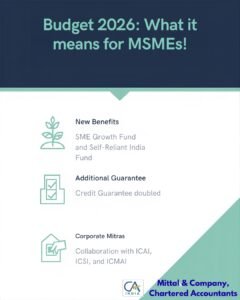
Key Changes for MSMEs
- Equity and Growth Capital
- A ₹10,000-crore SME Growth Fund has been announced to provide equity and quasi-equity capital to high-potential MSMEs, especially those with scalability and export potential.
- The Self-Reliant India Fund receives a ₹2,000-crore top-up, expanding the pool of risk capital.
Significance: This marks a shift from debt-heavy support toward growth financing, enabling MSMEs to modernize, expand markets, and compete globally.
- Stronger Credit and Liquidity Support
- Credit Guarantee Expansion: Coverage under the Credit Guarantee Fund Trust for Micro and Small Enterprises (CGTMSE) has been doubled from ₹5 crore to ₹10 crore, with lower guarantee fees to make borrowing more affordable.
- TReDS Integration: The Trade Receivables Discounting System (TReDS) is now mandatory for all CPSE procurement from MSMEs. It will also be linked with GeM (Government e-Marketplace), and invoice financing on TReDS will receive credit guarantee support.
Impact: These measures aim to reduce payment delays and strengthen working capital cycles, a critical pain point for MSMEs.
- Professional and Compliance Assistance
- The Budget proposes collaboration with ICAI, ICSI, and ICMAI to create “Corporate Mitras”- affordable professionals who will guide MSMEs through compliance, accounting, and digital adoption.
Relevance: This initiative is particularly valuable for MSMEs in Tier-2 and Tier-3 towns, where access to professional expertise is limited.
- Higher Classification Thresholds
- Relaxed investment and turnover ceilings continue to broaden MSME eligibility, allowing more businesses to qualify for credit, subsidies, and procurement opportunities.
- Missed Expectations
- No major tax relief or GST reforms were announced, leaving industry calls for simplification unmet.
- Effective tax rates remain uneven, with non-corporate MSMEs facing relatively higher burdens.
- Export incentives and digital credit platforms received limited attention, despite strong demand from industry bodies.
What MSMEs Should Do
Short-Term Actions
- Leverage New Credit Facilities: MSMEs should explore enhanced CGTMSE coverage and reduced fees to secure affordable loans.
- Adopt TReDS Early: With mandatory integration for CPSE procurement, MSMEs must familiarize themselves with TReDS to ensure smoother receivables financing.
- Seek Professional Guidance: Engaging with “Corporate Mitras” can help MSMEs streamline compliance, adopt digital tools, and reduce regulatory costs.
Medium-Term Strategies
- Tap Growth Capital: High-potential MSMEs should position themselves to access the SME Growth Fund and Self-Reliant India Fund by demonstrating scalability and export readiness.
- Strengthen Supply Chain Integration: With TReDS and GeM integration, MSMEs should align operations to participate more actively in government procurement and large supply chains.
- Invest in Technology: Equity financing opportunities should be used to upgrade technology, improve productivity, and enhance competitiveness in global markets.
Long-Term Considerations
- Advocate for Policy Reforms: MSMEs must continue to push for tax simplification, GST reforms, and digital credit platforms through industry associations.
- Focus on Compliance Efficiency: Even without major tax relief, MSMEs can reduce costs by adopting digital accounting, automation, and professional advisory services.
- Build Global Competitiveness: By leveraging government support and professional networks, MSMEs can gradually position themselves as “Champion MSMEs” capable of competing internationally.
Conclusion
Budget 2026 places MSMEs firmly at the heart of India’s growth agenda. By expanding access to equity capital, strengthening credit guarantees, and mandating liquidity platforms like TReDS, the government has addressed some of the sector’s most pressing challenges. The introduction of professional support through “Corporate Mitras” further signals recognition of the compliance burden faced by smaller firms.
However, the absence of tax relief and GST reforms means MSMEs must continue to navigate complex regulatory landscapes. The true impact of these measures will depend on effective implementation and the ability of entrepreneurs to seize new opportunities. For MSMEs, the path ahead involves balancing short-term wins in credit and compliance with long-term strategies for global competitiveness.
In essence, while the Budget does not tick every box, it provides a strategic foundation for MSMEs to strengthen resilience, scale operations, and contribute more meaningfully to India’s economic growth story.
BLOG BY – MITTAL & CO.