
The Income Tax Return (ITR) forms for AY 2026-27 have been significantly revised by the Central Board of Direct Taxes (CBDT). These changes are not just cosmetic; they reflect deeper compliance requirements, expanded disclosure norms, and alignment with evolving tax provisions. In this blog, we’ll explore the updates in ITR 1, ITR 2, ITR 3, and ITR 4, with explanations wherever necessary, so taxpayers and professionals can better understand the implications.
🏠 ITR 1 (Sahaj)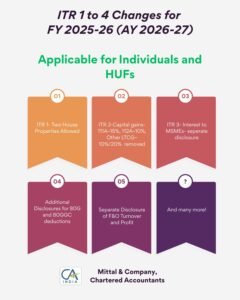
ITR 1 is the simplest form, meant for salaried individuals, pensioners, and those with limited income sources. However, FY 2025-26 brings notable changes:
1. Secondary Address & Contact Details
Taxpayers must now provide a secondary address along with secondary mobile and email IDs. This ensures better communication and helps the tax department track multiple residences (office, residential, or filing address).
2. Representative Assessee Details
If the return is filed by a representative assessee (for example, in case of minors, deceased taxpayers, or incapacitated individuals), their name, email, and contact number must be disclosed. This adds accountability and transparency.
3 . Two House Properties Allowed
Previously, ITR 1 permitted reporting of only one house property. Now, taxpayers can report two house properties. This is a major relaxation, as many individuals own more than one property.
4. Detailed House Property Reporting
Taxpayers must provide complete details such as:
-
- Property address
- Tenant details (PAN/Aadhaar mandatory if TDS claimed)
- Housing loan interest
- Co-ownership share
This ensures accurate computation of income/loss under the head “House Property.”
📈 ITR 2
ITR 2 is used by individuals and HUFs not having income from business or profession. The changes are substantial:
1. Capital Gains Schedule Simplified
-
- Questions related to sale dates before 23rd July 2025 have been removed, as they are no longer relevant.
- Older tax rates such as 111A–15%, 112A–10%, Other LTCG–10%/20% have been removed. This aligns with updated tax provisions where only current applicable rates remain.
2. New Income Section for Non-Residents
-
- Section 115A(1)(a)(iiaa) introduced:
Income received by non-residents as referred in the second proviso to section 194LC(1).
-
-
- Tax rate: 9%.
- Applicability: This covers specific interest income received by non-residents from certain borrowings.
-
3. Additional Reporting for Deductions
-
- 80G (Donations): Taxpayers must now provide transaction reference numbers (UPI/Cheque/IMPS/NEFT/RTGS) and IFSC codes. This ensures traceability of donations.
- 80GGC (Political Contributions): Name and PAN of the political party must be disclosed. This strengthens transparency in political funding.
💼 ITR 3
ITR 3 is for individuals and HUFs having income from profits and gains of business or profession. The changes here are extensive and technical.
1. MSME Act Reporting
Interest disallowable under section 23 of the Micro, Small and Medium Enterprises Development Act, 2006 must be reported separately.
-
- Explanation: Section 23 disallows interest payable beyond the prescribed period to MSMEs. By mandating disclosure, the government ensures compliance with MSME payment norms.
2. Business/Profession Updates
-
- Section 44BBD added.
- Description: Section 44BBD deals with presumptive taxation for income of foreign companies from services in connection with exploration of mineral oils.
- Applicability: Non-resident companies providing services or facilities in connection with prospecting/exploration of mineral oils can declare income on a presumptive basis (10% of gross receipts).
- Impact: Indian entities engaging foreign service providers must ensure proper reporting under this section.
- Section 44BBD added.
3. Simplified Tax Audit Applicability
Questions related to tax audit applicability based on turnover have been simplified. This reduces confusion for businesses hovering around audit thresholds.
1. Manufacturing & Trading Account
Turnover and income from Futures and Options (F&O) must be disclosed separately.
-
- Explanation: F&O transactions are considered business income. Separate disclosure ensures clarity in speculative vs. non-speculative income.
2. Profit & Loss Account Enhancements
-
- Presumptive income of non-residents under sections 44B, 44BB, 44BBA, 44BBC, 44BBD must be disclosed separately.
- Income credited to P&L but not chargeable to tax must also be shown separately.
3. Deductions & Exemption
-
- More disability categories added under 80DD & 80U.
- State Sikkim included under section 80IE (tax holiday for certain undertakings).
4. Income from Firms
Interest and remuneration received from firms must be disclosed separately.
📊 ITR 4 (Sugam)
ITR 4 is for individuals, HUFs, and firms (other than LLPs) opting for presumptive taxation under sections 44AD, 44ADA, or 44AE. The changes are focused on financial particulars and tax regime choices.
- Financial Particulars
Investments must now be shown separately in the financial details section. This ensures better visibility of asset holdings. - Tax Regime Switching (Form 10IEA)
Questions have been updated to accommodate cases where taxpayers re-opt into the new regime after previously choosing the old regime.- Explanation: Section 115BAC allows taxpayers to choose between old and new regimes. Form 10IEA is used to opt out of the new regime.
- The updated questions ensure proper disclosure when taxpayers switch regimes multiple times.
✨ Key Takeaways
- ITR 1: Expanded to allow two house properties, with detailed reporting of tenants and loans.
- ITR 2: Simplified capital gains schedules, new non-resident income section, and stricter donation reporting.
- ITR 3: Major compliance updates including MSME Act disclosures, presumptive taxation under 44BBD, F&O reporting, and expanded deductions.
- ITR 4: Investments must be separately reported, and regime-switching disclosures refined.
📌 Conclusion
The changes across ITR 1–4 for AY 2026-27 reflect the government’s push for greater transparency, accountability, and alignment with evolving tax laws. Taxpayers must be prepared for more detailed disclosures, especially in areas like house property, capital gains, MSME payments, and presumptive taxation.
For professionals, these updates mean more diligence in preparing returns, verifying supporting documents, and ensuring compliance with new reporting norms. For taxpayers, it’s a reminder that even “simpler” forms like ITR 1 and ITR 4 now demand comprehensive information.
Blog By – Mittal & Co.