
Introduction
The Goods and Services Tax (GST) law in India has introduced a significant amendment effective from 30 March 2026. The place of supply for intermediary services will now be determined by the recipient’s location instead of the supplier’s location. This change has major implications for businesses engaged in cross-border transactions.
What is Intermediary Service?
Section 2(13) of IGST Act defines intermediary as “a broker, an agent or any other person, by whatever name called, who arranges or facilitates the supply of goods or services or both… between two or more persons, but does not include a person who supplies such goods or services on his own account.”
What was the old rule?
The old rule stated that the place of supply for intermediary services was always the supplier’s location. As a result, intermediary services provided to overseas clients were taxed in India and did not qualify as exports. Also, intermediary services provided by overseas vendors were considered as supplied outside India and there were no RCM GST liability on such transaction because it was not import of service.
What is the new rule?
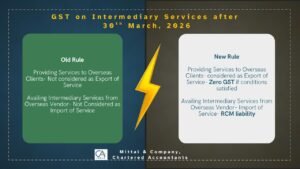
The new rule states that the place of supply for intermediary services will be the recipient’s location. This change allows services provided to overseas clients to qualify as exports and services received from overseas suppliers to be treated as imports.
How does this affect outward intermediary services (India → Overseas)?
Outward intermediary services provided by Indian suppliers to overseas clients will now be treated as exports of services. If payment is received in convertible foreign exchange or permitted INR, and the supplier and recipient are not establishments of the same entity, the supply will be considered zero-rated. Businesses can either supply under LUT without payment of tax or pay IGST and claim a refund.
How does this affect inward intermediary services (Overseas → India)?
Inward intermediary services received by Indian businesses from overseas suppliers will now be treated as imports of services. GST liability will arise under the Reverse Charge Mechanism (RCM), meaning the Indian recipient must pay IGST. Input Tax Credit (ITC) can be claimed subject to eligibility.
How is the time of supply determined?
The time of supply will decide whether the old rule or the new rule applies. It is generally the earlier of the invoice date, the service provision date, or the payment receipt date.
Case Study: Indian Consultancy Firm
An Indian consultancy firm provides intermediary services to a US-based client. Before 30 March 2026, the place of supply was India, and GST was payable in India. The service did not qualify as an export. After 30 March 2026, the place of supply is the USA, and the service qualifies as an export. The firm can supply under LUT without payment of tax or pay IGST and claim a refund. This results in a significant cash flow advantage and improved competitiveness in global markets.
What are the transition risks?
Businesses must be careful with advances received before 30 March 2026, invoices issued prior to the amendment date, continuous or milestone-based contracts, and back-to-back arrangements involving overseas parties. Accurate determination of the time of supply is essential to avoid disputes.
This amendment is a progressive step that aligns GST with destination-based taxation principles. It provides clarity and fairness in the taxation of intermediary services, enabling businesses to benefit from export incentives while ensuring proper taxation of imports. Companies must adopt a disciplined approach to time-of-supply compliance to minimize risks during the transition.