
TL;DR
India’s tax ecosystem in 2026 is heavily data-driven. The government now uses AI systems, GSTN analytics, AIS/TIS reporting, banking integrations, e-invoicing, and digital payment tracking to identify mismatches automatically. Businesses with inconsistent GST filings, unexplained cash flow, incorrect ITC claims, or underreported income are increasingly receiving scrutiny notices. Proactive compliance, reconciliation, and expert advisory are now essential.
The New Era of AI-Powered Tax Surveillance
For years, tax scrutiny in India depended heavily on manual assessments and selective investigations. That landscape has changed dramatically.
In 2026, tax departments no longer rely only on declared figures in returns. They now compare data from multiple systems simultaneously:
- GST returns
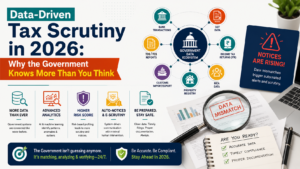
- Income tax filings
- AIS/TIS records
- TDS filings
- E-invoices
- Banking transactions
- UPI and digital payment trails
- MCA and ROC filings
- Customs and import-export data
The result is a highly connected compliance ecosystem where inconsistencies are detected faster than ever.
Businesses that previously assumed small discrepancies would go unnoticed are now facing automated alerts and notices.
What “Data-Driven Tax Scrutiny” Actually Means
Data-driven scrutiny refers to the use of technology, analytics, and AI-based risk assessment to identify suspicious tax behavior.
Instead of randomly selecting taxpayers, authorities now use algorithms to identify:
- High-risk transactions
- Unusual input tax credit claims
- Mismatched turnover
- Suspicious vendor chains
- Fake invoicing patterns
- Underreported income
GSTN Analytics
The GST Network now performs advanced invoice-level matching.
If your:
- GSTR-1,
- GSTR-3B,
- E-way bills,
- E-invoices,
- Vendor filings,
do not align properly, the system can flag the discrepancy automatically.
This is one of the major reasons GST notices are increasing across India.
AIS & TIS Reporting
Annual Information Statement (AIS) and Taxpayer Information Summary (TIS) have become powerful scrutiny tools.
The Income Tax Department can now see:
- High-value banking transactions
- Mutual fund investments
- Stock market activity
- Foreign remittances
- Credit card spends
- Property purchases
- Interest income
- TDS/TCS data
If your filed income does not align with financial behavior, the mismatch becomes visible instantly.
Banking & Digital Payment Tracking
The rapid adoption of:
- UPI,
- POS machines,
- Payment gateways,
- Digital wallets,
has significantly reduced untraceable transactions.
Businesses operating heavily in cash but showing low digital turnover patterns inconsistent with industry benchmarks may attract scrutiny.
MCA, ROC & PAN Integration
Government departments increasingly share information across platforms.
For example:
- ROC turnover data may be compared with GST turnover
- PAN-linked banking transactions may be checked against ITR disclosures
- TDS deductions may be matched with declared income
This interconnected approach leaves far fewer gaps in reporting.
Why Tax Notices Are Increasing in 2026
Real-Time Data Matching
Earlier, mismatches could remain unnoticed for years.
Now, automated systems detect:
- ITC mismatches
- Vendor inconsistencies
- Duplicate invoices
- Delayed filings
- Suspicious refund claims
in near real time.
Automated Risk Profiling
Businesses are increasingly assigned risk scores based on:
- Filing behavior
- Industry patterns
- Transaction size
- Compliance history
- Vendor network quality
Higher-risk profiles are more likely to receive:
- GST notices
- Income tax scrutiny
- Audit requests
- Compliance verification communications
E-Invoicing Expansion
The government’s continued expansion of e-invoicing has dramatically increased transaction transparency.
Authorities can now track:
- Invoice generation timing
- Invoice amendments
- Supply chain patterns
- Tax liability consistency
This reduces opportunities for invoice manipulation.
UPI & Digital Trail Visibility
Digital payments create permanent records.
Large unexplained credits, frequent high-value transfers, or inconsistent reporting between bank statements and tax filings can quickly trigger automated checks.
Common Triggers That Invite Scrutiny
| Trigger | Possible Impact |
|---|---|
| GSTR-1 and GSTR-3B mismatch | GST notice |
| Excess ITC claims | ITC reversal scrutiny |
| High cash deposits | Income tax verification |
| Low profit margins inconsistent with industry | Assessment risk |
| Vendor non-compliance | ITC denial |
| Incorrect HSN/SAC usage | GST classification dispute |
| Delayed return filing | Higher scrutiny probability |
| Mismatch between AIS and ITR | Income tax notice |
How GST and Income Tax Departments Cross-Verify Data
One of the biggest misconceptions among businesses is believing GST and Income Tax departments operate independently.
In reality, cross-verification has become increasingly sophisticated.
For example:
| Data Source | Cross-Checked Against |
|---|---|
| GST turnover | Income tax turnover |
| E-invoices | GSTR filings |
| Bank transactions | Declared business receipts |
| TDS entries | Revenue disclosures |
| ROC filings | Tax returns |
| Vendor GST filings | ITC claims |
This integrated structure allows authorities to identify inconsistencies rapidly.
Red Flags Businesses Often Ignore
Many scrutiny cases arise not from fraud, but from negligence.
Common examples include:
- Claiming ITC from non-compliant vendors
- Ignoring reconciliation processes
- Incorrect expense classification
- Filing returns without verification
- Multiple revisions and corrections
- Sudden turnover spikes
- Unrealistic profit disclosures
Businesses often underestimate how visible these patterns have become.
Practical Compliance Checklist for Businesses
Monthly Compliance Actions
- Reconcile GSTR-1 and GSTR-3B
- Verify vendor GST compliance
- Match purchase registers with ITC claims
- Review bank transaction consistency
Quarterly Actions
- Conduct internal GST review
- Validate e-invoice reporting
- Review TDS compliance
- Analyze AIS/TIS entries
Annual Actions
- Perform full tax reconciliation
- Compare ROC and GST turnover
- Validate expense documentation
- Conduct tax risk assessment
What to Do If You Receive a Notice
Receiving a notice does not automatically mean wrongdoing.
However, delayed or incorrect responses can escalate matters.
Recommended Steps
- Review the notice carefully
- Identify the exact mismatch or issue
- Gather supporting documentation
- Reconcile all relevant returns
- Respond within deadlines
- Consult a qualified tax professional
Avoid:
- Ignoring notices
- Submitting incomplete replies
- Providing inconsistent explanations
How Professional Tax Advisors Reduce Risk
Modern compliance is no longer just about filing returns.
Professional CA firms help businesses:
- Conduct proactive reconciliations
- Detect risk indicators early
- Maintain audit-ready documentation
- Handle GST and income tax notices
- Improve compliance systems
- Reduce litigation exposure
For growing businesses, this proactive approach can significantly reduce operational and financial stress.
Mittal & Co. provides GST compliance, tax advisory, audits, registrations, accounting support, and business compliance services for businesses and professionals in Pune and across India.
Conclusion
Tax scrutiny in India has entered a new technological era.
In 2026, government systems can connect GST filings, banking data, AIS records, e-invoices, TDS filings, and digital payment trails with unprecedented efficiency.
Businesses that rely on outdated compliance practices face increasing exposure to notices and investigations.
The safest strategy is no longer reactive compliance. It is proactive transparency, regular reconciliation, strong documentation, and professional oversight.
As regulatory systems become smarter, businesses must become more compliance-focused than ever before.
6. FAQ SECTION
1. What is data-driven tax scrutiny?
Data-driven tax scrutiny refers to the use of AI, analytics, and integrated databases by tax authorities to detect mismatches, suspicious transactions, and compliance risks automatically.
2. Why are GST notices increasing in 2026?
GST notices are increasing because authorities now use automated data matching between GST returns, e-invoices, vendor filings, and banking data.
3. Can the government track digital payments?
Yes. UPI, bank transfers, payment gateways, POS systems, and other digital payment methods create traceable financial records.
4. What is AIS in income tax?
AIS (Annual Information Statement) is a detailed financial information statement containing banking transactions, investments, TDS entries, property transactions, and other financial activities.
5. What causes GST mismatch notices?
Common causes include incorrect ITC claims, mismatch between GSTR-1 and GSTR-3B, vendor non-compliance, invoice inconsistencies, and delayed filing.
6. How can businesses reduce tax scrutiny risk?
Businesses should perform regular reconciliations, maintain proper documentation, file accurate returns, verify vendors, and seek professional compliance support.
7. Is receiving a tax notice serious?
Not every notice indicates fraud, but every notice should be handled carefully and within prescribed timelines to avoid escalation.