
Dealing in Futures and Options? New Disclosures Are Introduced in ITR-3 for FY 2025-26!

Dealing in Futures and Options? New Disclosures Are Introduced in ITR-3 for FY 2025-26! If you trade in futures and options (F&O), this year’s income tax filing brings a change you can’t afford to ignore. The Central Board of Direct Taxes (CBDT) has revised the ITR-3 form for AY 2026-27 (income earned in FY 2025-26), and F&O traders now have dedicated disclosure fields that didn’t exist last year. Skip them, and your return could be marked defective. Here’s everything you need to know before you sit down to file. What’s Actually Changed Until last year (AY 2025-26), F&O traders typically lumped their derivative turnover and income together with other business receipts in the Trading Account schedule of ITR-3. That’s no longer allowed. Under the revised format, taxpayers who traded in F&O during FY 2025-26 must now separately disclose: Turnover from F&O trading Income from F&O transactions credited to the profit and loss account This granularity extends beyond F&O too. The updated “Part A – Trading Account” schedule now asks traders to break out intraday equity trading, commodity trading, and currency trading as distinct categories as well, rather than reporting one combined trading figure. Along with turnover and income, you’ll also need to disclose related details such as opening stock, purchases, direct expenses, sales, and closing stock for the relevant activity, plus the resulting gross profit or loss. Tax experts say the intent behind this is straightforward: better transparency and a cleaner audit trail for derivative trading activity, at a time when participation in F&O has grown sharply — even as SEBI data continues to show that the vast majority of individual F&O traders lose money. Why You Shouldn’t Leave These Fields Blank This isn’t a “nice to have” disclosure — it’s now a core part of the form. Tax experts have flagged that leaving these new columns empty can cause your return to be treated as defective under Section 139(9) of the Income Tax Act. A defective return isn’t automatically rejected, but if you don’t fix it within the timeline specified in the department’s notice, the return can be treated as invalid altogether. That has real consequences: Loss of the ability to carry forward business losses (F&O losses can otherwise be carried forward for up to eight assessment years) Potential penalties Delays in processing and refunds Increased scrutiny of your filing Given that F&O income is classified as non-speculative business income under the head “Profits and Gains of Business or Profession,” accurate reporting here directly affects your ability to set off losses against other business income and carry them forward. Other Notable Changes in ITR-3 for AY 2026-27 The F&O disclosures aren’t the only update this year. A few other changes are worth knowing about if you’re filing ITR-3: Higher asset-liability reporting threshold: The threshold for reporting assets and liabilities (Schedule AL) has gone up to ₹1 crore, from ₹50 lakh earlier. More granular disclosures for filing status, residential status, and address: Non-residents will now need to provide details like foreign tax identification numbers and specifics about their stay in India. Secondary address and alternate contact details: You can now add a secondary address, alternate mobile number, and email ID for official communication. More detail required for certain deductions: Taxpayers claiming deductions under Sections 80G, 80GGC, 80DD, and 80U will need to furnish additional supporting details. Simplified disclosures for audited accounts: For taxpayers subject to tax audit, some auditor-related disclosures have been simplified. Key Dates to Remember Non-audit cases: ITR-3 due date is 31st August 2026 Audit cases: Due date is 31st October 2026 Missing the deadline doesn’t just attract a late fee (up to ₹5,000 depending on income level) — it can also cost you the ability to carry forward business losses. A Common Mistake to Avoid Many F&O traders mistakenly file ITR-4 instead of ITR-3, thinking of their trading activity as a simple presumptive income source. Since F&O income falls under non-speculative business income, ITR-3 is generally the correct form — and it’s the only ITR form that allows reporting of non-presumptive business income along with capital gains, salary, house property, and other income sources. How to Get This Right Get your turnover calculation right first. F&O turnover isn’t the same as your total trade value — it’s typically computed as the absolute sum of profits and losses across trades (plus premium on options sold), per prescribed guidance. Cross-check this with your broker’s tax P&L statement. Reconcile with your broker statement and AIS. Before filling in the new fields, match your figures against your broker’s tax P&L report and the Annual Information Statement (AIS) on the income tax portal. Mismatches are a common trigger for scrutiny. Don’t club F&O with intraday or other trading. Report each category — F&O, intraday equity, commodities, currency — separately, as the revised schedule now requires. File early, but only after your data is ready. Even though the utility is live, it’s worth waiting until your Form 16, Form 26AS, and AIS are fully updated before filing, to avoid refund delays or notices from mismatches. When in doubt, consult a tax professional. Given the added complexity — turnover computation, audit applicability thresholds, and loss carry-forward rules — a CA’s review can save you from an expensive mistake. The Bottom Line The message from tax experts this year is consistent: F&O traders can no longer treat derivative income as an afterthought buried inside a combined business income line. The new ITR-3 wants it called out explicitly — turnover and income both — and the cost of getting it wrong isn’t trivial. If you’ve traded in futures and options in FY 2025-26, budget extra time this filing season to get these new schedules right. This article is for general informational purposes and does not constitute tax or financial advice. Please consult a qualified chartered accountant or tax advisor for guidance specific to your situation. Blog By : Mittal & Co.
Emerging Financial Compliance Changes in India and Their Impact on SMEs and Startups

TL;DR India’s regulatory landscape is evolving rapidly. Government departments are leveraging technology, automation, and data integration to improve transparency and reduce tax leakage. For SMEs and startups, compliance is no longer just a legal obligation—it has become a critical business function. Businesses that adapt early can reduce risks, attract investors, and scale confidently, while those that ignore emerging compliance requirements may face penalties, notices, and reputational damage. Why Compliance Is Becoming a Strategic Priority Over the last few years, India’s business ecosystem has undergone a significant transformation. Regulatory authorities are increasingly relying on digital platforms, AI-powered analytics, and interconnected databases to identify inconsistencies in tax filings, financial reporting, and corporate disclosures. For SMEs and startups, this means compliance can no longer be treated as a year-end activity. Today’s regulators can compare: GST returns Income tax returns TDS filings MCA disclosures Bank transaction records E-invoicing data Any mismatch can trigger scrutiny. As a result, businesses need stronger accounting controls and proactive compliance management. Major Financial Compliance Trends Shaping Indian Businesses Digital Compliance Ecosystems Government departments are moving toward fully integrated digital compliance systems. Examples include: GSTN integration MCA digital filings E-invoicing systems PAN-Aadhaar linkage validation Online assessment systems The objective is clear: real-time monitoring and faster detection of discrepancies. For businesses, manual processes are becoming increasingly risky. Increased GST Monitoring GST remains one of the most actively monitored compliance areas. Authorities are now focusing on: Fake invoice detection Input Tax Credit verification Supplier mismatch analysis E-way bill reconciliation E-invoice validation Common triggers include: Incorrect ITC claims Delayed return filing Mismatched invoices Unreported transactions SMEs with weak accounting systems face higher compliance risks. Enhanced Income Tax Scrutiny Data analytics is significantly improving tax assessment capabilities. Authorities can now compare information from: Bank accounts Property transactions GST filings Securities investments TDS statements Businesses should expect closer scrutiny of: High-value transactions Cash expenses Related-party dealings Unusual deductions Revenue inconsistencies Accurate bookkeeping has become more important than ever. Corporate Governance Expectations Corporate governance is no longer relevant only for large corporations. Investors, lenders, and regulators increasingly expect startups and SMEs to demonstrate: Transparent accounting Strong internal controls Documented decision-making Compliance monitoring processes Businesses seeking external funding must pay particular attention to governance practices. Data and Financial Reporting Requirements Financial reporting standards continue to evolve. Businesses are increasingly expected to maintain: Accurate financial records Digital documentation Audit-ready reports Real-time accounting information Poor recordkeeping often becomes a major obstacle during audits, funding rounds, and due diligence exercises. Key Compliance Changes SMEs Should Watch 1. Stricter GST Reconciliation Requirements Regular reconciliation between: GSTR-1 GSTR-3B Purchase registers E-invoices is becoming essential. Failure to reconcile data may result in denied tax credits and notices. 2. Greater Focus on Beneficial Ownership Disclosure Regulators are paying closer attention to ownership structures. Businesses must maintain updated records regarding: Directors Shareholders Significant beneficial owners Transparency requirements are expected to increase further. 3. Enhanced TDS Compliance Monitoring TDS compliance continues to be a major enforcement area. Authorities are increasingly monitoring: Delayed deposits Incorrect deductions Missing filings Businesses should establish periodic TDS review systems. 4. Improved Documentation Standards Authorities increasingly expect businesses to maintain: Contracts Invoices Board resolutions Payroll records Vendor agreements Digital storage systems are becoming essential. 5. Automation-Driven Compliance Reviews Automated risk assessment tools are helping authorities identify: Filing inconsistencies Tax mismatches Suspicious transaction patterns This reduces the likelihood that errors will go unnoticed. How Startups Are Affected Differently Startups face unique compliance challenges because of rapid growth. Common startup compliance issues include: Frequent Business Changes Startups often experience: New investors New products New locations New revenue streams Each change may create additional compliance requirements. Resource Constraints Many startups operate with: Small finance teams Limited compliance expertise Founder-led accounting This increases the risk of errors. Funding Due Diligence Investors now conduct extensive compliance reviews before funding. Areas typically examined include: Tax filings Cap table accuracy Financial statements Employment compliance Corporate records Compliance weaknesses can delay or even derail funding opportunities. Risks of Ignoring Compliance Updates Businesses that fail to adapt may face: Financial Penalties Non-compliance often leads to: Interest charges Late fees Monetary penalties Regulatory Notices Authorities may initiate: Assessments Investigations Audits Operational Disruption Management attention may shift from business growth to compliance disputes. Funding Challenges Investors and lenders frequently reject businesses with poor compliance histories. Reputational Damage Compliance issues can negatively impact stakeholder confidence. Practical Compliance Strategy for 2026 Successful SMEs and startups should adopt a structured approach. Step 1: Conduct Compliance Audits Review: GST compliance Income tax compliance TDS obligations Corporate filings Identify gaps before regulators do. Step 2: Automate Accounting Processes Use technology to improve: Recordkeeping Reconciliation Reporting Compliance tracking Step 3: Maintain Documentation Create organized digital records for: Financial transactions Contracts Tax filings Corporate decisions Step 4: Establish Compliance Calendars Track deadlines for: GST returns TDS returns ROC filings Income tax filings Step 5: Engage Professional Advisors Regular consultation with experienced Chartered Accountants helps businesses stay ahead of regulatory developments. Role of Chartered Accountants in Compliance Management Modern Chartered Accountants do far more than tax filing. They help businesses: Monitor regulatory changes Strengthen compliance frameworks Improve financial reporting Conduct compliance reviews Prepare for audits Support investor due diligence For growing SMEs and startups, professional guidance significantly reduces regulatory risks. Conclusion Financial compliance in India is evolving faster than ever. Digital monitoring, automated scrutiny, and stricter reporting standards are transforming how businesses operate. For SMEs and startups, compliance should be viewed as a strategic investment rather than a regulatory burden. Businesses that establish strong compliance systems today will be better positioned to attract investment, scale operations, and avoid costly regulatory issues tomorrow. As compliance requirements continue to evolve in 2026, partnering with experienced professionals can help businesses remain compliant, efficient, and growth-focused. 6. FAQ SECTION 1. What are the most important financial compliance changes affecting Indian businesses in 2026? The most significant compliance developments include increased GST scrutiny, automated tax assessments, stricter corporate governance requirements, enhanced beneficial ownership disclosures, digital compliance reporting, and greater use of AI-driven analytics by regulatory
Private Limited Company Compliance Checklist Every Director Must Follow
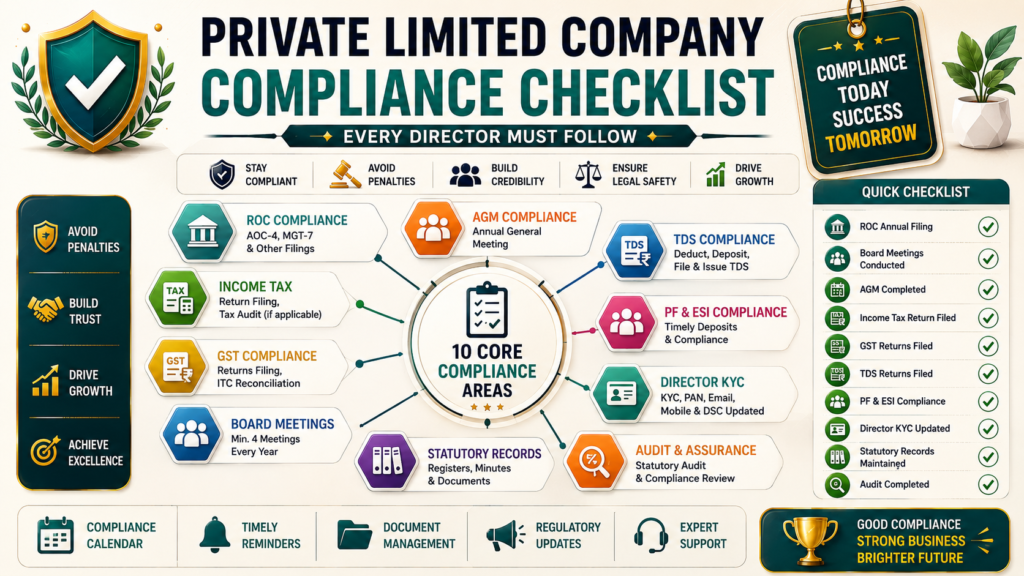
TL;DR Private limited companies in India must comply with multiple legal, tax, and regulatory requirements throughout the year. These include ROC filings, annual returns, board meetings, GST filings, TDS compliance, income tax returns, audit requirements, and director KYC obligations. Failure to comply can result in penalties, prosecution, and director disqualification. This checklist helps directors stay compliant and avoid costly mistakes. Why Compliance Matters for Private Limited Companies A private limited company enjoys several advantages, including limited liability protection, separate legal identity, easier fundraising opportunities, and increased business credibility. However, these benefits come with ongoing compliance obligations under: Companies Act, 2013 Income Tax Act GST Act Labour Laws MCA Regulations Other statutory frameworks Many directors focus heavily on business growth but overlook compliance responsibilities until notices or penalties arrive. Compliance should not be viewed as a burden. It protects the company, improves transparency, and strengthens investor confidence. Responsibilities of Company Directors Directors are responsible for ensuring that the company fulfills its statutory obligations. Their responsibilities include: Maintaining accurate financial records Conducting board meetings Filing annual returns Ensuring tax compliance Protecting shareholder interests Maintaining statutory registers Implementing internal controls Responding to regulatory notices Ignorance of compliance requirements is not considered a valid defense under the Companies Act. Complete Private Limited Company Compliance Checklist ROC Compliance Requirements The Registrar of Companies (ROC) requires companies to file various forms and annual returns. Mandatory ROC Filings Form AOC-4 Used for filing: Financial Statements Balance Sheet Profit and Loss Account Auditor Reports Form MGT-7 Used for filing: Annual Return Shareholding Details Director Information Registered Office Information Key Compliance Objective These filings provide transparency regarding the company’s financial and operational status. Board Meeting Compliance Board meetings are mandatory even for small private limited companies. Minimum Requirement A private limited company must generally hold: At least 4 Board Meetings annually Maximum gap of 120 days between two meetings Board Meeting Agenda May Include Financial performance review Compliance review Strategic decisions Budget approvals Funding discussions Risk management updates Documentation Required Notice of Meeting Attendance Register Minutes of Meeting Resolutions Passed Proper documentation is essential during inspections or audits. Annual General Meeting (AGM) Compliance Every private limited company must conduct an Annual General Meeting. AGM Objectives Adoption of Financial Statements Auditor Appointment Director-related Resolutions Shareholder Discussions Key Benefits AGMs improve governance and maintain transparency with shareholders. Income Tax Compliance Private limited companies are required to file Income Tax Returns annually. Key Tax Obligations Income Tax Return Filing Advance Tax Payments Tax Audit (if applicable) Maintenance of Books of Accounts Important Areas to Monitor Revenue recognition Expense classification Depreciation claims Related-party transactions Tax deductions Accurate tax reporting reduces scrutiny risk and ensures smooth assessments. GST Compliance If the company is registered under GST, compliance becomes an ongoing responsibility. GST Requirements GST Registration Monthly or Quarterly Returns Annual Reconciliation Invoice Compliance Input Tax Credit Reconciliation Common GST Errors Wrong GST classification Missed filing deadlines Incorrect ITC claims Vendor mismatches These errors often trigger departmental notices. TDS Compliance Tax Deducted at Source (TDS) obligations apply to many company transactions. TDS Activities Deduct TDS where applicable Deposit TDS on time File quarterly TDS returns Issue TDS certificates Common Transactions Covered Salaries Professional Fees Contractor Payments Rent Payments Commission Payments Failure to comply may result in interest and penalties. PF and ESI Compliance Companies meeting employee thresholds must comply with labour regulations. PF Compliance Employee registration Monthly PF deposits Employee record maintenance ESI Compliance Employee enrollment Monthly contributions Statutory reporting Labour compliance violations can attract inspections and financial penalties. Statutory Registers and Record Maintenance Private limited companies are legally required to maintain specific statutory records throughout the year. Essential Statutory Registers Register of Members Register of Directors Register of Charges Register of Share Transfers Register of Loans and Investments Register of Related Party Transactions Additional Records to Maintain Share Certificates Financial Statements Accounting Records Board Meeting Minutes AGM Minutes Tax Records GST Documentation Proper record maintenance helps during: ROC inspections Income Tax assessments GST audits Due diligence exercises Investor reviews Business acquisitions Director KYC Compliance Director Identification Number (DIN) holders must ensure their KYC details remain updated. Director KYC Requirements Directors should regularly verify: Mobile Number Email Address PAN Details Residential Address Digital Signature Certificate (DSC) Failure to complete Director KYC requirements may result in DIN deactivation and additional penalties. Audit Requirements Most private limited companies are subject to statutory audit requirements. Statutory Audit Objectives Verify financial accuracy Assess internal controls Identify compliance gaps Ensure regulatory adherence Improve transparency Auditor Responsibilities The auditor reviews: Financial statements Accounting policies Internal control systems Regulatory compliance Risk areas Regular audits strengthen financial governance and improve stakeholder confidence. Penalties for Non-Compliance Many directors underestimate the financial and legal consequences of missing compliance obligations. Common Consequences Financial Penalties Late filing fees can accumulate quickly across multiple forms and returns. Director Disqualification Persistent non-compliance may lead to restrictions on directors. Regulatory Notices Authorities may issue notices requiring explanations and supporting documentation. Increased Scrutiny Repeated compliance failures can trigger deeper examinations by tax and regulatory departments. Funding Challenges Investors and lenders often review compliance history before approving funding or credit facilities. Quick Compliance Checklist for Directors Use this checklist regularly throughout the year: Compliance Area Status Check ROC Annual Filing ✓ Board Meetings Conducted ✓ AGM Completed ✓ Income Tax Return Filed ✓ GST Returns Filed ✓ TDS Returns Filed ✓ PF Compliance Completed ✓ ESI Compliance Completed ✓ Director KYC Updated ✓ Statutory Registers Maintained ✓ Audit Completed ✓ Financial Statements Approved ✓ This checklist can serve as a simple monthly and quarterly compliance review tool. Best Practices to Stay Compliant Compliance becomes easier when systems are implemented proactively. Create an Annual Compliance Calendar Track all filing deadlines in advance. Include: GST dates TDS deadlines ROC filing dates Tax payment schedules Audit timelines Conduct Quarterly Compliance Reviews Quarterly reviews help identify issues before they become major problems. Review: Pending filings Tax obligations Documentation gaps Regulatory updates Maintain Digital Documentation Store important records securely. Examples: GST returns Tax filings Audit reports
Filing Your Own ITR vs Hiring a Professional: What the Numbers and the Rules Actually Say

Every year, around July, the same question does the rounds: should you file your income tax return yourself using the income tax portal, or should you get a professional to do it? With pre-filled forms, AIS/TIS data, and a much friendlier e-filing interface than a decade ago, self-filing has genuinely become easier. But “easier” and “right for your situation” are not the same thing. This article looks at both routes objectively, so you can decide which one suits your case. How self-filing actually works today The income tax portal now auto-populates a large part of your return using data from your Form 26AS, AIS (Annual Information Statement), and TIS (Taxpayer Information Summary). For someone with a single Form 16, no other income, and no investments beyond the standard deductions, the process can genuinely take fifteen to twenty minutes: Log in, select the correct ITR form (the portal often pre-selects it for you) Review pre-filled salary, TDS, and interest income Confirm deductions under Chapter VI-A if already reflected E-verify using Aadhaar OTP or net banking For this category of taxpayer, software and the portal do a reasonable job. The forms are designed for exactly this use case, and government utilities (and several free or freemium private platforms) walk you through it step by step. Where self-filing starts to strain This is exactly where most people feel confident — the form is pre-filled, the portal walks you through it, and the whole thing can be wrapped up in minutes. That sense of speed is real, but it can be misleading, because the portal doesn’t tell you when a number is technically correct yet substantively wrong. The difficulty isn’t in the act of filing; it’s in the judgment calls that filing requires, and several of these calls don’t show up as errors until much later — as interest, penalties, or a reassessment. Choosing between the old and new tax regime. This isn’t a one-time choice anymore if you have business or professional income, and even for salaried individuals, the “better” regime depends on the exact mix of deductions, HRA, home loan interest, and 80C/80D investments. Picking the wrong one isn’t flagged by the portal — it simply calculates tax on whatever you select, and the cost only becomes visible when compared with the regime you should have picked. Capital gains from equity, mutual funds, or property. Grandfathering rules for shares bought before January 2018, indexation choices, set-off and carry-forward of losses, and scrip-wise reporting for listed securities are all judgment-heavy. AIS data is often incomplete or mismatched with broker statements, with no prompt from the portal to reconcile the two. Multiple income heads. Freelance or consulting income, rental income with co-ownership, foreign income or assets, and crypto/VDA transactions each carry their own reporting quirks. Missing a foreign asset disclosure alone can attract penalties under the Black Money Act that are wildly disproportionate to the value of the asset itself. Disclosure schedules for assets, liabilities, foreign assets, and directorships. Schedule AL, Schedule FA, and the directorship disclosure are easy to skip because they don’t feel like “tax” entries, yet omitting them can trigger scrutiny entirely separate from the income computation itself. Reconciling AIS/TIS data against your own records. The pre-filled statement frequently has duplicate or misattributed entries. Filing it as-is, without checking it against bank statements, broker contract notes, and Form 16, can quietly overstate or understate income — and the mismatch only surfaces as a notice weeks or months later. Choosing the correct ITR form. The portal’s suggested form isn’t always right once you have capital gains, foreign assets, or presumptive income. Filing on the wrong form can get the entire return marked defective under section 139(9), with a limited window to fix it. Set-off and carry-forward of losses. House property loss limits, ordering rules between short-term and long-term capital losses, and the fact that a return filed late under section 139(4) forfeits the right to carry forward most losses at all — permanently — are easy to get wrong without realising it. Residential status confusion. Whether you’re Resident, Resident but Not Ordinarily Resident (RNOR), or Non-Resident depends on the number of days spent in India over the current and preceding years, not on nationality, passport, or where your salary is paid — and the thresholds change depending on whether you’re an Indian citizen leaving for employment abroad, a citizen with high Indian income visiting India, or a foreign national. Getting this wrong has wide consequences: it changes which income is even taxable in India (global income for residents, only Indian-sourced income for non-residents), which ITR schedules apply, and whether DTAA relief or foreign tax credit claims are valid. The portal doesn’t compute residential status for you — it simply accepts whatever you select, and an incorrect selection here can understate income for years where global income was actually taxable, or claim relief that wasn’t due. Variation between online (pre-filled) and offline (actual) data. A March TDS entry not yet reflected, a broker’s capital gains statement differing from AIS, or interest reported on a different accounting basis can all mean the auto-populated numbers don’t match reality. Filing purely off the portal’s data without cross-verifying your own paperwork is one of the most common ways an otherwise “clean” filing turns into a defective or under-reported return. None of this is visible at the moment of filing. The return goes through, the acknowledgment is generated, and everything looks fine — until a notice under section 143(1) or 139(9) arrives, or a mismatch triggers scrutiny, at which point what was a quick filing becomes a drawn-out correction involving interest under sections 234A/B/C, penalties, and in some cases reassessment. The speed of self-filing is genuine; what it doesn’t include is a check on whether the choices made along the way were the right ones. A real example of how this plays out. A salaried professional sold listed equity shares held for less than a year, generating a short-term capital gain. Filing the return himself on the
DPT-3 Filing Due Date Extended to 31 July 2026 for FY 2025-26: What Companies Need to Know
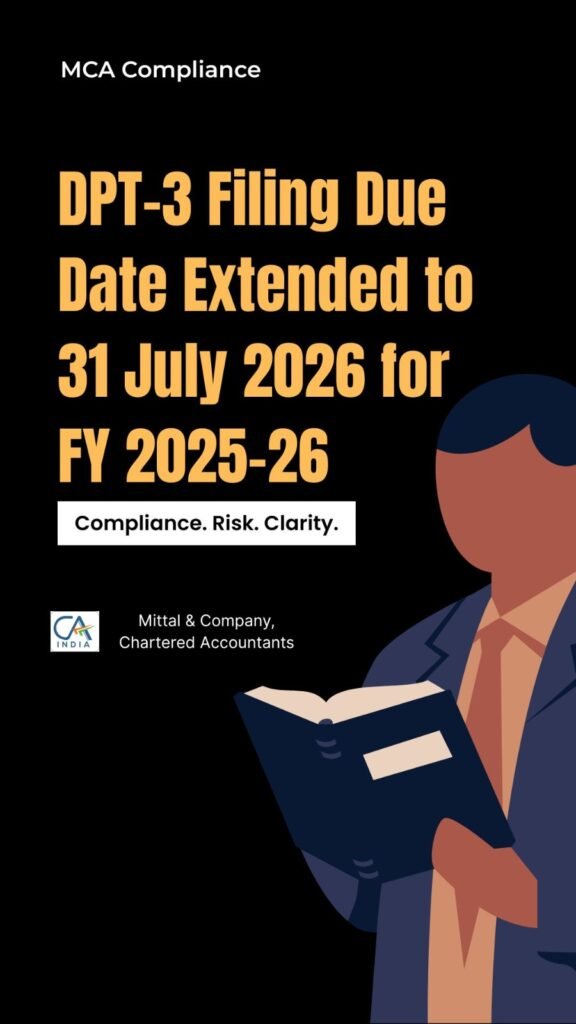
Introduction Every year, companies registered under the Companies Act, 2013 are required to file Form DPT-3 — the Return of Deposits — by 30 June. For FY 2025-26, however, an unexpected disruption at the MCA Data Center has prompted the government to step in with timely relief. Through a formal circular, the MCA has pushed the deadline to 31 July 2026, giving companies an additional month to complete this critical annual compliance without incurring any additional fees. For finance teams and compliance officers scrambling to meet the original deadline, this extension is a significant reprieve — but it is not a reason to delay. What is Form DPT-3? Form DPT-3 is an annual compliance filing mandated under Section 73 of the Companies Act, 2013, read with Rule 16 of the Companies (Acceptance of Deposits) Rules, 2014. It must be filed with the Registrar of Companies (ROC) and covers all amounts outstanding as on 31 March of the financial year. What DPT-3 covers Deposits accepted by the company, if any, along with depositor details. Exempted deposits — amounts not classified as deposits under the Act, including director loans to private companies, inter-corporate borrowings, bank loans, and certain advances. These must still be reported even if they are not deposits. Important: A common misconception is that DPT-3 is required only if a company has accepted public deposits. Any company with outstanding director loans, bank borrowings, or inter-corporate loans is also required to file. Every company incorporated under the Companies Act, 2013 — except government companies and those specifically exempted under Rule 1(3) — must file DPT-3 annually. This includes private limited companies, public limited companies, one-person companies, and even Section 8 (non-profit) companies. The Date Extension at a Glance Original due date 30 June 2026 FY 2025-26 annual return Extended due date 31 July 2026 No additional fees if filed by this date Key relief Companies filing Form DPT-3 on or before 31 July 2026 will not be required to pay any additional fees. Filings made after 31 July 2026 will attract additional fees as per normal rules. The statutory obligation to file remains unchanged — only the fee waiver window has been extended. The MCA Notification: General Circular No. 02/2026 The extension was formally announced through MCA General Circular No. 02/2026 dated 19 June 2026, bearing F.No. Policy-02/2/2020-CL-V-MCA. The circular was signed by Indrajit Vania, Joint Director (Policy), and was issued with the approval of the competent authority. It is addressed to the DGCOA, all Registrars of Companies, all Regional Directors, and all stakeholders. Circular number General Circular No. 02/2026 Date of issue 19 June 2026 File number F.No. Policy-02/2/2020-CL-V-MCA Signed by Indrajit Vania, Joint Director (Policy) Reason for extension Fire at MCA Data Center on 05 June 2026 Applicable to All companies filing DPT-3 under Rule 16 The primary reason cited for the extension is the fire that broke out at the MCA Data Center on 5 June 2026. Following this incident, significant capacity enhancement and restoration activities were undertaken, making it difficult for companies and professionals to access MCA21 portal services reliably. Recognising this practical difficulty, the MCA extended the fee waiver window to ensure stakeholders are not penalised for system-related delays beyond their control. Warning: Don’t wait until 31 July While the deadline has been extended, companies are strongly advised to avoid last-minute filing. Review outstanding loan and deposit records, reconcile financial data, and prepare Form DPT-3 well in advance to ensure accuracy and timely submission — especially given that MCA systems are still in restoration phase. Consequences of Missing the Extended Deadline Companies that fail to file DPT-3 even by the extended date of 31 July 2026 will face additional fees on top of standard filing charges. In more serious cases of non-compliance, penalties under Section 73 can be severe: The higher of Rs. 1 crore or twice the deposit amount (up to Rs. 10 crore) for companies accepting deposits without complying with rules. Officers in default may face imprisonment of up to 7 years along with personal fines ranging from Rs. 25 lakh to Rs. 2 crore. Rule 21 adds a fine of up to Rs. 5,000, plus Rs. 500 per day for ongoing defaults. Beyond financial penalties, non-compliance can also affect investor due diligence and funding rounds. A missing DPT-3 is flagged during standard MCA compliance checks, raising concerns about the company’s overall governance culture. Conclusion The MCA’s decision to extend the DPT-3 filing deadline for FY 2025-26 from 30 June to 31 July 2026 — without additional fees — reflects a practical and stakeholder-friendly approach to corporate compliance during an exceptional period of infrastructure disruption. The relief provided by General Circular No. 02/2026 ensures that companies are not unfairly penalised for challenges arising from the MCA Data Center fire. That said, compliance teams should treat this extension as an opportunity to file accurately and on time — not as a reason to defer preparation. Use the extra month wisely: reconcile your books, confirm all outstanding loan and deposit figures as on 31 March 2026, and submit Form DPT-3 on the MCA V3 portal well before the 31 July 2026 deadline. Sources: MCA General Circular No. 02/2026 dated 19 June 2026 | Companies Act, 2013 — Section 73 | Rule 16, Companies (Acceptance of Deposits) Rules, 2014 Disclaimer The information in this article is for general informational purposes only and does not constitute legal, financial, or professional advice. Readers are advised to refer to official MCA notifications and consult a qualified Chartered Accountant or Company Secretary for advice specific to their circumstances. The author shall not be liable for any loss or consequences arising from reliance on this content. BLOG BY: Mittal & Co.
GST Registration Cost, Process, and Timeline Explained for Small Businesses
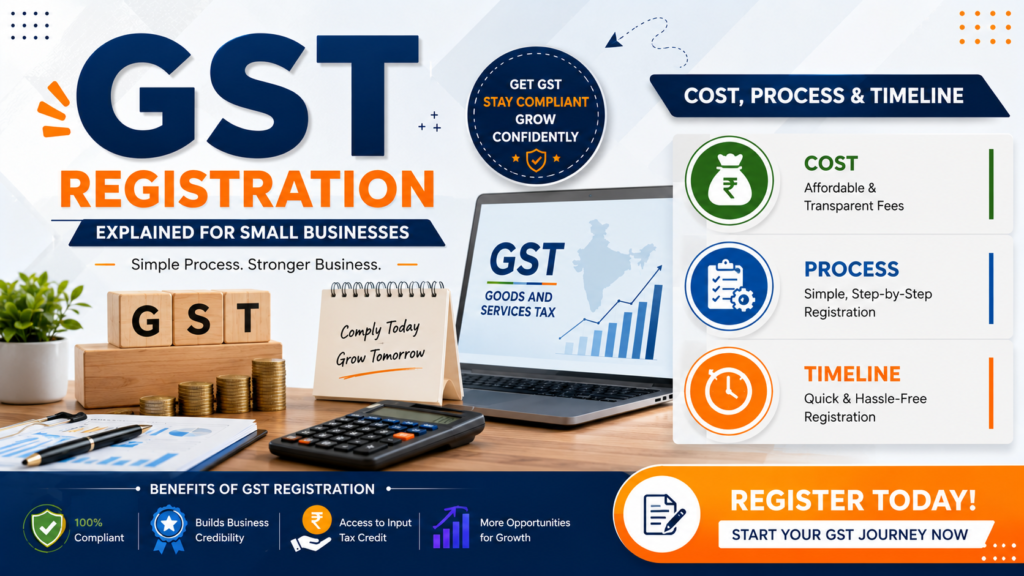
TL;DR If you operate a business in India, GST registration may be mandatory depending on your turnover, business model, or interstate operations. While government GST registration itself is generally free, businesses often incur professional fees for documentation, filing, and compliance support. Most GST registrations are approved within 7–15 working days when documents are accurate and complete. This guide explains: GST registration cost Eligibility requirements Required documents Registration process Timeline expectations Common mistakes to avoid What Is GST Registration? Goods and Services Tax (GST) is India’s unified indirect tax system that replaced multiple state and central taxes. Businesses that meet specific eligibility criteria must register under GST and obtain a unique GST Identification Number (GSTIN). GST registration allows businesses to: Collect GST from customers Claim Input Tax Credit (ITC) Conduct interstate business legally Participate in government tenders Improve business credibility For many startups and growing businesses, GST registration is not just a compliance requirement—it is a growth enabler. Who Needs GST Registration in India? Many business owners assume GST registration is required only after crossing a turnover threshold. While turnover is important, several other factors trigger mandatory registration. GST Registration Is Mandatory If: Criteria Registration Required Interstate supply of goods Yes E-commerce seller Yes Casual taxable person Yes Input service distributor Yes Reverse charge applicability Yes Certain notified businesses Yes Turnover-Based GST Registration For Goods Suppliers Businesses exceeding prescribed turnover limits under GST regulations must register. For Service Providers Service providers crossing applicable turnover thresholds must obtain GST registration. Even if registration is not mandatory, voluntary registration can offer significant advantages. Benefits of GST Registration for Small Businesses Many small business owners view GST purely as a compliance burden. In reality, GST registration provides several strategic benefits. 1. Input Tax Credit Benefits Registered businesses can claim credit on GST paid for: Office rent Equipment purchases Professional services Software subscriptions Business supplies This reduces the overall tax burden significantly. 2. Increased Business Credibility Customers, suppliers, and corporate clients often prefer working with GST-registered businesses because it reflects compliance and professionalism. 3. Expansion Opportunities GST registration allows businesses to: Sell across India Partner with large corporations Join e-commerce marketplaces Participate in tenders 4. Easier Business Financing Banks and financial institutions often evaluate GST filings while assessing business loan applications. Regular GST compliance demonstrates financial discipline and transparency. GST Registration Cost Explained One of the most common questions entrepreneurs ask is: “How much does GST registration cost?” Government GST Registration Fee The GST portal does not charge a government fee for standard GST registration. Government Cost: ₹0 However, this does not mean businesses incur no expenses. Professional Fees Most businesses hire Chartered Accountants or GST consultants because documentation errors frequently cause delays or rejections. Professional fees generally vary depending on: Business structure Documentation complexity Additional registrations Advisory requirements State-specific compliance needs Typical Cost Components Expense Approximate Cost GST Registration Filing Professional Fee Based Documentation Support Variable GST Advisory Variable Compliance Setup Variable Post-Registration Assistance Variable Businesses should focus on accuracy rather than choosing the lowest-cost service provider. A registration error can cost significantly more than professional assistance. Documents Required for GST Registration Proper documentation is the most important factor in obtaining quick approval. For Proprietorship Firms Required documents typically include: PAN Card Aadhaar Card Passport-size photograph Mobile number Email address Business address proof Bank account details For Companies and LLPs Additional documents include: Certificate of Incorporation PAN of entity Board Resolution Authorization Letter Director KYC documents Address Proof Documents Accepted documents generally include: Electricity bill Property tax receipt Rent agreement NOC from owner Ensure all documents are current and consistent. Even small discrepancies can trigger clarification notices. Step-by-Step GST Registration Process Step 1: Gather Documentation Collect all required documents before beginning the application. Verify: Names match PAN records Addresses are accurate Mobile and email details are active Step 2: Create GST Application The application is submitted through the GST registration portal. Information required includes: Business details Promoter information Business activities Bank information Authorized signatory details Step 3: Upload Supporting Documents Upload scanned copies of all supporting documents. Ensure: Clear image quality Correct file formats Proper document categorization Step 4: Verification Through OTP Verification is completed using: Aadhaar authentication OTP validation Electronic verification methods Step 5: Application Review GST authorities review submitted information. They may: Approve registration Seek clarification Request additional documents Step 6: GSTIN Allocation Upon approval, the business receives: GSTIN Registration Certificate Access to GST compliance activities How Long Does GST Registration Take? The timeline depends largely on documentation quality. Standard GST Registration Timeline Stage Expected Duration Application Submission 1 Day Verification 1–3 Days Officer Review 3–7 Days Approval & GSTIN Issuance 1–5 Days Average Total Timeline 7–15 Working Days When documentation is complete and accurate, approval can occur even faster. Factors That Delay GST Registration Common reasons include: Incorrect PAN details Address mismatch Invalid documents Poor-quality uploads Aadhaar verification issues Missing NOC documents Working with an experienced Chartered Accountant helps avoid these delays. Common Reasons GST Applications Get Rejected Understanding rejection reasons can save valuable time. Frequent Mistakes Wrong business activity selection Incomplete address proof Incorrect legal name Missing authorization documents Invalid bank details Inconsistent information across documents Most rejections are preventable through proper preparation and professional review. GST Compliance After Registration Obtaining a GSTIN is only the beginning. Once registered, businesses must comply with ongoing GST requirements to avoid penalties, interest, and notices from tax authorities. Key GST Compliance Requirements 1. Timely GST Return Filing Depending on the business type and turnover, registered taxpayers may need to file: GSTR-1 (Outward supplies) GSTR-3B (Monthly/Quarterly summary return) Annual GST Return Other applicable GST forms Even if there are no transactions during a period, certain returns may still need to be filed. 2. Maintaining Proper Records Businesses should maintain: Sales invoices Purchase invoices E-way bills Credit notes Debit notes Input Tax Credit records GST payment records Proper recordkeeping helps during assessments and audits. 3. Accurate Input Tax Credit (ITC) Claims Incorrect ITC claims are among the most common reasons businesses receive GST notices.
The Ultimate Guide to Income Tax Return Filing in Pune for Salaried and Business Professionals

TL;DR If you earn a salary, run a business, work as a freelancer, or operate a startup in Pune, filing your Income Tax Return (ITR) correctly is essential. Apart from legal compliance, timely filing helps you claim refunds, avoid penalties, improve loan eligibility, and maintain a strong financial profile. This guide explains everything from eligibility and documents to deductions, forms, and expert tax-saving strategies. Why Income Tax Return Filing Matters Income Tax Return Filing in Pune is more than just an annual compliance requirement. It is a crucial financial activity that affects your tax liability, creditworthiness, and future financial opportunities. Many taxpayers assume that tax filing is only necessary when taxes are payable. However, even individuals with tax deducted at source (TDS) may benefit from filing returns. Timely filing helps: Avoid penalties and interest Claim income tax refunds Carry forward losses Improve loan approvals Simplify visa applications Maintain financial transparency With increasing digitization and data integration by the Income Tax Department, accurate filing has become more important than ever. Who Should File an Income Tax Return? Salaried Employees Most salaried professionals in Pune receive Form 16 from their employers. However, filing an ITR remains your responsibility. You should file if: Your income exceeds applicable exemption limits TDS has been deducted You want to claim a refund You have multiple income sources You own foreign assets or investments Freelancers and Consultants Freelancers, digital marketers, doctors, architects, lawyers, designers, and consultants often receive income from multiple clients. Proper tax filing helps: Report professional income correctly Claim eligible business expenses Maintain financial records Avoid scrutiny notices Business Owners Business owners must accurately report: Business turnover Profit and loss Expenses GST-related information Capital gains Investments Incorrect reporting can lead to penalties and tax notices. Startups and LLPs Startups and LLPs operating in Pune have additional compliance requirements including: Income tax returns Audit reports TDS compliance GST reconciliation Financial statement reporting Professional guidance becomes essential for these entities. Benefits of Filing Your Income Tax Return Many taxpayers view tax filing as an obligation. In reality, it offers significant benefits. Benefit Why It Matters Tax Refund Recover excess TDS deducted Loan Approval Banks prefer filed returns Visa Processing Often required by embassies Carry Forward Losses Offset future taxable income Financial Credibility Demonstrates income transparency Compliance Avoid legal complications For professionals and business owners, consistently filed returns also strengthen business credibility. Documents Required for Income Tax Return Filing Before beginning the filing process, gather all relevant documents. For Salaried Employees PAN Card Aadhaar Card Form 16 Salary slips Bank statements Investment proofs Home loan certificate Interest certificates For Business Owners Profit & Loss Statement Balance Sheet GST Returns Bank Statements TDS Certificates Investment Records Expense Records For Freelancers Client invoices Payment records Expense bills Professional receipts Bank statements Having complete documentation reduces errors and speeds up filing. Understanding Different ITR Forms Selecting the correct form is critical. ITR-1 (Sahaj) Suitable for: Salaried individuals Pensioners Income from one house property Interest income Generally used by most salaried employees. ITR-2 Suitable for: Individuals with capital gains Multiple house properties Foreign income or assets ITR-3 Suitable for: Business owners Professionals Proprietorship businesses This form is commonly used by consultants, doctors, architects, and traders. ITR-4 (Sugam) Suitable for: Presumptive taxation scheme taxpayers Small businesses Eligible professionals This form simplifies tax compliance for qualifying taxpayers. Step-by-Step Income Tax Return Filing Process Step 1: Collect Financial Documents Gather all relevant income and deduction documents. Step 2: Verify Form 26AS and AIS Cross-check: TDS entries Tax payments Interest income Investment details This ensures data consistency. Step 3: Choose the Correct ITR Form Selecting the wrong form can lead to defective return notices. Step 4: Calculate Taxable Income Include: Salary income Business income Rental income Capital gains Interest income Step 5: Claim Eligible Deductions Review deductions available under various sections before filing. Step 6: File the Return Submit the return through the Income Tax Portal. Step 7: Verify the Return Verification can be completed through: Aadhaar OTP Net Banking Digital Signature Bank Account Verification Without verification, the return remains incomplete. Major Tax Deductions and Exemptions Tax planning plays a crucial role in reducing tax liability. Section 80C Maximum deduction up to ₹1.5 lakh through: ELSS PPF EPF Life Insurance Premium Tax-saving Fixed Deposits Section 80D Deduction for health insurance premiums paid for: Self Spouse Children Parents Home Loan Benefits Tax benefits may be available on: Principal repayment Interest payments Education Loan Interest paid on eligible education loans can qualify for deductions. NPS Contributions Additional tax benefits may be available through National Pension System investments. Proper tax planning before filing can significantly reduce overall tax burden. Common ITR Filing Mistakes to Avoid Many tax notices arise due to avoidable errors. Reporting Incorrect Income Ensure all income sources are disclosed. Choosing Wrong Tax Regime Compare the old and new tax regimes before filing. Ignoring AIS and Form 26AS Mismatch issues frequently trigger notices. Missing Deductions Many taxpayers overlook legitimate deductions. Filing at the Last Minute Last-minute filing often results in mistakes and technical issues. Income Tax Return Filing for Business Professionals Business owners face additional complexities compared to salaried taxpayers. Important considerations include: Advance tax compliance GST reconciliation Expense classification Depreciation claims TDS compliance Audit applicability A professional review can prevent costly mistakes and improve tax efficiency. Why Hire a Chartered Accountant for ITR Filing in Pune? While online filing tools have simplified the process, tax laws continue to evolve. A qualified CA helps: Identify tax-saving opportunities Select the correct tax regime Ensure accurate reporting Reduce compliance risks Handle notices and assessments Maximize legitimate deductions For business owners and high-income professionals, expert guidance often results in significant tax savings. How Mittal & Co. Helps Taxpayers in Pune Mittal & Co., Chartered Accountant in Pune, assists individuals, professionals, startups, and businesses with comprehensive tax compliance and advisory services. Services include: Income Tax Return Filing Tax Planning GST Compliance Business Taxation Startup Advisory Audit & Assurance Accounting Services Whether you are a salaried employee filing your first return
📝 ITR 3 – Complete Guide for FY 2025-26

🔹 Introduction Income Tax Return (ITR) forms are designed to suit different taxpayer categories. ITR 3 is one of the most comprehensive forms, meant for individuals and Hindu Undivided Families (HUFs) with income from business or profession. With the new updates for FY 2025-26, taxpayers must clearly understand its scope, eligibility, and recent changes. 📌 What is ITR 3? ITR 3 is applicable to Individuals and HUFs earning income from profits and gains of business or profession. It covers all heads of income (salary, house property, capital gains, business/profession, and other sources) and includes all schedules for detailed reporting. Taxpayers who cannot file ITR 4 because they have capital gains, multiple house properties, or are partners in a firm can go for ITR 3. Freelancers, consultants, proprietors, and those engaged in F&O trading must also use ITR 3. 🚫 ITR 3 Not Required For ITR 3 is not required in the following cases: No Business Income – Individuals with only salary, pension, one house property, or income from other sources can file ITR 1 (Sahaj) or ITR 2. Presumptive Income Only – Taxpayers declaring income under presumptive taxation (sections 44AD, 44ADA, 44AE) should use ITR 4 (Sugam). Entities Like Companies, LLPs, and Firms – These must file using their respective forms (ITR 5, ITR 6, etc.) instead of ITR 3. ✅ Who Must File ITR 3 You must file ITR 3 if: You earn income from business or profession (including consultancy, freelancing, or proprietorship). You have income from Futures & Options (F&O) or speculative trading. You are a company director or hold unlisted equity shares. You earn from multiple sources including capital gains, house property, and foreign assets. You want to carry forward previous years’ business or speculation losses for set-off in future years. You are a partner in a partnership firm or LLP and earn interest, remuneration, or share of profit from the firm. 🔄 Changes in ITR 3 for FY 2025-26 The new ITR 3 form introduces several compliance-focused updates: Profit & Loss Schedule Remuneration and interest received from partnership firms must be shown separately. Section 44AD Update Code 09029 has been removed. Audit Details Fewer details are now required, simplifying reporting. Schedule Salary Section 10(17) has been added to the exemption list. Schedule Business/Profession Income or receipts credited to Profit and Loss account but not chargeable to tax to be shown separately. Other Updates MSME Act compliance reporting for disallowable interest. Section 44BBD added for specific business income. Expanded disability categories under 80DD & 80U. Sikkim included under section 80IE. 🏁 Conclusion ITR 3 is a comprehensive return form designed for taxpayers with complex income structures, especially those engaged in business or professional activities. The FY 2025-26 changes emphasize greater transparency, simplified audit reporting, and updated exemptions. Taxpayers with capital gains, multiple properties, partnership income, or carry-forward losses must use ITR 3 to ensure proper disclosure and compliance. Reviewing these updates carefully will help avoid errors and penalties during filing. BLOG BY: Mittal & Co.
GST Data Matching & Scrutiny in 2026: Why Notices Are Increasing and How to Stay Safe
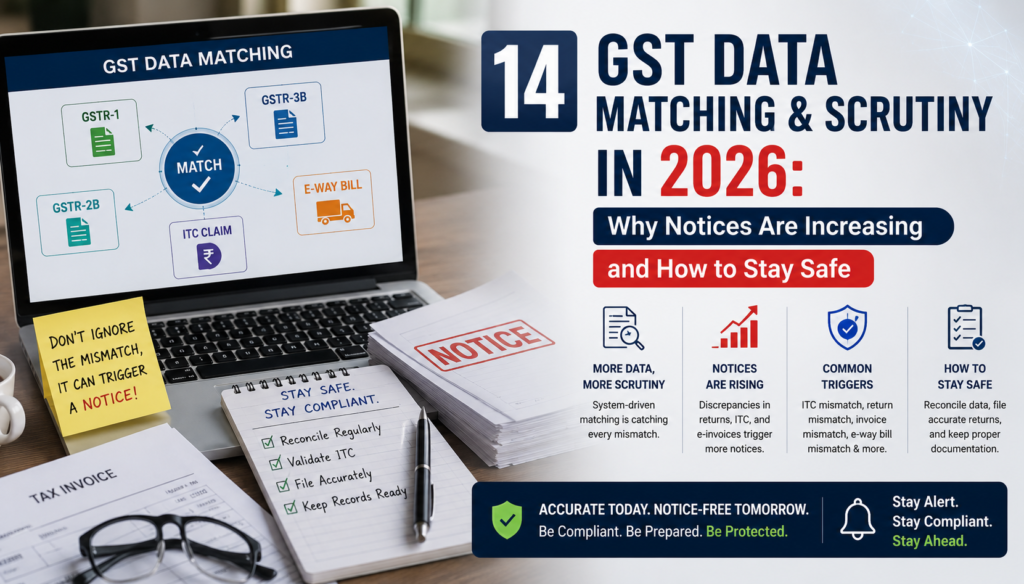
TL;DR GST scrutiny in India has become significantly stricter in 2026 due to advanced data matching systems, AI-driven compliance monitoring, e-invoicing integration, and automated reconciliation checks. Businesses are increasingly receiving notices because of: GSTR mismatches Incorrect ITC claims Vendor non-compliance E-invoice inconsistencies Delayed reconciliations Companies that implement proactive GST compliance systems and regular reconciliation processes are far better positioned to reduce notice risks and avoid financial disruption. Why GST ScrutinyIs Increasing in 2026 The GST ecosystem has evolved rapidly over the last few years. The government now has access to: Real-time invoice data E-invoicing systems Banking integrations AI-powered analytics Cross-platform transaction matching This has significantly improved the ability of tax authorities to detect: Reporting inconsistencies Fake invoicing Incorrect tax credit claims Non-compliant vendors Revenue leakages As a result, GST scrutiny notices are increasing across: SMEs Startups Ecommerce businesses Manufacturers Service providers Many businesses receive notices not because of fraud, but because of poor reconciliation and weak compliance systems. What Is GST Data Matching? GST data matching refers to the automated comparison of financial and tax data across multiple GST filings and systems. The department compares: GSTR-1 GSTR-3B GSTR-2B E-invoices E-way bills Vendor filings The objective is to identify mismatches, irregularities, and inconsistencies. Example If a business reports sales in GSTR-1 but pays lower tax in GSTR-3B, the mismatch may trigger automated scrutiny. Similarly, claiming input tax credit from a vendor who has not filed returns can create compliance exposure. Major GST Mismatches Triggering Notices 1. GSTR-1 vs GSTR-3B Mismatch One of the most common triggers in 2026 is mismatch between: Outward supplies reported in GSTR-1 Tax liability reported in GSTR-3B Common Causes Incorrect reporting Manual entry errors Delayed invoice uploads Adjustments not properly disclosed Risk This can trigger: Automated notices Tax demand queries Departmental scrutiny 2. GSTR-2B Mismatches Input tax credit claims are now heavily monitored. Businesses often face problems when: Vendors fail to file returns Vendor invoices are missing ITC is claimed incorrectly Reconciliation is delayed Why This Matters Improper ITC claims can result in: ITC reversals Interest liabilities Penalties Notice exposure 3. E-Invoicing Inconsistencies E-invoicing has increased transparency significantly. Authorities now compare: Invoice values GST returns E-way bill data Tax liability reporting Even small inconsistencies can trigger alerts. 4. Vendor Non-Compliance Many businesses assume their compliance ends after filing returns. However, vendor behavior now directly affects GST risk. Common Issues Vendors not filing returns Fake invoice chains Incorrect GSTIN usage Suspicious transaction patterns Result Businesses may lose input tax credit eligibility despite making valid purchases. 5. Incorrect Classification & Tax Rates Applying incorrect GST rates remains a major issue across industries. This commonly affects: Ecommerce sellers Manufacturers Multi-product businesses Even classification misunderstandings can create: Tax shortfall disputes Interest liabilities Retrospective scrutiny Common Reasons Businesses Receive GST Notices Top Notice Triggers in 2026 Trigger Risk Level GSTR mismatch High ITC mismatch High Delayed filing Medium Vendor non-compliance High E-invoice inconsistency High Incorrect tax classification Medium High-risk transaction patterns High How Automated GST Tracking Has Changed Compliance Earlier, GST scrutiny relied heavily on manual assessments. Now, automated systems continuously monitor: Filing patterns Invoice matching Tax payment consistency Vendor compliance behavior E-way bill movement This means businesses must maintain: Accurate records Timely reconciliations Strong documentation Real-time compliance monitoring Reactive compliance is no longer sufficient. The Financial Impact of GST Errors GST notices can create significant operational and financial pressure. Potential Consequences Interest liabilities Penalties Working capital blockage ITC reversals Audit scrutiny Increased compliance costs In severe cases, businesses may also face: Reputation damage Vendor trust issues Operational disruptions Step-by-Step Guide to Reducing GST Risk Step 1: Reconcile Monthly Businesses should reconcile: GSTR-1 GSTR-3B GSTR-2B E-invoices every month instead of waiting for annual reviews. Step 2: Monitor Vendor Compliance Track whether vendors: File returns regularly Maintain active GST registration Upload invoices properly Vendor monitoring is now critical for protecting ITC claims. Step 3: Automate GST Tracking Use: GST reconciliation software Automated mismatch alerts Compliance dashboards Automation reduces manual errors significantly. Step 4: Maintain Proper Documentation Businesses should maintain: Tax invoices E-way bills Vendor records Purchase reconciliations Audit trails Strong documentation improves notice response capability. Step 5: Conduct Periodic GST Reviews Quarterly GST health checks help identify: Reporting inconsistencies ITC risks Vendor issues Compliance gaps before notices occur. Real Business Example Manufacturing Company Scenario A manufacturing company receives a GST notice due to mismatch between: Vendor invoice uploads ITC claimed in returns The root issue was delayed reconciliation and vendor non-compliance. After implementing monthly reconciliation and automated tracking systems, the business significantly reduced compliance risks. GST Compliance Best Practices for Businesses Recommended Practices Monthly reconciliation reviews Vendor compliance tracking Automated GST reporting systems Internal GST audits Proper invoice documentation Real-time compliance monitoring Professional GST advisory support Businesses with structured compliance systems are far less likely to face major scrutiny issues. Why Professional CA Advisory Matters More in 2026 GST compliance is becoming increasingly technical and data-driven. Professional CA firms help businesses: Interpret GST provisions correctly Reduce mismatch risks Handle notices properly Conduct reconciliations Improve documentation systems Monitor compliance proactively This proactive approach reduces operational risk and improves long-term compliance stability. How Mittal & Co. Helps Businesses Stay GST-Compliant Mittal & Co. helps businesses strengthen GST compliance systems through: GST consultancy Return filing support Reconciliation reviews Notice handling Compliance audits Vendor compliance monitoring Strategic GST advisory For businesses in Pune and across India, proactive GST management is becoming essential for financial stability and operational continuity. Suggested Internal Links GST Consultancy Services Accounting & Bookkeeping Audit & Assurance Tax Advisory Services Compliance Management Solutions Conclusion GST scrutiny in 2026 is no longer limited to manual departmental reviews. Advanced data matching systems now continuously monitor: GST returns Vendor filings E-invoices ITC claims Transaction patterns Businesses that continue using weak reconciliation practices and reactive compliance systems face increasing notice risks. The safest approach is to: Maintain accurate records Reconcile regularly Monitor vendors proactively Use automation intelligently Work with experienced GST professionals In the current compliance environment, prevention is significantly more effective than notice response. 6. FAQ
Filing ITR-2 for FY 2025-26: Everything You Need to Know
Introduction Every year, many taxpayers get confused about which ITR form to file. A common mistake is filing ITR-1 (Sahaj) when in reality, their income profile requires ITR-2. This often leads to missing out on important disclosures; especially for non-residents, company directors, or individuals with capital gains and multiple house properties. Another overlooked aspect is the carry forward of previous year’s losses, which cannot be properly claimed if the wrong form is filed. Understanding the distinction is key to avoiding defective returns and ensuring full compliance. ✅ Who Can File ITR-2? ITR-2 is designed for taxpayers whose income does not fall under “Profits and Gains of Business or Profession.” It applies to: Salary/Pension Income – Whether from one employer or multiple, including allowances and perquisites. House Property Income – Covers rental income from one or more properties, including cases where you own more than two houses. Capital Gains – Short-term or long-term gains from sale of shares, mutual funds, property, or other capital assets. Other Sources – Includes interest income, winnings from lotteries, betting, gambling, racehorses, etc. Agricultural Income – If agricultural income exceeds ₹5,000. Special Cases: Non Residents Individuals who are directors in a company. Individuals who held unlisted equity shares during the year. Carry forward of previous year’s losses 🔄 Who Should File ITR-2 Instead of ITR-1? While ITR-1 (Sahaj) is meant for salaried individuals with income up to ₹50 lakhs, limited to one or two house properties, and no capital gains, certain taxpayers must switch to ITR-2. You should file ITR-2 instead of ITR-1 if: You own more than two house properties or earn rental income from multiple properties. You have capital gains from sale of shares, mutual funds, property, or other assets. You have carry forward of previous year’s losses You have agricultural income exceeding ₹5,000. You are a non-resident with income in India. You are a company director or hold unlisted equity shares. Your income includes lottery winnings, betting, gambling, or racehorses. 👉 In short, if your income profile goes beyond the “simpler” categories covered under ITR-1, you must opt for ITR-2 to ensure proper compliance. 🚫 Who Cannot File ITR-2? ITR-2 is not applicable if your income includes: Profits and gains from business or profession. Income such as interest, salary, bonus, commission, or remuneration received from a partnership firm, taxable under “Profits and Gains of Business or Profession.” Carry forward of business loss from any previous years Speculation income In such cases, you must opt for ITR-3 instead. 📂 Documents Required for ITR-2 Filing To ensure smooth filing, keep the following documents ready: Form 16 – For salaried individuals, issued by the employer. Form 16A – For interest income where TDS is deducted. Form 26AS & AIS – Comprehensive tax credit statements available on the e-filing portal. Rent Receipts – For HRA claims if not submitted to employer. Capital Gains Statement – Profit/loss summary of share or securities transactions. Bank Passbook & FDRs – To calculate interest income. House Property Details – Tenant information, municipal tax receipts, loan interest details. Loss Documents – Proof of current year losses for set-off. Previous Year’s ITR – For carrying forward losses. Deduction Proofs (80C, 80D, 80G, 80GG, etc.) – Insurance premiums, tuition fees, donation receipts, rent receipts, etc. ⚡ Precautions to Avoid Issues To prevent rejection or delays in refunds: Link Aadhaar with PAN – Mandatory for most taxpayers. Pre-validate your bank account – Ensures smooth refund credit. Select the correct ITR form – Filing with the wrong form leads to a defective return. File within due dates – Avoid penalties and interest. Verify your return promptly – E-verification is the fastest and most reliable option. Conclusion ITR-2 is designed for taxpayers with diverse income streams beyond business or profession. With detailed disclosures and stricter compliance requirements, preparation is key. By keeping the right documents ready, choosing the correct form, and verifying your return on time, you can ensure a seamless filing experience and avoid unnecessary hassles. Filing smart today means peace of mind tomorrow. For more information, please feel free to connect with us on info@camittal.com or 9096623634. Disclaimer: This blog is for educational purposes only and should not be considered professional accounting, tax, or legal advice. Please consult a qualified professional before making financial decisions. BLOG BY: Mittal & Co.