
Data-Driven Tax Scrutiny in 2026: Why the Government Knows More Than You Think
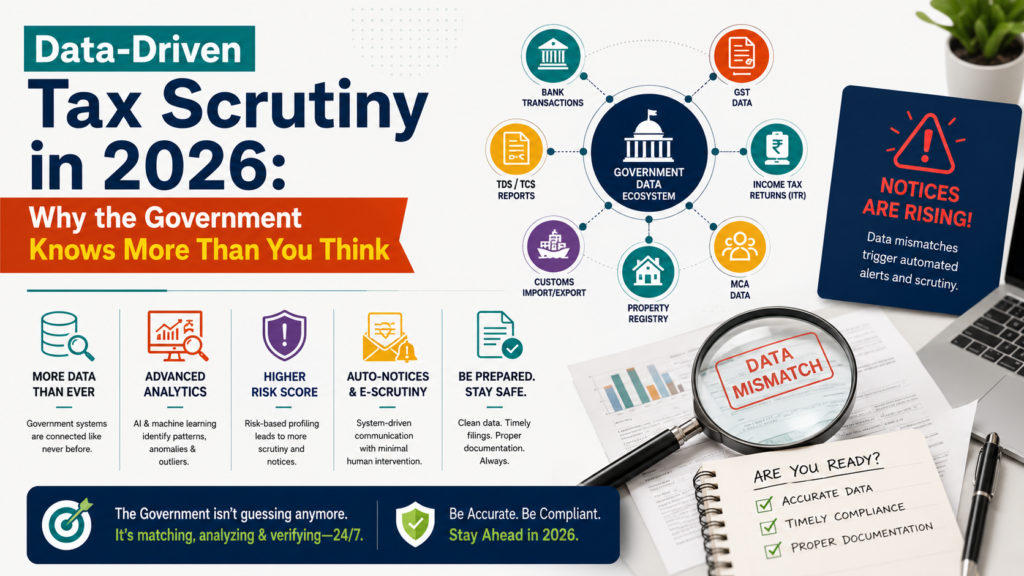
TL;DR India’s tax ecosystem in 2026 is heavily data-driven. The government now uses AI systems, GSTN analytics, AIS/TIS reporting, banking integrations, e-invoicing, and digital payment tracking to identify mismatches automatically. Businesses with inconsistent GST filings, unexplained cash flow, incorrect ITC claims, or underreported income are increasingly receiving scrutiny notices. Proactive compliance, reconciliation, and expert advisory are now essential. The New Era of AI-Powered Tax Surveillance For years, tax scrutiny in India depended heavily on manual assessments and selective investigations. That landscape has changed dramatically. In 2026, tax departments no longer rely only on declared figures in returns. They now compare data from multiple systems simultaneously: GST returns Income tax filings AIS/TIS records TDS filings E-invoices Banking transactions UPI and digital payment trails MCA and ROC filings Customs and import-export data The result is a highly connected compliance ecosystem where inconsistencies are detected faster than ever. Businesses that previously assumed small discrepancies would go unnoticed are now facing automated alerts and notices. What “Data-Driven Tax Scrutiny” Actually Means Data-driven scrutiny refers to the use of technology, analytics, and AI-based risk assessment to identify suspicious tax behavior. Instead of randomly selecting taxpayers, authorities now use algorithms to identify: High-risk transactions Unusual input tax credit claims Mismatched turnover Suspicious vendor chains Fake invoicing patterns Underreported income GSTN Analytics The GST Network now performs advanced invoice-level matching. If your: GSTR-1, GSTR-3B, E-way bills, E-invoices, Vendor filings, do not align properly, the system can flag the discrepancy automatically. This is one of the major reasons GST notices are increasing across India. AIS & TIS Reporting Annual Information Statement (AIS) and Taxpayer Information Summary (TIS) have become powerful scrutiny tools. The Income Tax Department can now see: High-value banking transactions Mutual fund investments Stock market activity Foreign remittances Credit card spends Property purchases Interest income TDS/TCS data If your filed income does not align with financial behavior, the mismatch becomes visible instantly. Banking & Digital Payment Tracking The rapid adoption of: UPI, POS machines, Payment gateways, Digital wallets, has significantly reduced untraceable transactions. Businesses operating heavily in cash but showing low digital turnover patterns inconsistent with industry benchmarks may attract scrutiny. MCA, ROC & PAN Integration Government departments increasingly share information across platforms. For example: ROC turnover data may be compared with GST turnover PAN-linked banking transactions may be checked against ITR disclosures TDS deductions may be matched with declared income This interconnected approach leaves far fewer gaps in reporting. Why Tax Notices Are Increasing in 2026 Real-Time Data Matching Earlier, mismatches could remain unnoticed for years. Now, automated systems detect: ITC mismatches Vendor inconsistencies Duplicate invoices Delayed filings Suspicious refund claims in near real time. Automated Risk Profiling Businesses are increasingly assigned risk scores based on: Filing behavior Industry patterns Transaction size Compliance history Vendor network quality Higher-risk profiles are more likely to receive: GST notices Income tax scrutiny Audit requests Compliance verification communications E-Invoicing Expansion The government’s continued expansion of e-invoicing has dramatically increased transaction transparency. Authorities can now track: Invoice generation timing Invoice amendments Supply chain patterns Tax liability consistency This reduces opportunities for invoice manipulation. UPI & Digital Trail Visibility Digital payments create permanent records. Large unexplained credits, frequent high-value transfers, or inconsistent reporting between bank statements and tax filings can quickly trigger automated checks. Common Triggers That Invite Scrutiny Trigger Possible Impact GSTR-1 and GSTR-3B mismatch GST notice Excess ITC claims ITC reversal scrutiny High cash deposits Income tax verification Low profit margins inconsistent with industry Assessment risk Vendor non-compliance ITC denial Incorrect HSN/SAC usage GST classification dispute Delayed return filing Higher scrutiny probability Mismatch between AIS and ITR Income tax notice How GST and Income Tax Departments Cross-Verify Data One of the biggest misconceptions among businesses is believing GST and Income Tax departments operate independently. In reality, cross-verification has become increasingly sophisticated. For example: Data Source Cross-Checked Against GST turnover Income tax turnover E-invoices GSTR filings Bank transactions Declared business receipts TDS entries Revenue disclosures ROC filings Tax returns Vendor GST filings ITC claims This integrated structure allows authorities to identify inconsistencies rapidly. Red Flags Businesses Often Ignore Many scrutiny cases arise not from fraud, but from negligence. Common examples include: Claiming ITC from non-compliant vendors Ignoring reconciliation processes Incorrect expense classification Filing returns without verification Multiple revisions and corrections Sudden turnover spikes Unrealistic profit disclosures Businesses often underestimate how visible these patterns have become. Practical Compliance Checklist for Businesses Monthly Compliance Actions Reconcile GSTR-1 and GSTR-3B Verify vendor GST compliance Match purchase registers with ITC claims Review bank transaction consistency Quarterly Actions Conduct internal GST review Validate e-invoice reporting Review TDS compliance Analyze AIS/TIS entries Annual Actions Perform full tax reconciliation Compare ROC and GST turnover Validate expense documentation Conduct tax risk assessment What to Do If You Receive a Notice Receiving a notice does not automatically mean wrongdoing. However, delayed or incorrect responses can escalate matters. Recommended Steps Review the notice carefully Identify the exact mismatch or issue Gather supporting documentation Reconcile all relevant returns Respond within deadlines Consult a qualified tax professional Avoid: Ignoring notices Submitting incomplete replies Providing inconsistent explanations How Professional Tax Advisors Reduce Risk Modern compliance is no longer just about filing returns. Professional CA firms help businesses: Conduct proactive reconciliations Detect risk indicators early Maintain audit-ready documentation Handle GST and income tax notices Improve compliance systems Reduce litigation exposure For growing businesses, this proactive approach can significantly reduce operational and financial stress. Mittal & Co. provides GST compliance, tax advisory, audits, registrations, accounting support, and business compliance services for businesses and professionals in Pune and across India. Conclusion Tax scrutiny in India has entered a new technological era. In 2026, government systems can connect GST filings, banking data, AIS records, e-invoices, TDS filings, and digital payment trails with unprecedented efficiency. Businesses that rely on outdated compliance practices face increasing exposure to notices and investigations. The safest strategy is no longer reactive compliance. It is proactive transparency, regular reconciliation, strong documentation, and professional oversight. As regulatory systems become smarter, businesses must become more
Capital Gains Tax Rules AY 2025-26 vs AY 2026-27

🔹Capital Gains Tax Rules: AY 2025-26 vs AY 2026-27 Capital Gains Tax Rules have undergone significant changes for AY 2026-27. Taxpayers dealing with property, equity shares, or mutual funds must understand the revised tax rates, holding periods, indexation provisions, and exemptions. This guide compares Capital Gains Tax Rules applicable in AY 2025-26 and AY 2026-27 to help investors and property owners plan their taxes effectively. This blog explains capital gains in detail; what they are, how they are computed, asset‑wise holding periods, valuation rules, applicable tax rates, and exemptions. It also highlights the differences between AY 2025-26 and AY 2026-27, helping taxpayers understand how these changes impact their ITR filing. 🔹 What is Capital Gain? Capital gain is the profit arising from the transfer of a capital asset. It is chargeable to tax under Section 45(1) in the year of transfer. Computation Formula: [ Capital Gain = Full Value of Consideration – (Expenses + Cost of Acquisition + Cost of Improvement) ] Key Points: Certain transfers are excluded under Section 47. • Reinvestment benefits under Sections 54 to 54GB allow exemption. • Capital gains are classified as short-term or long-term depending on the holding period. 🔹 Asset-wise Holding Period and Valuation Rules 🏠 Immovable Property (Land, Building, or Both) Holding Period: Short-term: Held for less than 24 months. • Long-term: Held for 24 months or more. Valuation Rules: Full Value of Consideration (Section 50C): Higher of actual consideration or Stamp Duty Value (SDV). If SDV exceeds actual consideration by more than 10%, SDV is deemed full value. • Cost of Acquisition: For assets acquired before 01-04-2001, cost is higher of actual purchase price or FMV as on 01-04-2001 (subject to SDV cap). • Cost of Improvement: Only capital expenditure incurred on or after 01-04-2001 is considered. 📈 Equity Shares Holding Period: Short-term: Held for less than 12 months. • Long-term: Held for 12 months or more. Valuation Rules: Cost of Acquisition: – Acquired on/before 31-01-2018 → Higher of actual cost or lower of FMV (31-01-2018) and sale consideration. – Acquired after 01-02-2018 → Actual cost. STT Requirement: STT must be paid at acquisition and transfer (with exceptions for IFSC transactions in foreign currency). 📊 Units of Equity-Oriented Mutual Funds Holding Period: • Short-term: Held for less than 12 months. • Long-term: Held for 12 months or more. Valuation Rules: • Cost of Acquisition: Actual purchase price. • STT Requirement: STT must be paid at transfer for concessional tax treatment. 🔹 Tax Rates on Capital Gains AY 2025-26 vs AY 2026-27 Asset Type AY 2025-26 AY 2026-27 Immovable Property (LTCG) If sold before 23-07-2024: 20% with indexation If sold on or after 23-07-2024: 12.5% without indexation (20% with indexation optional available if acquired before 23-07-2024, if beneficial) 12.5% without indexation (20% with indexation if acquired before 23-07-2024, if beneficial) Immovable Property (STCG) Slab rates Slab rates Equity Shares (STCG)/ Mutual Fund Units- Equity oriented (STCG) If sold before 23-07-2024: 15% If sold on or after 23-07-2024: 20% 20% Equity Shares (LTCG)/ Mutual Fund Units- Equity oriented (LTCG) If sold before 23-07-2024: 10% If sold on or after 23-07-2024: 12.5% Exemption: ₹1,25,000 12.5% Exemption: ₹1,25,000 🔹 Exemptions Sections 54 to 54GB: • Reinvestment in residential property, agricultural land, bonds, or shares. • Specific timelines and conditions must be met. Special Exemptions: • Section 10(37): Compulsory acquisition of urban agricultural land. • Section 10(37A): Andhra Pradesh land pooling schemes. 🔹 Key Changes from AY 2025-26 to AY 2026-27 Immovable Property: LTCG rate changed to 12.5% without indexation; grandfathering provision allows 20% with indexation for assets acquired before 23-07-2024. Equity Shares & Mutual Funds: STCG rate increased to 20%; LTCG rate increased to 12.5% with threshold exemption raised to ₹1,25,000. Indexation Benefit: Abolished for most assets, except grandfathering for immovable property acquired before 23-07-2024. ✅ Conclusion Capital gains taxation has undergone a major shift in AY 2026-27, with simplified rates and reduced reliance on indexation. While immovable property gains now face a lower flat rate of 12.5%, securities taxation has moved to slightly higher concessional rates with enhanced threshold exemptions. Taxpayers should carefully evaluate: • Holding periods to determine STCG vs LTCG. • Valuation rules for cost of acquisition and improvement. • Grandfathering provisions for immovable property and securities. • Exemptions under Sections 54 to 54GB to minimize liability. By understanding these changes, taxpayers can plan better and ensure accurate ITR filing under the new regime. For more information, please feel free to connect with us on info@camittal.com or 9096623634. Disclaimer: This blog is for educational purposes only and should not be considered professional accounting, tax, or legal advice. Please consult a qualified professional before making financial decisions. BLOG BY: Mittal & Co.
The Hidden Financial Mistakes Killing Business Profits in 2026 (Most Founders Don’t Even Notice)

TL;DR Many businesses in 2026 are generating revenue but still struggling with profitability because of hidden financial mistakes. Poor cash-flow management, weak financial visibility, compliance inefficiencies, tax planning gaps, and inaccurate accounting systems are silently reducing profits. Businesses that proactively improve financial management and work with experienced chartered accountants are better positioned for long-term profitability and sustainable growth. Why Profits Are Shrinking for Many Businesses One of the biggest misconceptions among founders is assuming that rising sales automatically mean a financially healthy business. In reality, many businesses experience: Increasing operational costs Weak cash-flow control Compliance leakages Untracked expenses Poor pricing structures Inefficient financial planning As competition increases and margins become tighter in 2026, even small financial inefficiencies can significantly impact profitability. This problem is especially common among: Fast-growing startups SMEs Ecommerce businesses Service agencies Manufacturing companies The most dangerous part is that many founders do not notice these issues until cash-flow pressure becomes severe. The Most Dangerous Financial Mistakes Founders Ignore 1. Poor Cash-Flow Monitoring Many businesses focus heavily on revenue while ignoring cash flow. Revenue may look strong on paper, but delayed receivables, high operating expenses, and weak collections can create serious liquidity problems. Common Signs Frequent payment delays Vendor pressure Salary management issues Overdependence on short-term borrowing Why It Hurts Profits Poor cash flow increases financing pressure and operational instability. Solution Businesses should maintain: Weekly cash-flow reviews Receivable tracking systems Expense forecasting Emergency liquidity planning 2. Weak Pricing Strategy Many businesses underprice services to stay competitive. This creates: Thin profit margins Unsustainable scaling High operational stress Common Mistake Founders calculate pricing without considering: Compliance costs Operational overheads Tax impact Future scaling expenses Solution Review pricing structures quarterly and align them with: Actual operating costs Industry benchmarks Profit targets 3. Delayed GST & Compliance Tracking Compliance mistakes are one of the biggest hidden profit killers. Businesses often lose money due to: GST mismatches Missed filings Input credit errors Penalties Interest liabilities In many cases, these issues remain unnoticed until notices arrive. Solution Businesses should implement: Automated reconciliation systems Monthly compliance audits Professional GST reviews 4. No Financial Forecasting Many founders make decisions based only on current bank balances instead of financial projections. Without forecasting, businesses struggle with: Expansion planning Inventory management Hiring decisions Working capital requirements What Smart Businesses Do They create: Revenue forecasts Expense projections Cash-flow models Quarterly financial reviews 5. Mixing Personal & Business Expenses This remains a common issue among SMEs and startups. Mixing expenses creates: Accounting confusion Tax complications Inaccurate profitability analysis Weak financial discipline Solution Maintain: Separate bank accounts Clear accounting structures Professional bookkeeping systems 6. Ignoring Profit Margins Many businesses track sales growth but ignore profitability metrics. Critical Metrics Founders Must Monitor Gross profit margin Net profit margin Customer acquisition cost Operating expense ratio Cash conversion cycle Without margin analysis, businesses may grow revenue while reducing actual profitability. 7. Poor Inventory Management Inventory-related losses are common in: Ecommerce Manufacturing Retail businesses Problems include: Overstocking Dead inventory Stock mismatch Untracked wastage These inefficiencies silently reduce margins. Solution Businesses should use: Inventory tracking systems Demand forecasting Monthly stock audits 8. No Strategic Financial Advisory Many businesses only consult accountants during: Tax filing season Audits Notices This reactive approach creates missed opportunities. A strategic CA helps businesses: Improve tax efficiency Reduce compliance risk Improve financial controls Build scalable systems Increase profitability How Small Financial Mistakes Become Major Profit Leaks A single inefficiency may appear minor initially. However, when combined, these issues create: Lower profitability Reduced operational efficiency Cash-flow pressure Compliance exposure Poor scalability Example A business may simultaneously face: Delayed receivables GST mismatches Weak pricing Rising operational costs Individually manageable. Collectively damaging. Real-World Business Scenario Ecommerce Business Example An ecommerce company experiences strong sales growth but faces declining profits. The root causes include: High return costs Inventory inefficiencies Incorrect GST reconciliations Rising marketing expenses After financial restructuring and compliance optimization, the company improves visibility into actual profitability drivers. Financial Systems Every Business Needs in 2026 Businesses that want sustainable profitability should implement structured financial systems. Essential Systems Financial Area Recommended System Accounting Cloud accounting software Compliance Automated GST tracking Cash Flow Weekly monitoring dashboards Reporting Real-time financial reports Expense Tracking Department-wise budgeting Advisory Strategic CA review process Signs Your Business Has Hidden Financial Problems Warning Indicators Revenue increasing but profits shrinking Constant cash shortages Delayed vendor payments Frequent compliance corrections Lack of financial clarity No forecasting systems Rising operational costs Businesses noticing these patterns should immediately review their financial structure. How Smart Businesses Protect Profitability High-performing businesses in 2026 focus heavily on: Financial visibility Compliance discipline Automation Profitability tracking Strategic advisory They do not treat accounting as a back-office activity. They treat finance as a business growth function. Why Strategic CA Advisory Matters More Than Ever Modern business environments are increasingly complex. Businesses now require support for: GST management Financial planning Tax optimization Compliance monitoring Risk reduction Business structuring Scalability planning A professional CA firm provides both operational oversight and strategic direction. This combination helps businesses: Reduce financial leakages Improve reporting accuracy Strengthen profitability Build long-term stability How Mittal & Co. Helps Businesses Improve Financial Health Mittal & Co. helps startups, SMEs, and growing businesses improve financial systems, strengthen compliance, and build sustainable profitability. The firm supports businesses with: Accounting and bookkeeping GST consultancy Tax planning Financial advisory Compliance management Business structuring Financial reporting systems For businesses in Pune and across India, proactive financial management is becoming one of the biggest competitive advantages in 2026. Suggested Internal Links GST Consultancy Services Startup Advisory Accounting Outsourcing Audit & Assurance Virtual CFO Services Conclusion The biggest financial threats to businesses in 2026 are often invisible. Most founders focus on revenue growth while hidden inefficiencies quietly reduce profitability. Poor cash-flow control, compliance gaps, weak forecasting, and inefficient financial systems create long-term operational pressure. Businesses that: Build strong financial systems Monitor profitability actively Use automation strategically Work with experienced financial advisors will be significantly better positioned for sustainable growth. Profitability is no longer only about selling more. It is
Annual Information Statement (AIS): A Complete Guide for Taxpayers
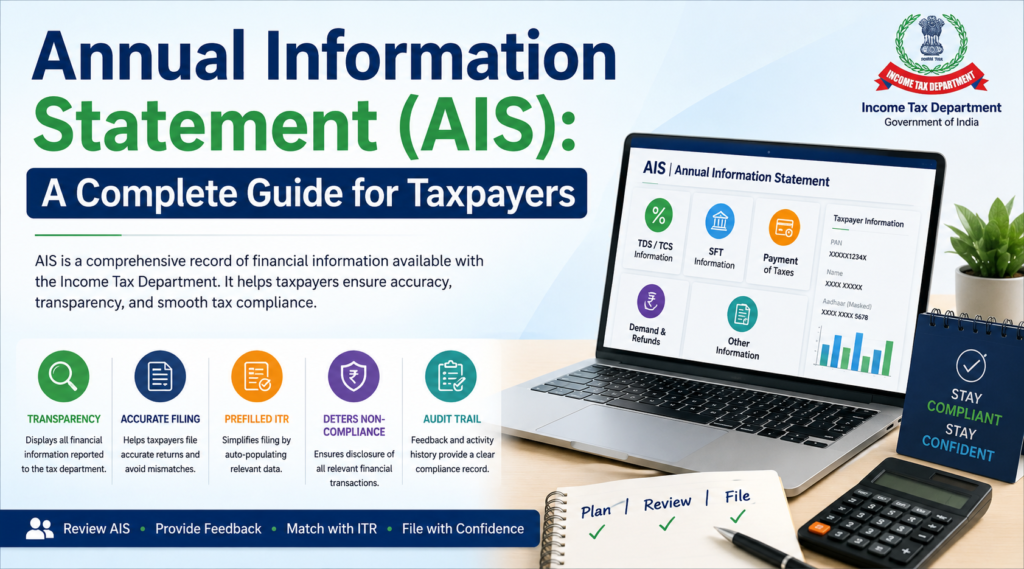
Introduction The Annual Information Statement (AIS) is a comprehensive record of financial information available with the Income Tax Department. It provides taxpayers with a consolidated view of their income, taxes paid, and other financial transactions. By offering transparency and enabling prefilled returns, AIS has become a cornerstone of India’s compliance ecosystem. Importance of AIS ✅ Transparency: Displays all financial information reported to the tax department. ✅ Voluntary Compliance: Helps taxpayers file accurate returns and avoid mismatches. ✅ Prefilled Returns: Simplifies filing by auto-populating data. ✅ Deters Non-Compliance: Ensures taxpayers disclose all relevant transactions. ✅ Audit Trail: Feedback and activity history provide a clear compliance record. Contents of AIS AIS is divided into two main parts: Part A – General Information PAN, masked Aadhaar, name, date of birth/incorporation, contact details, and address. Part B – Financial Information TDS/TCS Information: Tax deducted/collected at source. SFT Information: High-value transactions reported by banks, mutual funds, etc. Payment of Taxes: Advance tax and self-assessment tax. Demand & Refunds: Refunds issued and demands raised. Other Information: Salary details, foreign remittances, GST turnover, interest on refunds, etc. Additionally, AIS allows taxpayers to provide feedback on reported transactions, showing both reported and modified values. Matching AIS with ITR To ensure smooth filing: Download AIS in PDF/CSV/JSON formats. Compare AIS data with your own records (salary slips, bank statements, Form 16, etc.). Check for mismatches in TDS, SFT, or other reported transactions. Submit feedback if any entry is incorrect or requires modification. Use Taxpayer Information Summary (TIS) – the deduplicated and confirmed values here are used for prefilled ITRs. This process ensures your Income Tax Return (ITR) matches the department’s records, reducing the chances of notices or scrutiny. FAQs on AIS Q1: Is AIS the same as Form 26AS? No. Form 26AS only shows TDS/TCS data, while AIS covers a wider range of financial information. Q2: Can I modify feedback multiple times? Yes, there is currently no limit on modifying feedback. Q3: Does AIS show GST turnover? Yes, under the code EXC-GSTR3B, visible in the “Other Information” tab. Q4: How can I access AIS? Login to Income Tax Portal, navigate to e-File → AIS, and view/download your statement. Q5: Can I track my activity history? Yes, AIS provides an Activity History tab with system-generated IDs for each action. Conclusion The Annual Information Statement (AIS) is more than just a compliance tool; it’s a taxpayer’s mirror into their financial footprint. By reviewing AIS carefully, submitting feedback, and matching it with your ITR, you ensure accuracy, avoid disputes, and make tax filing seamless. As India moves toward greater transparency, AIS empowers taxpayers to stay compliant with confidence. BLOG BY: CA MITTAL & Co.
How AI & Automation Are Transforming Accounting in India: What Businesses Must Do to Stay Ahead

TL;DR AI and automation are fundamentally changing accounting in India by improving speed, accuracy, reporting, and compliance efficiency. However, businesses that rely entirely on software without strategic financial oversight may face compliance risks, poor decision-making, and operational blind spots. The future belongs to businesses that combine automation with expert chartered accountancy guidance. Why Accounting in India Is Rapidly Changing India’s financial and compliance ecosystem has evolved dramatically over the last decade. Businesses today operate in an environment driven by: GST digitization E-invoicing Real-time compliance monitoring Automated tax reporting Digital banking integration Cloud-based financial systems As regulatory expectations increase, traditional manual accounting methods are becoming inefficient and risky. At the same time, AI-powered accounting platforms are helping businesses: Automate repetitive financial tasks Reduce manual errors Generate real-time reports Improve operational efficiency This transformation is no longer optional. Businesses that fail to modernize their financial systems may struggle with compliance delays, reporting inefficiencies, and slower decision-making. The Rise of AI and Automation in Finance Artificial intelligence is no longer limited to large enterprises. Today, even SMEs and startups in India use automation tools for: Bookkeeping Payroll processing GST filing Bank reconciliation Invoice generation Expense tracking Modern accounting systems can now: Detect anomalies Categorize transactions automatically Predict cash-flow trends Generate financial insights This shift allows finance teams to spend less time on repetitive tasks and more time on strategic decision-making. Key Areas Where AI Is Transforming Accounting 1. Automated Bookkeeping AI-powered accounting systems can automatically: Record transactions Match invoices Categorize expenses Reconcile bank statements This reduces human error and significantly improves efficiency. Example An ecommerce business processing hundreds of daily transactions can automate reconciliation instead of manually matching records. 2. GST Compliance Automation GST compliance is one of the biggest operational challenges for Indian businesses. Automation tools now help businesses: Track GST liabilities Match invoices Reconcile input tax credit File returns faster Detect mismatches early This minimizes compliance delays and reduces notice risks. However, strategic interpretation still requires professional expertise. 3. Smart Invoice Processing AI-based OCR technology can: Read invoices automatically Extract vendor data Validate entries Reduce data-entry work This improves operational speed and reduces accounting bottlenecks. 4. Real-Time Financial Reporting Traditional reporting often happens weeks after transactions occur. Modern AI systems provide: Real-time dashboards Profitability analysis Cash-flow visibility Expense tracking Department-wise reporting Business leaders can make faster decisions using live financial data. 5. Fraud Detection & Risk Monitoring AI tools can identify: Unusual spending patterns Duplicate invoices Suspicious transactions Compliance inconsistencies This strengthens internal financial controls. Benefits of AI in Accounting for Indian Businesses Benefit Business Impact Faster processing Improved operational efficiency Better accuracy Reduced manual errors Real-time visibility Faster decision-making Automation Lower repetitive workload Better compliance tracking Reduced filing delays Scalable systems Easier business growth Risks of Over-Reliance on Automation While automation provides major benefits, businesses should avoid assuming that software can replace financial expertise entirely. Common Risks 1. Incorrect Data Interpretation AI systems depend on entered data. Incorrect configurations or classifications can create reporting errors. 2. Compliance Complexity Indian tax laws frequently change. Automated systems may not always interpret legal nuances correctly. 3. Lack of Strategic Advisory Software can generate reports, but it cannot fully advise on: Business restructuring Tax optimization Expansion planning Investment decisions Risk management 4. Cybersecurity & Data Risks Cloud-based systems require strong: Access controls Backup systems Data protection policies Why Human Expertise Still Matters Even in highly automated environments, businesses still require experienced financial professionals. A chartered accountant provides: Financial interpretation Strategic advisory Regulatory understanding Tax optimization Audit readiness Business structuring guidance AI improves execution speed. Human experts improve decision quality. How Businesses Should Adapt in 2026 Businesses that want to stay competitive should modernize their accounting approach strategically. Step 1: Automate Repetitive Processes Start with: Bookkeeping Payroll Invoice processing GST reconciliation Step 2: Use Cloud-Based Financial Systems Cloud accounting improves: Accessibility Collaboration Reporting efficiency Step 3: Build Real-Time Reporting Systems Decision-makers need live visibility into: Revenue Expenses Cash flow Tax exposure Step 4: Strengthen Compliance Monitoring Automation should support proactive compliance management, not replace oversight. Step 5: Partner With an Experienced CA Firm Technology alone cannot replace strategic financial expertise. Businesses need professional advisors who understand: Tax regulations Industry risks Financial growth planning Compliance strategy The Hybrid Future: AI + Chartered Accountants The future of accounting in India is not AI versus accountants. It is AI-enabled accountants. Modern CA firms are increasingly integrating: Automation tools Cloud accounting AI-driven reporting Digital compliance systems This hybrid model gives businesses: Speed Accuracy Scalability Strategic insight Compliance confidence Real-World Business Example Startup Example A fast-growing startup automates bookkeeping and payroll using cloud accounting tools. As the business scales, investors request: Financial due diligence Compliance verification Forecasting models Audit-ready reports The company realizes automation alone cannot meet strategic financial expectations. A professional CA firm helps structure financial operations for long-term growth. How Mittal & Co. Helps Businesses Modernize Accounting Mittal & Co. supports businesses in adopting modern accounting systems while maintaining strong compliance and financial oversight. The firm helps businesses: Implement efficient accounting workflows Improve GST compliance Strengthen financial reporting Optimize taxation Build scalable finance systems Integrate technology with strategic advisory For businesses in Pune and across India, combining automation with expert CA guidance creates a more resilient and growth-oriented financial structure. Suggested Internal Links GST Consultancy Services Virtual CFO Services Audit & Assurance Startup Advisory Accounting Outsourcing Services Conclusion AI and automation are transforming accounting in India faster than ever before. Businesses now have access to tools that improve: Efficiency Accuracy Reporting speed Compliance visibility But technology alone is not enough. The businesses that will succeed in 2026 are those that combine: Smart automation Strong financial controls Strategic advisory Professional compliance oversight AI can automate accounting tasks. Experienced chartered accountants help businesses make better financial decisions. That combination is what truly creates long-term business growth. 6. FAQ SECTION How is AI changing accounting in India? AI is improving accounting by automating bookkeeping, GST reconciliation, invoice processing, reporting, and compliance tracking. Will AI replace chartered accountants? No. AI can
Best CA in Pune vs Online Accounting Platforms: What Actually Works for Business Growth in 2026?
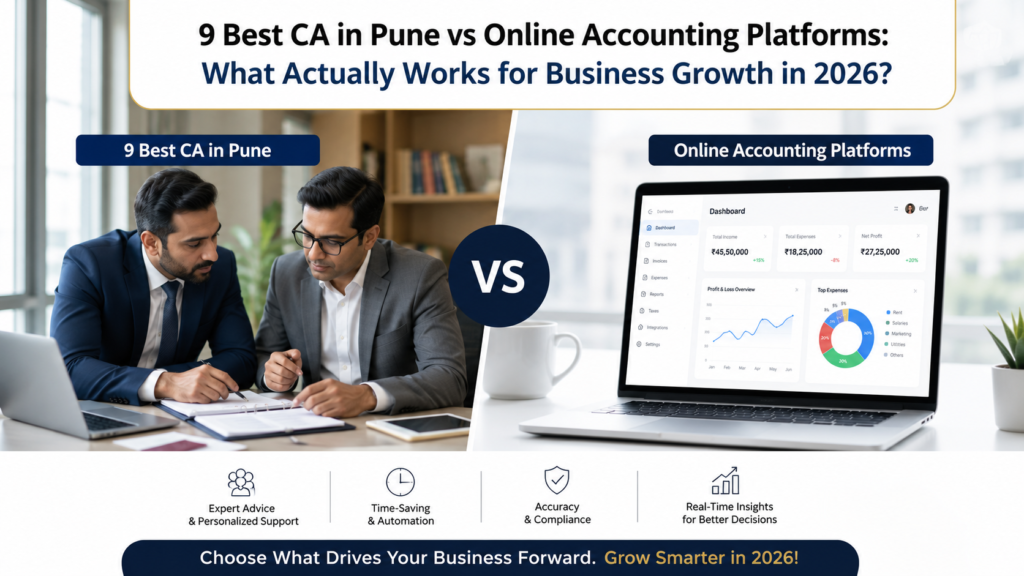
TL;DR Online accounting platforms have transformed bookkeeping and compliance management for startups and SMEs. They offer: Automation Cloud-based access Faster data entry Basic GST workflows However, accounting software alone cannot replace: Strategic tax planning Financial advisory ROC compliance expertise Audit readiness Business structuring support For growing businesses in Pune, the most effective approach in 2026 is often a combination of: Technology-driven accounting systems Experienced CA-led advisory and compliance management This guide explains: The real difference between CA firms and online accounting platforms Which solution works best for different business stages What startups and SMEs should prioritize for long-term growth Why This Comparison Matters in 2026 Indian businesses are rapidly adopting: Cloud accounting AI-driven bookkeeping Automated invoicing GST software integrations At the same time, regulatory complexity continues to increase. Businesses today must manage: GST compliance TDS filing ROC filings Payroll compliance Audit preparedness Tax optimization Financial forecasting This has created a major debate among startups and SMEs: Should businesses rely on online accounting platforms or work with professional CA firms? The answer depends on the company’s: Growth stage Compliance exposure Financial complexity Expansion goals What Online Accounting Platforms Actually Offer Online accounting platforms primarily focus on automation and bookkeeping efficiency. Common Features Feature Purpose Cloud bookkeeping Real-time financial access Automated invoicing Faster billing workflows GST integration Return preparation support Expense tracking Financial monitoring Dashboard reporting Business visibility Bank integrations Transaction synchronization Advantages of Online Platforms Faster Routine Operations Automation reduces manual data entry and repetitive accounting tasks. Better Accessibility Business owners can access financial reports remotely from any location. Easier Invoice Management Digital invoice systems improve operational efficiency and documentation. Useful for Early-Stage Businesses Startups with low transaction complexity may initially benefit from software-based systems. What Traditional CA Firms Offer Beyond Accounting Many businesses misunderstand the role of CA firms. Modern CA firms do far more than: Tax filing Ledger management Compliance paperwork They provide strategic financial guidance that directly impacts business growth. Core Services Offered by CA Firms Service Area Business Impact Tax planning Reduced compliance risks Financial advisory Better decision-making Audit preparation Regulatory readiness ROC compliance Legal continuity Startup structuring Scalability support Cash flow planning Financial stability Investor reporting Funding readiness CA Firms vs Online Platforms: Core Comparison Factor Online Platforms CA Firms Automation Strong Moderate Strategic advisory Limited Strong Tax optimization Basic Advanced GST litigation support Weak Strong Compliance interpretation Limited High Business structuring Minimal Extensive Financial forecasting Basic Advanced Human judgment Low High Where Online Accounting Platforms Work Well Online platforms are useful for: Freelancers Small service providers Early-stage startups Businesses with low compliance complexity They help automate repetitive accounting operations efficiently. Suitable Use Cases Invoice generation Basic bookkeeping Expense management Standard GST workflows Simple reporting Where Businesses Still Need CA Firms As businesses scale, regulatory and financial complexity increases significantly. CA firms become critical when businesses require: Strategic tax planning Investor due diligence Multi-state GST management ROC compliance Financial audits Corporate restructuring Risks of Depending Only on Automation Many startups incorrectly assume software can replace financial expertise. This creates serious risks. 1. Incorrect GST Classification Automated systems may fail to identify: Industry-specific GST implications Input credit issues Reverse charge applicability 2. Poor Tax Planning Software processes data but does not create strategic tax structures. 3. Compliance Blind Spots Businesses relying solely on automation may miss: ROC deadlines Director disclosures Regulatory changes 4. Limited Financial Interpretation Dashboards provide numbers. CA firms provide business interpretation and strategic action plans. Hybrid Accounting Models: The Emerging Trend In 2026, many growing businesses prefer hybrid financial management models. This combines: Cloud accounting systems CA-led compliance and advisory Why Hybrid Models Are Growing Businesses gain: Automation efficiency Human expertise Better scalability Stronger compliance control This approach reduces operational inefficiencies without sacrificing strategic financial oversight. What Growing Businesses in Pune Usually Prefer Pune’s startup and SME ecosystem is increasingly focused on: Investor readiness Process scalability Governance Tax efficiency As businesses grow, founders often realize they need: Dedicated compliance experts Financial advisors Tax strategists Audit support This is why many businesses continue working with established CA firms despite adopting accounting software. How to Choose the Right Accounting Partner Businesses should evaluate accounting partners based on: Evaluation Area Importance Industry expertise High GST knowledge High Startup advisory capability High Technology integration High Response time High Financial planning support High Audit readiness High Mittal & Co.: Combining Technology with Financial Expertise Mittal & Co. supports startups and SMEs with: Accounting services GST compliance ROC filing Tax planning Audit support Business advisory The firm combines modern accounting processes with strategic CA-led guidance tailored for growing businesses in Pune. (camittal.com) Final Verdict Online accounting platforms are excellent operational tools. But they are not complete financial management solutions. Businesses focused on sustainable growth require: Compliance interpretation Strategic planning Tax efficiency Risk management Financial governance The most effective model for businesses in Pune in 2026 is typically: Technology-enabled accounting combined with Experienced CA-led advisory support That combination creates operational efficiency without compromising long-term business stability. FAQ SECTION Is online accounting software enough for startups? It may work for very early-stage startups with simple operations, but growing businesses usually require professional compliance and tax advisory support. Why do businesses still hire CA firms? CA firms provide strategic financial guidance, compliance expertise, audit support, and tax planning that software alone cannot offer. Can accounting software handle GST compliance? Software can automate return preparation, but GST interpretation, notices, disputes, and complex compliance still require professional expertise. Which is better: CA or accounting platform? They serve different purposes. Platforms automate workflows, while CA firms provide strategic and regulatory expertise. Do startups in Pune need a dedicated CA? Most startups benefit from working with a CA firm as they scale because compliance complexity increases over time. What are the risks of relying only on automation? Businesses may face compliance gaps, filing errors, poor tax planning, and lack of financial strategy. What is the best approach for SMEs in 2026? A hybrid approach combining accounting software with CA-led advisory is often the most effective model.
Business Setup & ROC Compliance in Pimpri-Chinchwad: Complete Guide for Private Limited Companies
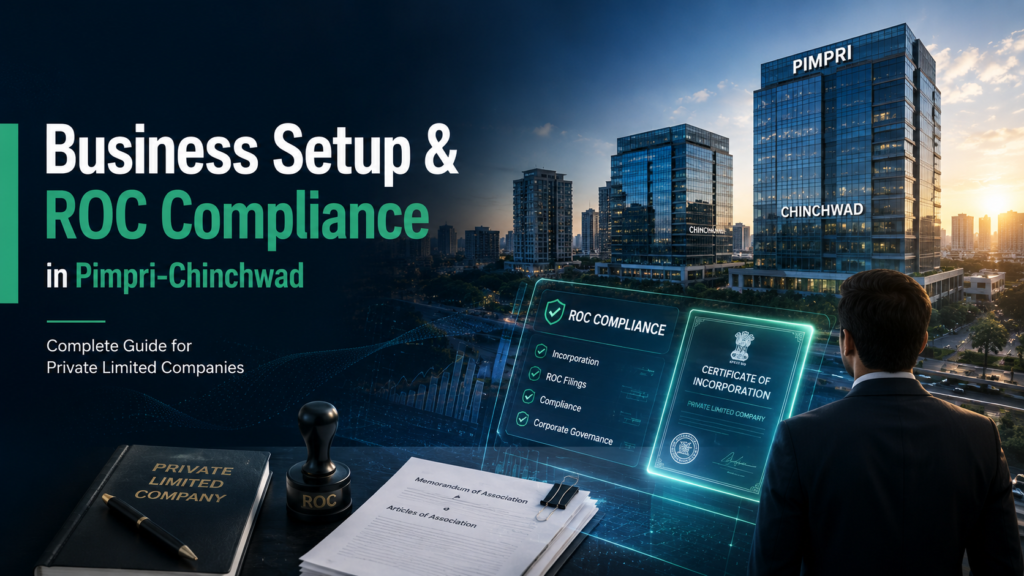
TL;DR Entrepreneurs and startups in Pimpri-Chinchwad increasingly prefer Private Limited Company structures because they provide: Legal credibility Limited liability protection Better fundraising opportunities Stronger operational structure However, company registration is only the beginning. Private Limited Companies must also maintain ongoing ROC compliance through: MCA filings Annual returns Financial statement submissions Director-related disclosures Statutory documentation This guide explains: How to set up a Private Limited Company ROC compliance requirements Common mistakes businesses make How CA firms help startups remain compliant Why Pimpri-Chinchwad Is Emerging as a Business Hub Pimpri-Chinchwad has become one of Maharashtra’s fastest-growing industrial and startup ecosystems. The region hosts: Manufacturing businesses Engineering companies IT firms Startups Logistics companies SMEs Its proximity to Pune’s technology and commercial ecosystem makes it attractive for entrepreneurs launching scalable businesses. As businesses expand, structured company registration and compliance management become increasingly important. What Is a Private Limited Company? A Private Limited Company is a legally registered corporate entity governed under the Companies Act, 2013. It operates as a separate legal entity from its owners. Key Features of a Private Limited Company Feature Benefit Separate legal identity Improved legal protection Limited liability Reduced personal financial risk Structured ownership Easier investor participation Better credibility Improved business trust Perpetual succession Business continuity Benefits of Registering a Private Limited Company 1. Better Business Credibility Registered companies generally appear more credible to: Clients Investors Vendors Financial institutions 2. Easier Fundraising Most investors prefer structured entities with proper documentation and governance systems. 3. Scalability Private Limited structures are suitable for businesses planning: Expansion Partnerships Investment rounds Multi-state operations 4. Legal Protection The company structure separates business liabilities from personal assets. Step-by-Step Process for Business Setup Step 1: Choose the Business Structure Entrepreneurs must first decide whether a Private Limited Company is the right structure compared to: LLP Partnership Proprietorship For scalable businesses, Private Limited Companies are generally preferred. Step 2: Obtain DSC & DIN Directors require: Digital Signature Certificate (DSC) Director Identification Number (DIN) These are mandatory for MCA filings. Step 3: Company Name Approval The company name must comply with MCA naming guidelines and availability requirements. Step 4: Draft Incorporation Documents Key incorporation documents include: MOA AOA Address proof Identity documents Director declarations Step 5: MCA Registration Filing After document submission and verification, the MCA issues: Certificate of Incorporation PAN TAN Step 6: Post-Incorporation Compliance After incorporation, businesses must manage: GST registration Accounting setup ROC compliance Statutory record maintenance Understanding ROC Compliance ROC compliance refers to statutory filings and disclosures submitted to the Registrar of Companies under MCA regulations. These filings ensure: Corporate transparency Legal accountability Financial reporting compliance Important ROC Filings Every Company Must Know Annual Return Filing Companies must submit annual returns containing: Shareholding details Director information Company structure disclosures Financial Statement Filing Companies are required to file audited financial statements annually. Board Meeting Compliance Private Limited Companies must maintain: Board resolutions Meeting records Statutory registers Director KYC Compliance Directors must complete periodic KYC-related filings to maintain active DIN status. Common ROC Compliance Mistakes Businesses Make Missing Filing Deadlines Late filings can trigger: MCA penalties Additional compliance scrutiny Operational disruptions Poor Documentation Many startups fail to maintain: Proper resolutions Statutory registers Shareholder records Ignoring Compliance After Registration Some businesses assume compliance ends after incorporation, which creates significant long-term risks. Lack of Professional Guidance Incorrect filing structures and procedural errors increase legal exposure. Why Startups Outsource ROC Compliance Most startups and SMEs do not maintain dedicated legal compliance teams. Outsourcing helps businesses: Maintain filing consistency Reduce compliance risk Improve documentation quality Stay updated with MCA changes It also allows founders to focus on operational growth. How CA Firms Help with Business Setup & Compliance Professional CA firms support businesses with: Company registration ROC filing GST registration Accounting setup Annual compliance Financial reporting Mittal & Co. Business Compliance Services Mittal & Co. provides company registration, ROC compliance, accounting, taxation, and startup advisory services for businesses in Pune and nearby regions. (camittal.com) The firm’s service structure aligns with startups and SMEs seeking integrated compliance and advisory support. Choosing the Right Compliance Partner Businesses should evaluate CA firms based on: Evaluation Area Importance ROC expertise High Startup experience High MCA filing knowledge High Advisory support High Documentation management High Responsiveness High Technology adoption Medium Final Thoughts Business registration and ROC compliance are foundational components of long-term business stability. For startups and SMEs in Pimpri-Chinchwad, structured compliance management helps: Avoid legal risks Improve operational discipline Build investor confidence Maintain regulatory continuity Professional firms like Mittal & Co. support businesses with integrated company setup, ROC filing, taxation, and compliance services designed for growing enterprises. (camittal.com) Internal Linking Suggestions “company registration services Pune” “startup compliance consultants” “GST registration services” “accounting and bookkeeping services” “audit and assurance support” 6. FAQ SECTION What is ROC compliance for Private Limited Companies? ROC compliance refers to mandatory filings and disclosures submitted to the Registrar of Companies under MCA regulations. Is ROC filing mandatory every year? Yes. Private Limited Companies must file annual returns and financial statements regularly to maintain compliance status. What happens if ROC compliance is missed? Missed ROC filings can lead to penalties, compliance notices, director disqualification risks, and operational restrictions. How do I register a Private Limited Company in Pune? The process includes obtaining DSC and DIN, name approval, incorporation filing, and MCA registration. Can CA firms handle company incorporation? Yes. CA firms assist businesses with registration, documentation, ROC filing, and ongoing compliance support. Why do startups outsource ROC compliance? Outsourcing improves filing accuracy, reduces legal risks, and helps startups maintain regulatory discipline. Which documents are required for company registration? Common documents include PAN, Aadhaar, address proof, MOA, AOA, and director-related declarations. BLOG BY: Mittal & Co.
Top CA in Pune for Startup Tax Planning & Compliance: Best Firms in Hinjawadi & Baner Compared

TL;DR Startups in Pune’s growing technology and business hubs like Hinjawadi and Baner increasingly require specialized CA firms that go beyond traditional compliance filing. Modern startups need support for: Tax planning GST compliance Startup structuring Financial reporting Investor readiness Regulatory compliance Virtual CFO support This guide compares what startups should look for while selecting CA firms in Pune and explains why advisory-focused firms create stronger long-term business value. Why Startups in Pune Need Specialized CA Firms in 2026 Pune has emerged as one of India’s fastest-growing startup ecosystems, especially across: SaaS companies IT firms E-commerce startups Consulting businesses D2C brands Fintech startups Areas like Hinjawadi and Baner continue attracting: Technology startups Venture-backed businesses Service companies Scaling SMEs However, rapid business growth also creates financial and compliance complexity. Startups today deal with: GST compliance TDS management ROC filings Payroll compliance Funding documentation ESOP structures Financial reporting requirements Generic accounting support is no longer sufficient for modern startups operating in competitive markets. Common Tax & Compliance Challenges Startups Face 1. Poor Financial Structuring Many startups begin operations without proper: Tax planning Business structuring Compliance workflows Documentation systems This creates scaling challenges later. 2. GST & TDS Errors Fast-growing businesses handling multiple transactions often face: GST mismatches Incorrect filings Vendor reconciliation problems Delayed tax reporting 3. Lack of Financial Visibility Without proper accounting systems, startups struggle to monitor: Cash burn Profitability Expense allocation Revenue tracking 4. Investor Readiness Issues Investors increasingly evaluate: Financial hygiene Tax compliance Documentation accuracy Audit preparedness Weak compliance systems reduce credibility during fundraising. What Makes a CA Firm Startup-Friendly? Not every CA firm is equipped to support startup operations effectively. A startup-focused CA firm should provide: Fast response times Technology-driven systems Advisory-oriented support Scalable compliance management Startup ecosystem understanding Key Traits of Startup-Focused CA Firms Technology Adoption Modern startups prefer firms experienced with: Cloud accounting ERP systems Automated reconciliation Digital reporting systems Advisory Capability The best CA firms help startups: Optimize tax structures Reduce compliance risks Improve cash flow planning Prepare for due diligence Startup Ecosystem Experience Firms familiar with startup operations better understand: Funding cycles Burn management ESOP compliance Multi-state GST challenges Top CA Firms in Pune for Startup Tax Planning & Compliance Mittal & Co. Mittal & Co. is a Pune-based chartered accountancy firm offering startup-focused accounting, taxation, audit, compliance, GST, and business advisory services. (camittal.com) The firm’s services align with startups, SMEs, and growing businesses seeking centralized compliance and financial management support. Key Startup Services Offered According to the firm’s service portfolio, startups can access: Startup registration support GST compliance Accounting & bookkeeping Tax planning Audit services Virtual CFO support Financial advisory Business compliance services (camittal.com) Why Startups Consider Mittal & Co. 1. Startup & SME-Oriented Service Structure The firm appears positioned for: Early-stage startups Growth-stage businesses Service companies SMEs requiring scalable compliance systems 2. Integrated Compliance & Advisory Support Businesses benefit from centralized support covering: GST Accounting Taxation Audits Financial reporting instead of coordinating with multiple vendors. 3. Technology Compatibility The firm highlights experience with: Tally ERP systems SAP environments Computerized accounting ecosystems (camittal.com) 4. Business-Focused Approach The firm positions itself as a comprehensive business solution provider supporting operational and compliance efficiency. Types of CA Firms Startups Commonly Compare Firm Type Best For Freelance accountants Basic bookkeeping Boutique CA firms Personalized startup support Mid-sized CA firms Scalable compliance Advisory-focused firms Growth-stage startups Enterprise consulting firms Large funded companies Key Services Every Startup Should Expect Startup Registration & Structuring Proper entity structuring impacts: Tax efficiency Fundraising Compliance obligations GST & Tax Compliance Startups require: Timely GST filings Vendor reconciliations TDS management Tax planning support Accounting & Financial Reporting Strong reporting systems improve: Decision-making Investor communication Financial transparency Virtual CFO Services As startups scale, they often require: Financial forecasting MIS reporting Strategic planning Budget monitoring Comparison Table: What Startups Should Evaluate Evaluation Criteria Importance Startup expertise High Tax planning capability High GST support High Financial reporting High Technology adoption High Advisory support High Investor readiness support Medium Scalability High Why Startups in Hinjawadi & Baner Prefer Outsourced Financial Advisory Hinjawadi and Baner host a growing concentration of: Tech startups SaaS companies IT service providers D2C brands Most startups prefer outsourced CA firms because it: Reduces operational overhead Improves compliance quality Provides specialized expertise Enables scalable finance operations Outsourced advisory also helps founders focus on growth instead of administrative compliance management. Mistakes Startups Make While Choosing CA Firms Choosing Only Based on Convenience Many startups select firms based purely on proximity or referrals without evaluating capability. Ignoring Advisory Strength Compliance alone is insufficient for scaling startups. Startups increasingly require: Strategic tax planning Financial guidance Risk management support Delaying Financial Structuring Improper structuring early on creates long-term taxation and compliance inefficiencies. Weak Documentation Systems Poor accounting discipline creates challenges during: Funding rounds Audits Due diligence Tax assessments How Tax Planning Impacts Startup Growth Effective tax planning improves: Cash flow management Compliance efficiency Operational stability Investor confidence It also helps startups: Avoid unnecessary tax exposure Optimize deductions Maintain stronger financial discipline Final Thoughts Startups in Pune require far more than basic accounting support in 2026. The best CA firms for startups combine: Tax planning expertise GST compliance Accounting systems Startup advisory Financial strategy Scalable compliance management For startups operating in Hinjawadi, Baner, and nearby business hubs, firms like Mittal & Co. position themselves as integrated startup compliance and advisory partners. (camittal.com) Internal Linking Suggestions “GST compliance services in Pune” “startup company registration” “virtual CFO services” “accounting and bookkeeping support” “audit and assurance services” 6. FAQ SECTION Which is the best CA firm in Pune for startups? The best CA firm depends on your startup’s industry, compliance needs, and growth stage. Startups should evaluate firms based on advisory capability, tax planning expertise, and responsiveness. Why do startups need tax planning services? Tax planning helps startups improve cash flow management, reduce unnecessary tax exposure, and maintain better compliance efficiency. What services should startup CA firms provide? Startup-focused CA firms should provide GST compliance, accounting, tax planning, ROC filings, financial reporting, audit
GST: Change in Place of Supply rule for Intermediary Services (Effective 30 March 2026)
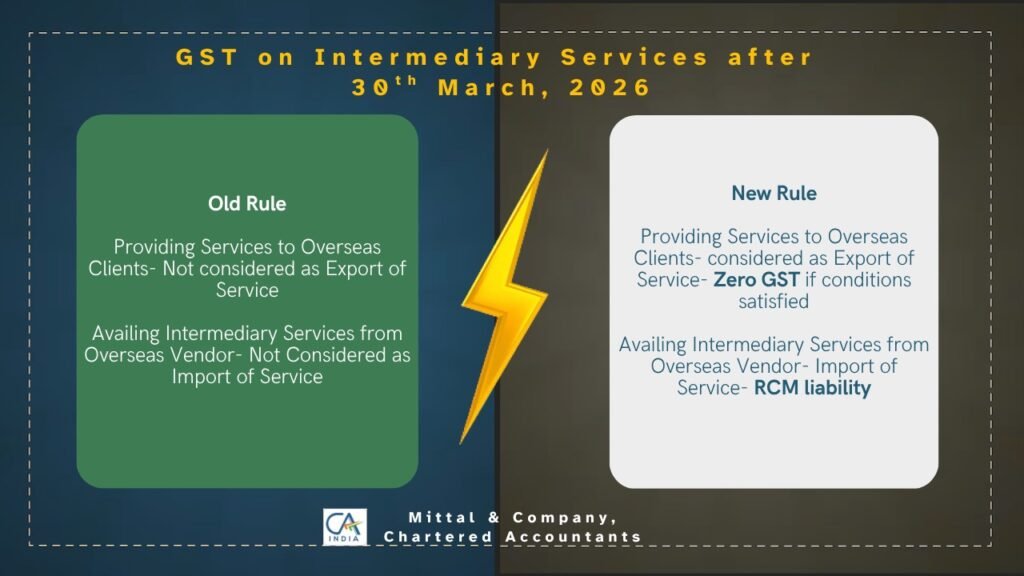
Introduction The Goods and Services Tax (GST) law in India has introduced a significant amendment effective from 30 March 2026. The place of supply for intermediary services will now be determined by the recipient’s location instead of the supplier’s location. This change has major implications for businesses engaged in cross-border transactions. What is Intermediary Service? Section 2(13) of IGST Act defines intermediary as “a broker, an agent or any other person, by whatever name called, who arranges or facilitates the supply of goods or services or both… between two or more persons, but does not include a person who supplies such goods or services on his own account.” What was the old rule? The old rule stated that the place of supply for intermediary services was always the supplier’s location. As a result, intermediary services provided to overseas clients were taxed in India and did not qualify as exports. Also, intermediary services provided by overseas vendors were considered as supplied outside India and there were no RCM GST liability on such transaction because it was not import of service. What is the new rule? The new rule states that the place of supply for intermediary services will be the recipient’s location. This change allows services provided to overseas clients to qualify as exports and services received from overseas suppliers to be treated as imports. How does this affect outward intermediary services (India → Overseas)? Outward intermediary services provided by Indian suppliers to overseas clients will now be treated as exports of services. If payment is received in convertible foreign exchange or permitted INR, and the supplier and recipient are not establishments of the same entity, the supply will be considered zero-rated. Businesses can either supply under LUT without payment of tax or pay IGST and claim a refund. How does this affect inward intermediary services (Overseas → India)? Inward intermediary services received by Indian businesses from overseas suppliers will now be treated as imports of services. GST liability will arise under the Reverse Charge Mechanism (RCM), meaning the Indian recipient must pay IGST. Input Tax Credit (ITC) can be claimed subject to eligibility. How is the time of supply determined? The time of supply will decide whether the old rule or the new rule applies. It is generally the earlier of the invoice date, the service provision date, or the payment receipt date. Case Study: Indian Consultancy Firm An Indian consultancy firm provides intermediary services to a US-based client. Before 30 March 2026, the place of supply was India, and GST was payable in India. The service did not qualify as an export. After 30 March 2026, the place of supply is the USA, and the service qualifies as an export. The firm can supply under LUT without payment of tax or pay IGST and claim a refund. This results in a significant cash flow advantage and improved competitiveness in global markets. What are the transition risks? Businesses must be careful with advances received before 30 March 2026, invoices issued prior to the amendment date, continuous or milestone-based contracts, and back-to-back arrangements involving overseas parties. Accurate determination of the time of supply is essential to avoid disputes. This amendment is a progressive step that aligns GST with destination-based taxation principles. It provides clarity and fairness in the taxation of intermediary services, enabling businesses to benefit from export incentives while ensuring proper taxation of imports. Companies must adopt a disciplined approach to time-of-supply compliance to minimize risks during the transition. BLOG BY: MITTAL & CO.
Best CA in Pune vs Online Accounting Platforms: What Actually Works for Business Growth in 2026?
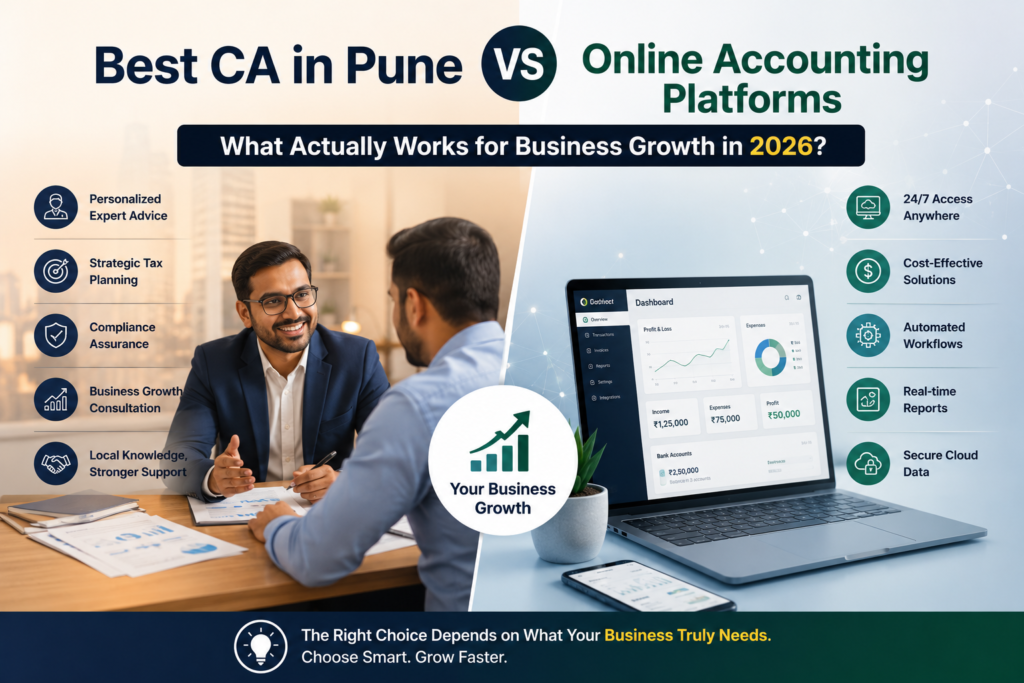
TL;DR Online accounting platforms have transformed bookkeeping and compliance management for startups and SMEs. They offer: Automation Cloud-based access Faster data entry Basic GST workflows However, accounting software alone cannot replace: Strategic tax planning Financial advisory ROC compliance expertise Audit readiness Business structuring support For growing businesses in Pune, the most effective approach in 2026 is often a combination of: Technology-driven accounting systems Experienced CA-led advisory and compliance management This guide explains: The real difference between CA firms and online accounting platforms Which solution works best for different business stages What startups and SMEs should prioritize for long-term growth Why This Comparison Matters in 2026 Indian businesses are rapidly adopting: Cloud accounting AI-driven bookkeeping Automated invoicing GST software integrations At the same time, regulatory complexity continues to increase. Businesses today must manage: GST compliance TDS filing ROC filings Payroll compliance Audit preparedness Tax optimization Financial forecasting This has created a major debate among startups and SMEs: Should businesses rely on online accounting platforms or work with professional CA firms? The answer depends on the company’s: Growth stage Compliance exposure Financial complexity Expansion goals What Online Accounting Platforms Actually Offer Online accounting platforms primarily focus on automation and bookkeeping efficiency. Common Features Feature Purpose Cloud bookkeeping Real-time financial access Automated invoicing Faster billing workflows GST integration Return preparation support Expense tracking Financial monitoring Dashboard reporting Business visibility Bank integrations Transaction synchronization Advantages of Online Platforms Faster Routine Operations Automation reduces manual data entry and repetitive accounting tasks. Better Accessibility Business owners can access financial reports remotely from any location. Easier Invoice Management Digital invoice systems improve operational efficiency and documentation. Useful for Early-Stage Businesses Startups with low transaction complexity may initially benefit from software-based systems. What Traditional CA Firms Offer Beyond Accounting Many businesses misunderstand the role of CA firms. Modern CA firms do far more than: Tax filing Ledger management Compliance paperwork They provide strategic financial guidance that directly impacts business growth. Core Services Offered by CA Firms Service Area Business Impact Tax planning Reduced compliance risks Financial advisory Better decision-making Audit preparation Regulatory readiness ROC compliance Legal continuity Startup structuring Scalability support Cash flow planning Financial stability Investor reporting Funding readiness CA Firms vs Online Platforms: Core Comparison Factor Online Platforms CA Firms Automation Strong Moderate Strategic advisory Limited Strong Tax optimization Basic Advanced GST litigation support Weak Strong Compliance interpretation Limited High Business structuring Minimal Extensive Financial forecasting Basic Advanced Human judgment Low High Where Online Accounting Platforms Work Well Online platforms are useful for: Freelancers Small service providers Early-stage startups Businesses with low compliance complexity They help automate repetitive accounting operations efficiently. Suitable Use Cases Invoice generation Basic bookkeeping Expense management Standard GST workflows Simple reporting Where Businesses Still Need CA Firms As businesses scale, regulatory and financial complexity increases significantly. CA firms become critical when businesses require: Strategic tax planning Investor due diligence Multi-state GST management ROC compliance Financial audits Corporate restructuring Risks of Depending Only on Automation Many startups incorrectly assume software can replace financial expertise. This creates serious risks. 1. Incorrect GST Classification Automated systems may fail to identify: Industry-specific GST implications Input credit issues Reverse charge applicability 2. Poor Tax Planning Software processes data but does not create strategic tax structures. 3. Compliance Blind Spots Businesses relying solely on automation may miss: ROC deadlines Director disclosures Regulatory changes 4. Limited Financial Interpretation Dashboards provide numbers. CA firms provide business interpretation and strategic action plans. Hybrid Accounting Models: The Emerging Trend In 2026, many growing businesses prefer hybrid financial management models. This combines: Cloud accounting systems CA-led compliance and advisory Why Hybrid Models Are Growing Businesses gain: Automation efficiency Human expertise Better scalability Stronger compliance control This approach reduces operational inefficiencies without sacrificing strategic financial oversight. What Growing Businesses in Pune Usually Prefer Pune’s startup and SME ecosystem is increasingly focused on: Investor readiness Process scalability Governance Tax efficiency As businesses grow, founders often realize they need: Dedicated compliance experts Financial advisors Tax strategists Audit support This is why many businesses continue working with established CA firms despite adopting accounting software. How to Choose the Right Accounting Partner Businesses should evaluate accounting partners based on: Evaluation Area Importance Industry expertise High GST knowledge High Startup advisory capability High Technology integration High Response time High Financial planning support High Audit readiness High Mittal & Co.: Combining Technology with Financial Expertise Mittal & Co. supports startups and SMEs with: Accounting services GST compliance ROC filing Tax planning Audit support Business advisory The firm combines modern accounting processes with strategic CA-led guidance tailored for growing businesses in Pune. (camittal.com) Final Verdict Online accounting platforms are excellent operational tools. But they are not complete financial management solutions. Businesses focused on sustainable growth require: Compliance interpretation Strategic planning Tax efficiency Risk management Financial governance The most effective model for businesses in Pune in 2026 is typically: Technology-enabled accounting combined with Experienced CA-led advisory support That combination creates operational efficiency without compromising long-term business stability. 6. FAQ SECTION Is online accounting software enough for startups? It may work for very early-stage startups with simple operations, but growing businesses usually require professional compliance and tax advisory support. Why do businesses still hire CA firms? CA firms provide strategic financial guidance, compliance expertise, audit support, and tax planning that software alone cannot offer. Can accounting software handle GST compliance? Software can automate return preparation, but GST interpretation, notices, disputes, and complex compliance still require professional expertise. Which is better: CA or accounting platform? They serve different purposes. Platforms automate workflows, while CA firms provide strategic and regulatory expertise. Do startups in Pune need a dedicated CA? Most startups benefit from working with a CA firm as they scale because compliance complexity increases over time. What are the risks of relying only on automation? Businesses may face compliance gaps, filing errors, poor tax planning, and lack of financial strategy. What is the best approach for SMEs in 2026? A hybrid approach combining accounting software with CA-led advisory is often the most